If you’ve ever driven around town with the radio on and the sun doing that late-afternoon slant that makes everything look like a memory already—gas stations glowing, parking lots half empty, the air buzzing with possibility and dread—then you already understand what Your Tuesday Afternoon Alternative is supposed to feel like.
And now, for the first time in a while, the last two full three-hour broadcasts are sitting online in all their sprawling, unruly glory over on Mixcloud. That’s six straight hours of music, ideas, weird segues, accidental poetry, and the kind of radio that only really works when nobody is trying too hard to make it work. Which, if we’re being honest, is the best kind.
Think of it as a kind of sonic time capsule: three hours where the world’s chaos gets distilled into guitars, synthesizers, a stray folk lament, maybe a punk blast that lasts ninety seconds but somehow resets your whole nervous system. Then you do it all again the next week. Radio as ritual. Radio as wandering conversation.
The thing about listening to these shows after the fact is that they become something slightly different than they were in the moment. Live radio is adrenaline and improvisation—you throw a song into the air and see what it does to the room. But on replay, the structure reveals itself. Themes emerge like ghosts in the static. Songs talk to each other across decades. A jangly indie track from 2024 suddenly feels like it’s answering a garage-rock scream from 1966.
That’s the secret architecture of good radio: it sounds loose but it’s secretly a web of connections. Which makes these two archived episodes especially fun to revisit. Over six hours, the mood drifts the way an actual Tuesday afternoon does. One minute the sun is out and everything sounds hopeful; the next minute you’re staring out the windshield thinking about every mistake you’ve ever made while some beautifully melancholy track hums through the speakers.
And that emotional whiplash is the point.
Great radio—especially college radio—has always been about resisting the algorithm. The streaming services want to smooth everything out into playlists that never challenge you. But real DJs still believe that music should occasionally knock the wind out of you. A dreamy pop song might suddenly give way to something ragged and noisy, and then a minute later you’re floating through a slow acoustic tune that feels like someone left a window open in your heart. That’s not bad programming. That’s life.
The two newly available shows capture that beautifully messy spirit. Across the six hours, you’ll hear indie rock rubbing shoulders with folk, garage, synth-pop, and the occasional left turn that makes you sit up and say, “Wait—what was that?” The answer, of course, is that it doesn’t always matter. Discovery is half the thrill.
And because the shows were recorded live, you also get the little human moments that make radio feel alive: the slightly crooked transitions, the spontaneous reflections, the sense that the whole thing could veer off the rails at any moment but somehow lands exactly where it needs to.
It’s the opposite of polished. It’s the sound of someone digging through a record collection and saying, You need to hear this.
Which is why having the full episodes archived on Mixcloud matters. Instead of a clipped highlight or a tidy playlist, you get the whole ride—the long arc of the afternoon, the gradual build, the strange emotional geography of three uninterrupted hours.
There’s a particular electricity to walking into a college radio station on a Tuesday afternoon that no algorithm has yet figured out how to bottle. The hallway smells faintly of burnt coffee and overworked carpet, even in the new Glass Center. The console used to look like it survived three administrative restructurings and at least one existential crisis. Maybe I am just channeling the ghost of the old board from when WUDR was in ArtStreet. Regardless, somewhere in the hum of the board, you can hear the ghost of every DJ who ever believed that three minutes and twenty seconds of noise could change a life.
Welcome to Your Tuesday Afternoon Alternative on WUDR Flyer Radio, broadcasting from the heart of Dayton, where the signal wobbles just enough to remind you that perfection is for tyrants and streaming platforms.
We open with “Se Llama (Tell Me What You Want)” by The Props from their Arrow – EP, and it’s the kind of track that doesn’t ask what you want so much as demand you admit you don’t know. It’s all nervous propulsion and sideways glances, the guitars like somebody rifling through your emotional junk drawer. I let it breathe. College radio isn’t about polite fades; it’s about letting the song finish its cigarette before you barge back in with your baritone wisdom.
Then comes “Delete Ya” by Djo (you know, the guy who played Steve on Stranger Things) from his record, The Crux. Now there’s a title for our era. Delete ya. Unfriend, unfollow, unremember. The song kicks like a garage door slamming shut on a relationship that was already half-packed. It’s jagged, but it’s catchy, the kind of melody that worms into your skull and starts redecorating. I imagine some sophomore in a dorm room texting someone they shouldn’t while this is playing and thinking it’s a sign from the universe. It’s not a sign. It’s just a good hook.
“Gone Baby Gone,” courtesy of Aysanabee from his Edge Of The Earth album, follows, and suddenly we’re in widescreen. Reverb like a prairie sky. Drums that sound like they were recorded in an abandoned aircraft hangar somewhere off I-75. This is the moment in the set where the car windows roll down even though it’s 42 degrees out, because transcendence doesn’t check the forecast.
“Regrets” from the Double Exposure record released by Penny Arcade (the secret name of James Hoare) doesn’t wallow; it smirks. It knows you’ll have them, and it’s already writing the sequel. There’s a kind of tensile bounce to it, a reminder that remorse can dance if you let it. I talk over the intro just a hair—because that’s the DJ’s prerogative—and muse about how regret is just memory with better lighting.
Then we snap into “Feelin’ A Rise” by Pimmer from their recent release, Trans Am. Now we’re cooking with circuitry. This is the motorik heartbeat of a robot who read too much Kerouac. The synths pulse like fluorescent lights in a 24-hour laundromat. You can’t half-listen to this; it drags you by the collar and says, “Move.”
We pause for the “Mrs. Dr. J WUDR legal ID,” eleven seconds of bureaucratic poetry. There is something profoundly punk about the legal ID. It’s the FCC’s reminder that even anarchy has paperwork. And then—right back into the fray.
“Nevermind” from the excellent record The Refrigerator created with love by Remember Sports. A title that shrugs and a band name that hums in the kitchen at 2 a.m. The song feels domestic in the best way—small-room guitars, a vocal that sounds like it was recorded with the singer leaning against the sink. It’s intimate without being precious. You can hear the plumbing in the walls.
“The Bitter End” (from The Bitter End – Single) by Trashcan Sinatras is next, and yes, we are aware of the recursion. Bitter about the end? Or is the end itself bitter? The track surges forward like it’s trying to outrun its own conclusion. There’s something defiant in it, a refusal to go quietly into whatever good night Spotify has queued up next. “Nothing” by nerve scales arrives like a gray cloud that’s decided it enjoys being gray. It sprawls. It hums. It lets the guitars smear into each other like oil paints. This is the point in the show where I remind listeners that silence is overrated and distortion is honest.
We keep it clean—“Nobody’s Heroes (CLEAN)” – The Menzingers and “Born To Kill (CLEAN)” by Social Distortion—because college radio lives in that tightrope space between rebellion and regulation. “Nobody’s Heroes” punches upward, as it should. It’s a rallying cry for the beautifully unexceptional. “Born To Kill,” scrubbed for broadcast, still crackles with danger. You can remove a word, but you can’t take out an attitude.
“Private” by The Neighborhood from their excellent album (((((ultraSOUND))))) feels like a transmission intercepted from a basement laboratory. It’s angular and twitchy, guitars cutting in geometric shapes. If privacy is dead, this song is the autopsy report. Then the sweet ache of “Can I Call You Tonight?” from Dayglow from the atmospheric Fuzzybrain. The melody glows like a phone screen in the dark. It’s longing in four minutes and thirty-nine seconds, the kind that makes you reconsider every “you up?” text you ever sent. I let that one play almost untouched. Some songs need space to confess.
“You got time and I got money” from Smerz Big city life strolls in with a grin. It’s transactional romance turned into a groove. There’s swagger here, but it’s self-aware, like it knows the joke is partly on itself. And that is the first hour in the books. We hit the Smug Brothers YTAA Theme—thirty-five seconds of identity—and then the “Dr. J New WUDR legal ID,” twenty-seven seconds reminding you that this is real, terrestrial, imperfect radio. Not a curated playlist assembled by a machine learning model with a minor in heartbreak.
The Pretty Flowers YTAA Theme Song blooms briefly, and then we dive into “It Is What It Isn’t” from The Black Watch from the collection, Varied Superstitions. Seven minutes and change. Now we’re talking. The guitars stretch out like they’ve paid rent on the horizon. The rhythm section locks into a trance. This is where the show stops being background and becomes an environment. You could build a small philosophy inside this track and still have room for doubt.
“Here’s The Thing” from Fontaines D.C. off of their Romance record snaps us back to conversational scale. It’s concise, almost cheeky. Here’s the thing: love is complicated, and so are guitar pedals. The song knows both. “Holy Roller” by The Format taken from Boycott Heaven thunders in next. There’s righteous fire here, but it’s not sanctimonious. It’s sweaty, urgent, maybe a little unhinged. The drums sound like they’re trying to kick down the pearly gates just to see what happens.
Independent music for everyone!
Then, because radio loves a wink—“Private Eyes” K.T. Tunstall from NUT released in 2022. You think you know that title, but this isn’t your dad’s yacht-rock paranoia. It’s sharper, more nervous, like someone swapped the sunglasses for safety goggles. “Cold Waves (featuring Mac McCaughan)” by Crooked Fingers (Eric Bachman’s project of the moment) from the album Swet Deth glides in with a chill that feels earned. The guest vocal threads through the mix like a lighthouse beam. It’s melancholy without surrender. The guitars shimmer, the drums keep their cool, and the whole thing feels like driving past Lake Erie in November with the heater on full blast.
Another “Mrs. Dr. J WUDR legal ID”—because the law insists—and then “Machines” from HAPPY LANDING. Aptly titled. The rhythm clanks and whirs, but there’s a human pulse inside it, a reminder that we built the machines in our image and then acted surprised when they reflected us. “Coming Home” from Lucky Now by Lande Hekt softens the edges. It’s all warmth and open chords, the musical equivalent of a porch light left on. After the clang and crash, it feels like forgiveness.
“The River Knows” from The Steeldrivers flows steadily and patiently. It suggests that maybe the landscape outlasts our noise. The guitars ripple. The drums roll like a current over stones. And “Dusking” from Concerns Of Wasp And Willow by The Corner Laughers. So damn glad to see that band back. It is a beautiful song. A title that sounds like a line from a lost pastoral poem. The song is brief, but it lingers. Twilight in two minutes and fifty-four seconds. The guitars fade not into silence, but into possibility.
That’s the thing about a Tuesday afternoon alternative show. It’s not about dominance or metrics. It’s about curation as conversation. It’s about trusting that somewhere in Dayton, someone heard one of these songs at exactly the right moment and felt less alone. And that is just part of the second hour for the show today!
The board goes quiet. The red “on air” light clicks off. And for a second, the room hums with the afterimage of sound. Radio isn’t dead. It’s just waiting for someone reckless enough to press play.
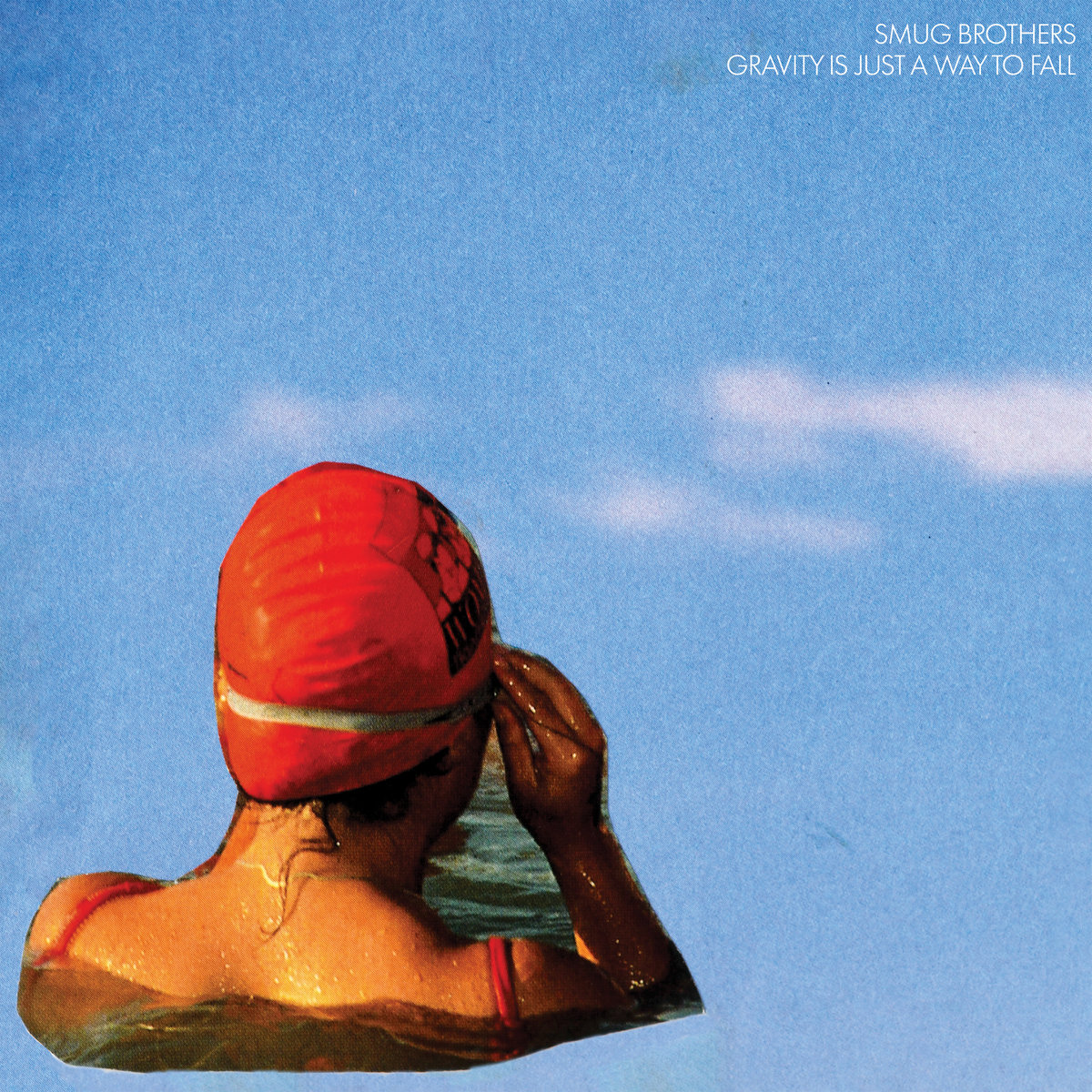
If rock and roll has gravity, it’s the kind that pulls you sideways — toward the basement show, the overdriven amp, the song that sounds like it was recorded in a kitchen but somehow rearranges your emotional furniture. And for twenty years, Dayton/Columbus, Ohio’s Smug Brothers have been quietly defying that gravity by embracing it. Their forthcoming 20-year retrospective, Gravity Is Just A Way To Fall (out May 15, 2026), isn’t a victory lap so much as a beautifully scuffed scrapbook — a reminder that some of the best American guitar music of the last two decades has been hiding in plain sight.
To understand Smug Brothers, you have to start in Dayton and then take a drive to Columbus, Ohio — that stubbornly fertile patch of Midwest soil that has produced more sharp, strange guitar bands than the coasts would like to admit. Think Guided by Voices, think Times New Viking, think Cloud Nothings, think Heartless Bastards. Bands that made imperfection a matter of principle. Beautiful chaos. Bands that treated melody like contraband — something to be smuggled past the gatekeepers of taste.
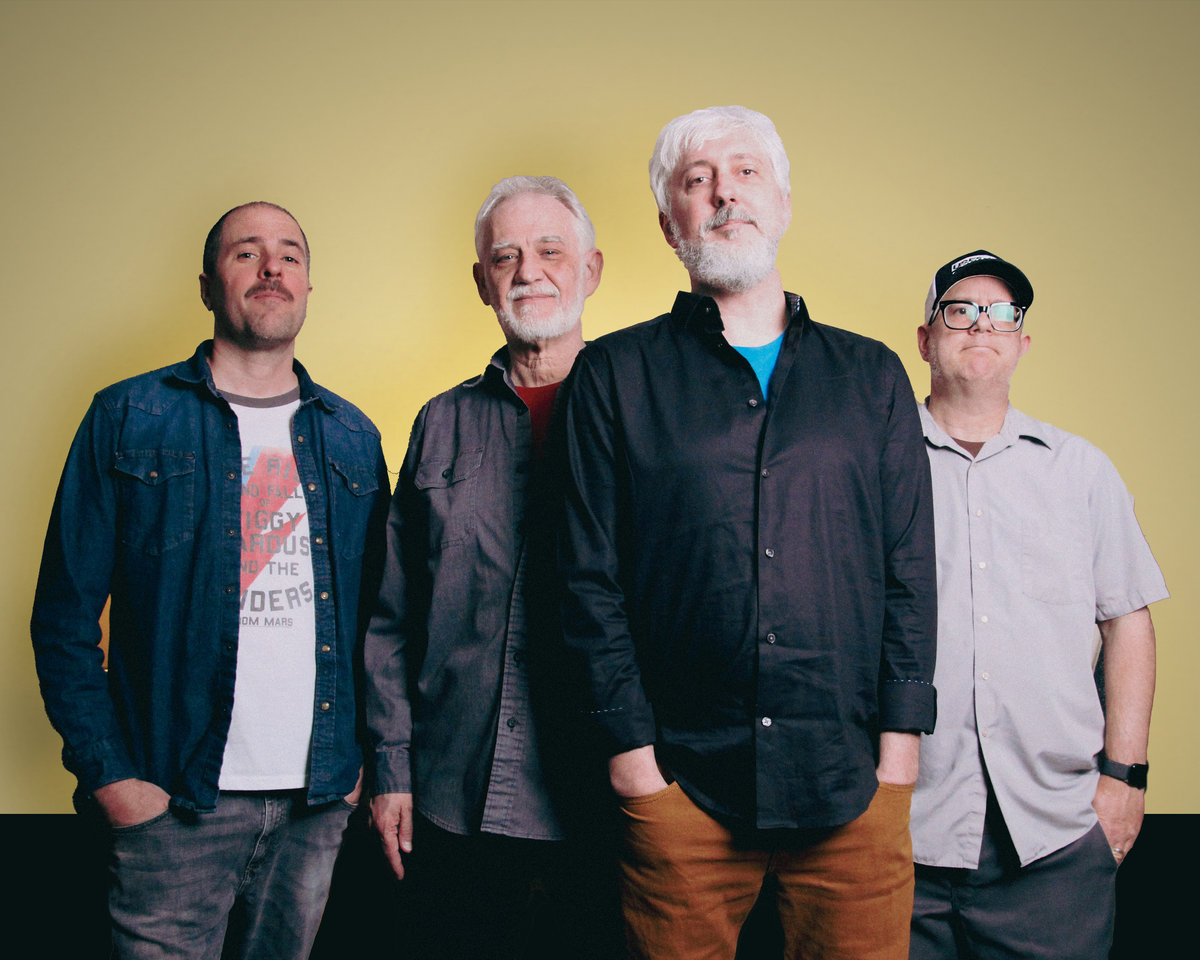
Smug Brothers fit that lineage, but they also complicate it. What began in the mid-2000s as a scrappy recording project between singer/guitarist Kyle Melton and Darryl Robbins (of Motel Beds) hardened into something deeper and more resilient when legendary drummer Don Thrasher — yes, that Don Thrasher from Guided by Voices and Swearing at Motorists — joined the fold. Since 2009, Melton and Thrasher have formed the core of a band that feels less like a stable lineup and more like an ongoing conversation over music. Over the years, that dialogue has included a rotating cast — Marc Betts, Brian Baker, Shaine Sullivan, Larry Evans, Scott Tribble, Kyle Sowash, Ryan Shaffer — all contributing to a catalog that’s as collector-friendly as it is emotionally direct. Each player adding something distinctive to the records they worked on.
But here’s the beautiful irony: you don’t need to track down the cassettes, the limited LPs, or the out-of-print CDs. Gravity Is Just A Way To Fall does the curatorial work for you. Several tracks have been remastered; some have never appeared on vinyl; a few have never existed in any physical format at all. After twenty years, the band decided to “summarize the work up to this point.” That word — summarize — sounds almost academic. What they’ve actually done is distill the fever.
And what a fever it is.
Smug Brothers have always specialized in the kind of riff-driven indie pop that feels both handmade and cosmically aligned. The early lo-fi recordings hinted at greatness — fuzzed-out guitars, melodies that ducked and weaved, drums that sounded like they were daring the tape machine to keep up. But even in those rough cuts, you could hear the bones: a Beatlesque instinct for earworms, an affection for left turns, a refusal to sand down the serrated edges.
Over time, Melton’s recording finesse sharpened. He recorded and mixed much of this retrospective himself, with key collaborations from Darryl Robbins and Micah Carli. Everything was mastered by Carl Saff, whose touch has become something of a seal of quality in indie circles. The result is a set of songs that feel alive rather than embalmed. This isn’t nostalgia; it’s voltage.
What makes Smug Brothers matter — especially now — is their commitment to the album as an artifact and as an attitude that reflects the music within. The front cover, “Solutions Vary With Regions.” The back cover, “The Hungry Rainmaker” (Artwork by PHOTOMACH. Layout by Joe Patterson and PHOTOMACH). These aren’t afterthoughts; they’re part of the argument. In an era where music is often stripped of context and shuffled into algorithmic soup, Smug Brothers insist on the tactile, the visual, the deliberate. Even when the songs are streaming in invisible code, they carry the residue of collage and ink.
And then there are the songs themselves — all written by Kyle Melton. That authorship matters. Across two decades, Melton has built a body of work that feels diaristic without being self-indulgent. The hooks sneak up on you. The choruses don’t explode so much as insist. The guitars jangle, scrape, shimmer. The drums propel rather than pummel. You find yourself humming along before you realize you’ve been converted.
A retrospective like Gravity Is Just A Way To Fall lives or dies by sequencing, and Smug Brothers have always understood that an album isn’t just a container — it’s a mood swing you consent to. These thirteen tracks trace the band’s restless melodic intelligence, moving from punchy immediacy to sly introspection without ever losing that basement-show voltage. It opens with “Let Me Know When It’s Yes,” a title that feels like a thesis statement for the entire catalog — yearning wrapped in defiance. And to be fair, a song that we have often played on YTAA. The guitars chime with that familiar Midwestern shimmer, but there’s an undercurrent of impatience here, a sense that indecision is the real antagonist. It’s a perfect curtain-raiser: concise, hook-forward, emotionally ambivalent in the best way.
“Interior Magnets” (clocking in at an impressively tight 3:01) is classic Smug Brothers compression — all tension and release packed into a pop-song frame. The rhythm section locks in with that loose-tight chemistry Kyle Melton and Don Thrasher have refined over the years, while the melody spirals inward. It’s a song about attraction and repulsion, about the invisible forces that keep people circling each other. One of our favorite Smug Brothers’ songs, “Meet A Changing World,” expands the lens. There’s something almost anthemic about it — not stadium-anthemic, but neighborhood-anthemic. The guitars layer into a bright, bracing wash, as if the band is daring uncertainty to make the first move. In contrast, “It Was Hard To Be A Team Last Night” — a simply brilliant tune — pulls the focus back to the micro-level of human friction. It’s wry, a little bruised, propelled by a riff that sounds like it’s arguing with itself.
“Beethoven Tonight” is pure Smug Brothers mischief — high culture dragged through a fuzz pedal. The song plays with grandeur without surrendering to it, balancing a classical wink with garage-rock muscle. Then comes “Hang Up,” lean and kinetic, built around the kind of chorus that arrives before you’ve fully processed the verse. It’s sharp, unsentimental, and irresistibly replayable. “Javelina Nowhere” may be the record’s most evocative left turn. The title alone suggests a desert hallucination, and the arrangement follows through a slightly off-center, textural, humming with atmosphere. “Take It Out On Me” snaps the focus back into a tight melodic frame, pairing vulnerability with propulsion. It’s accusatory and generous at once, a hallmark of Melton’s songwriting.
“Silent Velvet” glides toward you, in contrast, with a softness in the title, grit in the execution. There’s a dream-pop shimmer brushing against serrated guitar lines. “Seemed Like You To Me” feels like an old photograph discovered in a jacket pocket: reflective, warm, edged with ambiguity. Late-album highlights “Pablo Icarus” and “Every One Is Really Five” showcase the band’s love of conceptual wordplay. The former fuses myth and modernity, soaring melodically before tilting toward the sun. The latter is rhythmically insistent, almost mathy in its phrasing, but anchored by a chorus that keeps it human.
Closing track “How Different We Are” is less a statement of division than an acknowledgment of complexity. The guitars don’t explode; they bloom. The rhythm section doesn’t crash; it carries. As finales go, it’s quietly expansive — a reminder that across twenty years, Smug Brothers have thrived on tension: between polish and rawness, intimacy and noise, gravity and lift.
If last year’s Stuck on Beta (2025) suggested a band still hungry, still refining, still pushing outward, this retrospective confirms the long arc. Smug Brothers didn’t burn out. They didn’t calcify. They kept writing, recording, releasing, playing shows, and deepening their chemistry. Gravity, in their hands, isn’t a force that pins you down; it’s the thing you learn to fall through with style.
There’s something profoundly Midwestern about that ethos. No grand manifestos. No self-mythologizing. Just songs that are stacked one after another, each carrying its own small revelation. In a culture obsessed with the new thing, retrospectives can feel like retirement parties. But Gravity Is Just A Way To Fall plays more like a dispatch from a band still in motion.
Twenty years in, Smug Brothers remind us that indie rock isn’t a genre so much as a practice: keep the overhead low, keep the guitars loud, keep the songs sharp, keep the faith. The noise may be louder than ever, the platforms more crowded, the attention spans shorter. But when a riff locks in, when a chorus lifts, when a drumbeat nudges your pulse into alignment, none of that matters.
Gravity is just a way to fall. And sometimes, falling is how you learn what’s been holding you up all along.
If you spend enough time digging through Bandcamp tags at 2 a.m., you start to recognize the difference between lo-fi as an aesthetic and lo-fi as a way of seeing the world. The first is easy: tape hiss, gently warped guitars, a drum machine that sounds like it was rescued from a yard sale. The second is rarer and more interesting. It’s less about production tricks and more about a temperament—a willingness to let imperfection feel honest.
Dayton musician Luke Hummel, who will be appearing this week on Your Tuesday Afternoon Alternative with Dr. J from 4–5 p.m., belongs firmly in that second category.
Hummel has been drifting around the edges of Ohio’s DIY scene, releasing home-recorded EPs and singles that feel less like products than postcards. His songs arrive quietly, usually with little fanfare, and they tend to stick around longer than you expect. Listening to his catalog is a bit like thumbing through a box of Polaroids from someone else’s life: small moments, slightly faded, unexpectedly moving.
I’m supposed to have a vocabulary ready for this sort of thing. Words like “intimate,” “bedroom pop,” “hazy,” and “nostalgic.” All of them apply, and none of them quite capture what makes Hummel’s music worth paying attention to. The charm isn’t simply that it sounds homemade. It sounds lived in.
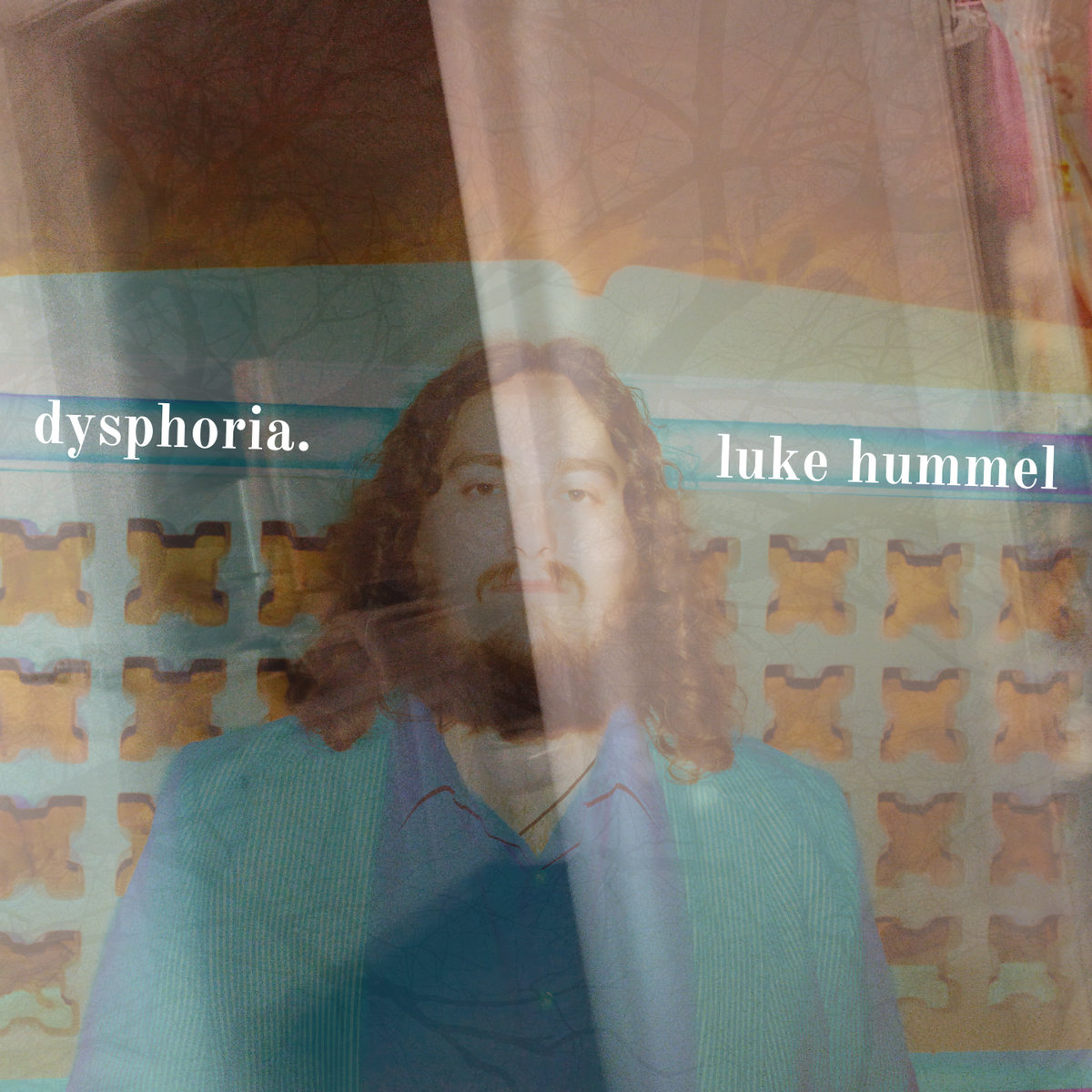
Take ‘woman,’ one of the standout tracks from his most recent release, dysphoria. The song barely rises above a murmur: a finger-picked guitar line, a barely-there beat, Hummel’s soft, conversational voice. On paper, it’s almost nothing. In practice, it’s the musical equivalent of a long exhale. You can hear the room around the song—the faint buzz of an amp, the subtle inconsistencies in the performance—and instead of feeling sloppy, those details make the track feel human.
That humanity is the through line of Hummel’s work. He writes about ordinary things: late shifts, half-remembered conversations, drives down Wilmington Pike after dark. But he treats those ordinary things with an uncommon tenderness. In an era when so much indie music strains for irony or grand statements, his songs feel refreshingly modest. They don’t demand your attention; they invite it.
Dayton, of course, has a long and strange musical history. This is the city that gave the world The Ohio Players, Guided by Voices, Brainiac, the Breeders, Hawthorne Heights, The New Old Fashioned, Oh Condor, The Creepy Crawlers—a place where scrappy experimentation has always thrived. Hummel fits comfortably into that lineage, even if his music is quieter than most of his hometown predecessors. Where Dayton rock once announced itself with blown-out guitars and basement-show chaos, Hummel represents the flip side: the reflective musician sitting on the back steps after the show, trying to make sense of everything.
One of the pleasures of lo-fi music is how it collapses the distance between artist and listener. Big studio records can feel like monuments; Hummel’s tracks feel like conversations. When he sings, it doesn’t sound like he’s performing so much as thinking out loud. In much of Luke’s music, it’s as if he is admitting that he’s better off being alone, ideas delivered so plainly thatit barely scans as a thought. Yet the idea lands with surprising weight. You believe him.
There’s also a gentle humor running through his work. Song titles like “fresh face” and “air dry clay” suggest a songwriter who understands his own anxieties well enough to smile at them. That balance—between melancholy and warmth, self-doubt and self-acceptance—is difficult to pull off without tipping into sentimentality. Hummel manages it with a light touch.
Hearing this kind of music on the radio can feel almost subversive. Commercial airwaves are designed for clarity and volume; lo-fi thrives on softness and texture. That’s what makes shows like Your Tuesday Afternoon Alternative with Dr. J so valuable. We carve out space for artists who operate outside the usual promotional machinery, musicians who might never trend on TikTok but who are building small, meaningful audiences one listener at a time.
For Hummel, a live radio appearance is less about plugging a product than about sharing a process. His performances tend to be relaxed and unvarnished, the musical equivalent of inviting strangers into his living room. I suspect that on the show, he’ll talk about quiet guitars, about recording on aging laptops, about the challenge of making art while holding down an ordinary Midwestern life. Those details matter because they’re inseparable from the songs themselves.
Lo-fi music often gets dismissed as minor or provisional—a stepping stone to something bigger and cleaner. Hummel’s work argues the opposite. There’s a quiet confidence in his refusal to polish away the rough edges. The imperfections aren’t problems to be fixed; they’re part of the story he’s telling.
In the end, that may be the best way to understand Luke Hummel: not as a local curiosity or a genre exercise, but as a careful observer translating everyday experiences into gentle, durable songs. His music doesn’t try to change the world. It tries to keep it company.
And on a Tuesday afternoon in Dayton, that feels like more than enough.
Mike Bankhead’s “Something That I Can’t Explain” doesn’t so much begin as it leaks out of the speakers, a humid, half-remembered confession that carries a feeling from basements, barroom carpets, and the ghost of every rehearsal space Dayton ever forced into existence. You don’t listen to this song so much as you wander into it, like opening the wrong door in a familiar house and finding a room you forgot was there. That’s Bankhead’s trick: he makes the local feel mythic and the mythic feel like it’s leaning against a busted amp, waiting for the others to arrive.
Dayton has always been one of America’s great under-credited noise factories, and yup, I am ready to die on that hill. We gave the world funk, post-punk, industrial weirdness, and enough basement-bred genius to stock a dozen glossy documentaries that will never get made. Mike Bankhead sits right in the middle of that lineage—not as a tourist or a revivalist, but as a lifer. He’s one of those musicians who doesn’t just play in a scene; he is part of its circulatory system, hauling gear, showing up for other people’s gigs, recording, mixing, encouraging, needling, and generally making sure the whole messy organism keeps breathing. Every scene needs someone like Mike, part fan, part musician, part reminder of the reasons people do this.
“Something That I Can’t Explain” sounds like it was written by someone who’s been around long enough to know that the best songs aren’t about clarity; they’re about staying with the confusion. Sometimes the grey area matters more than the easy answers. The melody lurches forward like it’s got something urgent to tell you and then second-guesses itself halfway through the sentence. The vocals don’t demand your attention—they sidle up to it, muttering truths they’re not totally sure they’re allowed to say. This is not stadium rock. This is backroom metaphysics.
What makes Bankhead essential to Dayton isn’t just that he writes songs like this; it’s that he’s helped create the conditions where songs like this can exist at all. Scenes don’t survive on big breaks. They survive on people who show up. Bankhead has been one of those gravitational figures who make it easier for others, strangers, and the less confident artists to take the leap. When someone tells you, “Yeah, Mike’s involved,” you know it means things will actually happen—records will get finished, shows will get booked, weird ideas will be taken seriously instead of laughed out of the room.
There’s a Dayton-specific emotional weather system in “Something That I Can’t Explain.” It’s in the way the song refuses to resolve cleanly, the way it keeps circling a feeling instead of pinning it down. Dayton’s a town that’s been promised a lot and delivered just enough to keep hoping. Bankhead understands that tension, and he doesn’t try to smooth it over. He lets it hum, like feedback you don’t quite know how to kill without losing the song.
Lester Bangs used to say that the best rock and roll made you feel less alone in your own weirdness. Bankhead does that, but he does it with a Dayton accent—gritty, affectionate, slightly suspicious of success, deeply loyal to the people who were there before anyone else cared. “Something That I Can’t Explain” isn’t just a song; it’s a little flare shot up from a city that keeps reinventing itself in basements and back rooms. And Mike Bankhead, bless him, keeps striking the matches.
If you want to understand American music, you don’t start in the places that market themselves as capitals. You start in places where people have learned how to survive without being watched. Dayton, Ohio, is one of those places. It’s not a brand; it’s a frequency—sometimes distorted, sometimes melodic, often both at once. It’s the sound of basements, nondescript halls, record stores, radio studios on the left side of the dial, and people who keep making music because not making it would be worse.
Dayton has long lived with the mythology of The Ohio Players, Brainiac, The Breeders, and Guided By Voices, and rightly so. Those bands didn’t just “come from” Dayton; they carried its nervous system with them. The Ohio Players reshaped the structure of music. Brainiac turned post-industrial anxiety into neon futurism. The Breeders made abrasion feel intimate. Guided By Voices proved that lo-fi wasn’t an aesthetic so much as a work ethic—songs written because they had to be written, not because the market asked for them. But the mistake outsiders make is assuming the story ended there, like a museum exhibit frozen in amber. Dayton never stopped. It just got better at multiplying.
What makes Dayton’s music community distinct is density. Musicians don’t just play in one band; they circulate. You’ll see David Payne one night in The New Old Fashioned, another night anchoring something else entirely, as if styles were jackets you try on before walking back out into the weather. You’ll hear Rich Reuter bring the same melodic intelligence to Kittinger. You can see Howard Hensley sing the narratives of your life that you keep hidden in a private journal. You’ll catch Kyleen Downes making vulnerability sound like strength, then turn around and hear Chad Wells and Aarika Voegele in Cricketbows and Creepy Crawlers remind you that psychedelia is still a radical act.
There’s a particular Dayton knack for bands that feel communal rather than hierarchical. Shrug operated like a shared engine—power pop with muscle memory, hooks built from collective trust. Smug Brothers do something similar in an indie lo-fi manner, but with a wink, as if to say: yes, we love the song, but we also love the joke inside it. Me Time pares things down until you can hear the room breathe, while Oh Condor leans into texture and atmosphere, stretching Dayton’s sound outward without losing its spine where punk urgency meets craft instead of fighting it.
And then there’s the streak of theatricality that runs through the city—not showbiz gloss, but the drama of people who know that art is a way to survive the week. Moira thrives on that tension between polish and pulse, while Todd The Fox reminds us that music doesn’t have to be ironic to be intelligent. Novena creates music that wraps around you and takes you through the experiences that you need not categorize but live within. Ghost Town Silence and Sadbox explore all of the corners, not as cosplay, but as honest terrain. They understand that Midwestern quiet can be loud if you listen closely enough.
Dayton also knows how to honor the songwriters—the ones who can stop a room with a voice and a guitar. Shannon Clark and The Sugar balance heart and harmony without sentimentality. Nick Kizinis crafts music that feels deeply personal and belonging to all of us at the same time. Mike Bankhead and Heather Redman carry storytelling traditions forward without turning them into nostalgia acts. Charlie Jackson, Sharon Lane, and Colin Richards and Spare Change all work in that space where craft meets community, where the goal isn’t fame but connection.
What’s striking is how the city supports experiments that don’t fit easy categories. The Nautical Theme reminds us that pop intelligence doesn’t have to announce itself with a thesis statement. Motel Faces and Motel Beds (separate names, shared grit) translate restlessness into motion, road songs for people who might not leave but still want to move. John Dubuc’s Guilty Pleasures embraces joy without apology, while Nick Kizirnis’s various projects show how longevity comes from curiosity, not branding.
Dayton’s rap and hip hop scene carries the same DIY backbone as its rock underground, but filtered through sharp lyricism, lived experience, and a deep sense of place. Tino delivers verses with clarity and purpose, balancing organic storytelling with an ear for hooks that stick without softening the message. Illwin brings a cerebral edge, blending introspection and technical skill in ways that reward close listening, while KCarter operates with a commanding presence, turning personal narrative into something anthemic and communal. Around them is a broader network of MCs, producers, DJs, and collaborators who treat hip hop not as a trend but as a language—one spoken fluently across clubs, community spaces, and independent releases. Like every vital Dayton scene, it thrives on collaboration over competition, local pride over imitation, and the belief that telling your own story, in your own voice, is the most radical move there is.
One of Dayton’s greatest strengths, too often undersold, never underpowered, is the depth and range of its women songwriters and musicians, artists who write with clarity, risk, and emotional authority. Amber Heart brings a fearless intimacy to her songs, pairing melodic grace with lyrical honesty that cuts clean through pretense. Samantha King writes with a restless intelligence, her work balancing vulnerability and bite, proof that introspection can still swing. Khrys Blank bends genre until it gives way, crafting songs that feel both deeply personal and quietly defiant, while Sharon Lane carries a lineage of soul, grit, and resilience that anchors the community itself. Add to this constellation the many other women shaping stages, sessions, and scenes across the city—singers, instrumentalists, bandleaders, collaborators—and a clearer picture emerges: Dayton doesn’t just feature women in its music culture; it is being actively defined by them. Their presence isn’t a sidebar or a trend. It’s the spine, the pulse, and the future of the sound.
Poptek Records operates like a pressure valve for Dayton pop intelligence, a label that understands hooks are a form of radical communication. The 1984 Draft brings nervy, literate indie punk rock that sounds like it’s pacing the room while thinking three steps ahead—melody sharpened by urgency, guitars wired straight into the bloodstream. Jill & Micah offer a different kind of voltage: intimate, harmonically rich, emotionally precise songs that trust quiet moments as much as crescendos, proving that restraint can hit just as hard as distortion. XL427 leans into power pop’s finest tradition—tight structures, smart turns, choruses that land without asking permission—while still carrying that unmistakable Dayton DNA of grit and sincerity. Taken together, and alongside the label’s other releases, Poptek’s roster feels less like a genre exercise and more like a shared belief system: songs matter, craft matters, and community matters. It’s pop music that knows where it’s from, isn’t embarrassed by joy, and refuses to confuse ambition with emptiness.
This ecosystem works because Dayton listens to itself. Bands go to each other’s shows. Musicians play on each other’s records. Area radio, house shows, small clubs, and DIY spaces form an infrastructure that doesn’t depend on permission. You can hear that lineage in The New Old Fashioned’s country infused power precision, in Oh Condor’s punk economy, in The Paint Splats’ melodic insistence, in Guided By Voices’s expansive moods still evolving. It’s a scene where influence flows sideways instead of top-down.
If the great rock critic, Lester Bangs (who I have been reading a lot of lately) taught us anything, it’s that scenes matter not because they’re perfect, but because they’re alive. Dayton’s scene is alive in the way a good band rehearsal is alive—messy, loud, generous, occasionally miraculous. It’s alive in the refusal to wait for validation. It’s alive in the way new bands grow up hearing old ones not as legends, but as neighbors.
So yes, celebrate Brainiac,The Breeders, and Guided By Voices. You should. But don’t stop there. Pay attention to Sharon Lane, Shrug, Amber Heart, Smug Brothers, The 1984Draft, Age Nowhere, Moira, Tino, The Heisy Glass Company, Harold Hensley, Todd The Fox, Ghost Town Silence, Sadbox, Novena, Me Time, Oh Condor, Motel Faces, Motel Beds, Mike Bankhead, Cricketbows and Creepy Crawlers, The Nautical Theme, Illwin, Khrys Blank, Seth Canan, XL427, Samantha King, The Typical Johnsons, KCarter and all the songwriters and collaborators who keep showing up. Dayton isn’t a chapter in a rock history book. It’s an ongoing argument about why music matters—and it keeps winning that argument one show at a time.
They keep saying it like it’s a diagnosis, like a doctor lowering his voice: There’s no good new music anymore. As if the patient is culture itself, lying flatlined under a white sheet, while the rest of us are supposed to nod solemnly and accept that the last real song was written sometime around when they were sixteen and emotionally combustible. This is nonsense, of course, the laziest kind of nonsense, the kind that requires no listening, no leaving the house, no risk, no sweat, no awkward eye contact in a half-lit room where the band is setting up next to a stack of amps that smell like beer, ozone, and promise.
New music is not dead. It’s just not coming to you. It’s not ringing your doorbell or algorithmically tucking itself into your ears while you scroll. It’s happening out there, in rooms that require pants and presence and a willingness to be changed, even slightly. And that’s the real problem: new music demands participation. It demands that you show up.
The great (boy, would he hate that sentiment) rock critic, Lester Bangs, understood this instinctively. He knew that music wasn’t an artifact to be archived, but a live wire, something that crackles when bodies gather, and sound hits air, and something unpredictable happens. The excitement of new music isn’t about novelty for novelty’s sake; it’s about the shock of recognition when you hear something you didn’t know you needed until it’s already inside your head, rearranging the furniture.
Going out to see local music—real local music, not brand-approved “scenes” packaged for export—is a civic act. It’s how communities remember they’re alive. You walk into a bar, a VFW hall, a coffee shop after hours, a basement with questionable wiring, and suddenly you’re part of a temporary republic founded on volume and intent. You’re standing next to people who live where you live, who work the jobs you know, who are writing songs not because it will scale, but because it has to come out. That matters. That changes things.
The need for new music isn’t abstract. It’s psychic. It’s the need to hear someone else articulate the same confusion, joy, dread, or stubborn hope you’re carrying around without a language. No documentation, just a real human need. When people say nothing is exciting being made anymore, what they’re really saying is that they’ve stopped being curious about other people’s interior lives. They want the old songs because the old songs already agree with them. New music argues back, it’s the packaging/re-packaging of human feelings in new bottles.
And that argument is healthy. It keeps culture from calcifying into a museum gift shop stocked with endlessly remastered memories. Live local music reminds us that art is a process, not a product. Bands miss notes. Lyrics change. Drummers (guitarists, bass players, etc.) quit. Someone forgets the bridge and laughs. These imperfections are not flaws; they’re evidence of life. They’re proof that the thing you’re witnessing hasn’t been fully decided yet.
The positive consequences ripple outward. You support a venue, which supports staff, which keeps a place open where people can gather without a screen between them. You give musicians a reason to keep writing, to keep rehearsing, to keep believing that the hours spent hauling gear and arguing about tempos aren’t insane. You create informal networks—musicians meet other musicians, shows lead to collaborations, friendships form, ideas cross-pollinate. This is how scenes happen, not because someone declares one into existence, but because enough people decide that showing up matters.
Local music also recalibrates your sense of scale. Not everything needs to be monumental to be meaningful. A great song played for forty people can hit harder than a festival set swallowed by branding and distance. There’s an intimacy in local shows that can’t be replicated: eye contact with the singer, the thump of the kick drum in your sternum, the shared glance when a chorus lands just right. You don’t leave as a consumer; you leave as a witness to something that you cannot quite describe.
And let’s be honest about the frustration. The claim that nothing compelling is being released now is often a cover for disengagement. It’s easier to blame the times than to admit you’ve stopped listening actively. The world didn’t run out of ideas; you ran out of patience. Meanwhile, musicians are still out here folding genres into new shapes, writing songs about now—about precarity, community, grief, humor, survival—with tools and influences that didn’t exist twenty years ago.
If you want excitement, you have to seek it out. You have to court it. You have to risk boredom, risk disappointment, risk being wrong. That’s the deal. New music doesn’t owe you greatness on demand; it asks for your attention in exchange for the possibility of revelation.
So go out. Stand in the back or press up front. Clap awkwardly. Buy the record/CD/download/tape. Talk to the band. Argue with your friends about what you heard. This is how culture stays porous and human. This is how a town sounds like itself instead of a rerun.
The future of music isn’t missing—it’s tuning up, waiting for you to get off the couch and walk through the door.
The last YTAA Show of 2024 broadcast on 12-31-2024 is up on the YTAA Mixcloud page! Please give the show a listen and share it with all of your friends. The first time you sit behind the mic and hear that low hum of the studio, you realize it’s a weird kind of experience. You’re not broadcasting a war, no, you’re not even sending out a weather report; you’re sending out your heartbeat. You’re putting yourself on the line, with nothing but an inch-thick foam divider and a sliding board full of dials between you and the abyss of total silence, the void of being utterly ignored. But that’s the thing. Even when you feel apart and separated from others, you’re not really alone.
There’s something visceral about radio. Yeah, even in 2024. It’s a love affair with anonymity after a fashion — you’re sending out these fragments of yourself, these half-thoughts, barely strung together sentences (I try, I actually am trying for something snappy and catchy), hoping someone, anyone, will hear. But even when no one’s listening, it doesn’t matter. You can say the weirdest stuff. You can be as loud as you want, or as quiet as you need to be in that moment. It’s like a secret between you and the speakers on the other side of the room. Who knows if anyone’s tuned in? Does it matter? Perhaps, it doesn’t matter. You’ve got the mic, and in this space, it’s yours even if it is only for three hours. You’re not just DJing songs; you’re performing the act of being. Becoming.
And there’s a rhythm to it, a pulse you can feel in your chest. The songs bleed into each other, and you start talking, almost without thinking, like an out-of-body experience. You riff, you ramble, you may talk about everything and nothing — akin to late-night rants, whispered secrets, some tale of life in the margins. It’s punk, it’s soul, it’s funk, it’s rock ‘n’ roll, and if you’re doing it right, it’s all on the edge of disaster, waiting to fly off the rails at any moment. And that’s the magic. You could screw it up. You probably will. But that’s what makes it real. In an increasingly overproduced, AI-scam-laden world, radio may be messy but that is what creates some of the joy in doing it.
Well, folks, here we are at the end of 2024, and I gotta say—thank you for sticking with me through the weirdness, the noise, and the absolute chaos that is Your Tuesday Afternoon Alternative. You could’ve been anywhere, listening to anything, but you chose to tune in to this mess of records, rants, and ramblings. Maybe you were searching for something new, or maybe you just wanted to escape the grind. Either way, I’m grateful for your ears, your time, and your madness. This isn’t just my show—it’s our show, so keep riding the wave, wherever it takes us in 2025.
In the coming weeks we celebrate the holidays in full indie music style — is that really a thing? On Tuesday, December 17th we will be playing new, classic, and cover holiday songs on the show. Another year has come and gone. Can anyone else believe that we have been doing this for at least fourteen years, sheesh time does pass fast!
Indie holiday music is like that stray cat you take in—scrappy, scruffy, full of attitude, but somehow comforting. It’s the sound of bells and lo-fi drum beats weaving through a haze of reverb and melancholy, like a cold winter’s night painted in pastel hues. Forget those sugar-coated carols, these songs are the unsung heroes of the season, cloaked in irony, aching for connection amidst the forced cheer. They’ve got that off-kilter honesty, a rawness that refuses to conform to the Hallmark image of Christmas. It’s a quiet rebellion, but hell, it’s also really kind of beautiful.
We know that there is a lot of stress during the holidays with all the planning, shopping, and whatever else we are told to do during the holiday season. Well, we believe that any task goes better with music. So, pour yourself the ‘Nog, eat a cookie or three and let us help you relax with some great indie holiday music. If you have a suggestion for a cool holiday tune, let us know on drjytaa on the gmail!
Dr. J can’t wait to co-host the 14th Annual Indie Holiday Radio Show on WUDR Flyer Radio 99.5/98.1’s Your Tuesday Afternoon Alternative with our good friend and frequent guest on the program, Tom Gilliam, who always brings some interesting holiday music to the mix. And as always, the talented Mrs Dr. J has made many a fine contribution to the show as well! You expect nothing less.
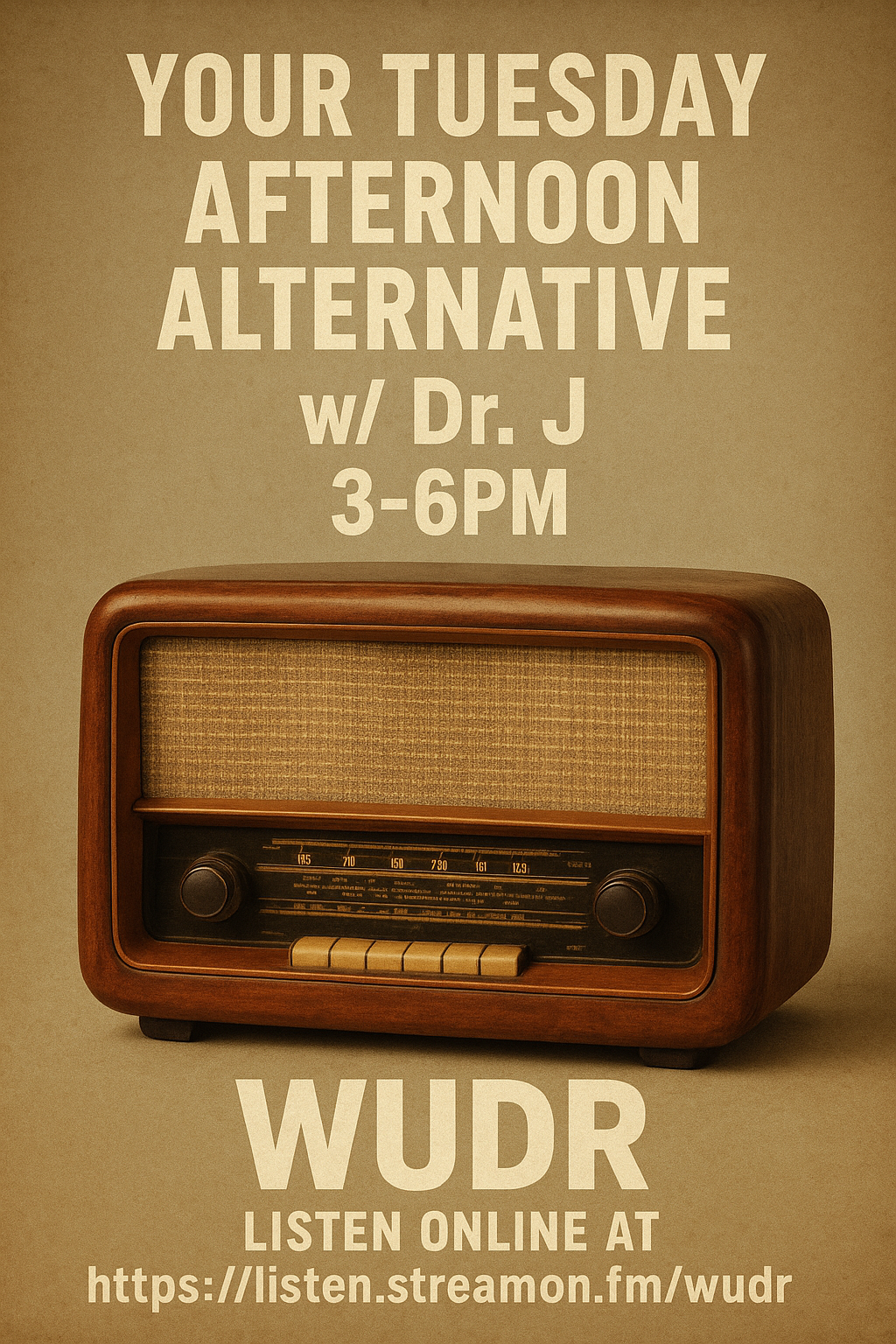
This year you have two chances to hear the indie holiday festivities! The first broadcast is on Tuesday, December 17th from 3-6 PM. Listen on 99.5 FM in Dayton, Ohio, USA, or stream the broadcast at wudr.udayton.edu. And if that was not enough we load the show into Mixcloud! You can listen on Wednesday at our Mixcloud page! We just can’t wait to play new and classic indie holiday songs for you. Save us some of the ‘nog.
Let’s get something straight from the jump: independent radio—college stations, community stations, those hissing, crackling signals of barely legal wattage—are more than relics. They’re lifelines, and in a world drowning in curated blandness, they’re salvation that is desperately needed. Sure, you’ve got your algorithmic playlists and big-budget streaming platforms that can spit out the sonic equivalent of a hamburger combo meal, but let me ask you this: when’s the last time one of those songs on the apps and services truly blew your mind? When’s the last time a Spotify playlist made you feel something raw, something real, something alive?
Enter the humble, often-overlooked world of independent radio. These stations don’t play by the rules and thank God for that. College and community DJs who aren’t bound by focus groups or corporate overlords telling them which ten songs to cycle endlessly. They’re the anarchists of the airwaves, throwing down pop punk at 3 a.m., jazz fusion at noon, and some spoken-word poetry over ambient noise just because they can. They’re the kid in the back of the record store who’ll tell you that the B-side of a 7” pressed in someone’s basement in 1984 will change your life—and they’re right. Forgive me if this sounds trite or self-serving, but we believe in the power of music to change your life.
This is radio as it was meant to be: unpolished, unpredictable, and unafraid to go weird. College radio, especially, is often powered by the most crucial demographic for musical discovery—students who don’t yet know the rules they’re breaking. These DJs are sometimes just learning what it means to piece together a playlist, to tell a story in 20-minute sets, to unearth that obscure track nobody else has heard of. It’s raw, and it’s beautiful because it’s real.
And let’s not forget the community stations—the hyper-local powerhouses keeping neighborhoods and subcultures alive. These aren’t just radio shows; they’re conversations. They’re where you tune in to hear the pulse of your city, the heartbeat of your neighbors. It’s where activists and artists collide, where voices ignored by the mainstream get a microphone. It’s radio as rebellion, as resistance, as a refuge from the overpowering heavy challenges we all face.
Here’s the thing the big media conglomerates and tech giants don’t want you to realize: not everything should be convenient. Finding great music—or a great anything—takes work. It takes passion. That’s what makes it matter. Independent radio doesn’t spoon-feed you the hits; it hands you a map, points vaguely in a direction, and says, “Go get lost.” And in that wandering, you discover magic. You stumble across a DJ spinning a 10-minute opus made by an area band or a live set from some local group that sounds like they’re playing from the edge of the world. And you want to go there so you can be part of it.
In an era where everything feels like it’s been prepackaged, sanitized, and optimized for maximum engagement, independent radio stands as a glorious middle finger to the machine. It’s messy, it’s chaotic, and it’s alive in ways that nothing else in the modern media landscape can touch even thought they try to say that experimentation came from them.
What’s more, independent radio matters because it’s often the training ground for the voices we’ll be listening to in 10, 20, or 30 years. Think about all the media icons who got their start in college radio. Two words: Howard Stern. Ever heard of Rick Rubin? He was just some punk kid spinning records at NYU before founding Def Jam. Or Ira Glass, who honed his storytelling chops on the airwaves before becoming public radio’s golden boy. The indie stations are incubators for talent because they’re places where experimentation isn’t just allowed—it’s expected.
And don’t let anyone tell you radio is dead. Sure, the format’s shifted, and the big commercial stations are shells of their former selves, but indie radio persists because it’s adaptable. College stations now stream online, bringing their wild, untamed ethos to a global audience. Community stations podcast their shows, extending their reach far beyond the low-powered transmitter on the roof.
But more than that, indie radio matters because it’s personal. It’s not just about the music—it’s about the human connection. There’s something deeply comforting about hearing another person on the other end of the signal, someone who isn’t trying to sell you something, someone who’s just as excited about this obscure Brazilian psych-rock track as you are now that you’ve heard it. It’s a reminder that music isn’t just content—it’s communion.
And yeah, maybe it’s a little romantic to wax poetic about this scrappy corner of the media world. Maybe it’s easier to dismiss it as nostalgia for a pre-streaming era. But dismissing indie radio is to dismiss the very soul of music, the thing that makes it matter in the first place. It’s the idea that art doesn’t have to be perfect, that it doesn’t have to be profitable, that it can just be.
So the next time you’re scrolling through an endless stream of playlists that all sound the same, do yourself a favor: tune in to the static. Find the frequency where some over-caffeinated college kid is ranting about a new band you’ve never heard of, or where a local DJ is spinning records in a tiny room plastered with band posters and graffiti. Listen with your whole heart, and remember what it feels like to discover.
Because independent radio isn’t just a medium—it’s a movement. And in a world that desperately wants you to settle for the lowest common denominator, it’s the one place still daring to reach higher.
Let me tell you something about Your Tuesday Afternoon Alternative with Dr. J on WUDR, broadcasting from the unassuming outpost of Dayton, Ohio: it’s not just a radio show; it’s a séance for the musically restless. Dr. J, equal parts professor (sorry), music priest, and punk-rock lifer, orchestrates a sonic sermon that grabs you by the collar and drags you kicking, screaming, and grinning through the unpolished spaces of independent and local music.
This isn’t your prepackaged corporate playlist drivel, churned out by some algorithm. No, this is real-deal, deep-dive, bloodshot-eye curation. We don’t just play songs; we conduct a reckless, unhinged exploration of soundscapes that defy the mainstream’s sterilized borders. One minute you’re grooving to the jangly guitars of a Midwest indie gem; the next, you’re pummeled by fuzz-soaked shoegaze or swept away by a tender acoustic ballad. It’s a rollercoaster for your ears, and you’re strapped in tight for the ride.
The show’s strength lies in its refusal to compromise. We are not here to appease Spotify metrics or chase TikTok trends. We pride ourselves on digging into the marrow of what makes music vital: the stories, the sweat, and the imperfections that turn a song into a revelation. Local bands? We’ve got them. Overlooked gems? You bet. It’s a treasure map to sounds you didn’t know you needed but now can’t imagine living without.
Sure, the production’s raw, the format loose, but that’s part of the charm. A little nerdy? You betcha! It feels like you’re eavesdropping on a record store conversation in town. If music is a lifeline, Your Tuesday Afternoon Alternative is one of the buoys that keeps us from drowning in the sea of mediocrity. Dayton might be criminally overlooked, but we strive to ensure it’s never unheard of.
Today’s program featured music from Wussy, The Tragically Hip, Fancy Gap, Latvian Radio, Shai Fox, Rockaway, The English Beat, The Talking Heads, The Boxcar Suite, Smug Brothers, Friedberg, Brian Lisik, and much more. We also heard two songs recorded by and two live songs performed by our guests, Kyleen Downes and Sisco Red of Freya’s Felines.
Freya’s Felines is an engaging band from Dayton, Ohio, blending a unique mix of indie rock and folk influences with a touch of ethereal storytelling. The group’s name, inspired by Freya, the Norse goddess associated with love, beauty, and cats, reflects their whimsical yet deeply introspective artistic vision. Their music resonates with themes of nature, mysticism, and human connection, offering a fresh sound that has captivated local audiences.
The band, which began as a trio, is now composed of four members: guitarists and vocalists Kyleen Downes and Sisco Red form an unshakeable foundation. Their voices blend in waves of evocative yet accessible timbre, pitch, and flow. Abigail Moone’s hauntingly soulful voice serves as a key part of their sound. The most recent member Gabriella Erbacher is a bassist who brings a rhythmic pulse to their tracks with an almost soulful groove. Moone also contributes drumming whose subtle yet powerful beats add depth to their arrangements. Together, these musicians weave a sonic atmosphere that feels both intimate and expansive, drawing listeners into their world.
Streaming Forward, Powered By The Past - if you love the 80s music, new music, Eurovision, cheesy pop and awesome playlists then let's get this pop party started!









 your tuesday afternoon alternative