Chicago’s four-piece rock-and-rollers have a debut album, a warehouse full of bad smells, and absolutely no intention of behaving themselves.
There are two kinds of rock-and-roll bands in this world. There are bands that want to be rock stars, and there are bands that want to play rock and roll. The first kind spends a lot of time worrying about how it looks, whether the lighting is right, whether the photographs make them look sufficiently dangerous, and whether somebody somewhere has decided they are the next big thing. The second kind gets together in a room that smells like things best left unidentified, plugs in the guitars, turns everything up, and gets on with the business of making noise that means something.
The Trash Kickers, a four-piece outfit from Chicago, seem to belong firmly to the second category. And thank God for that.
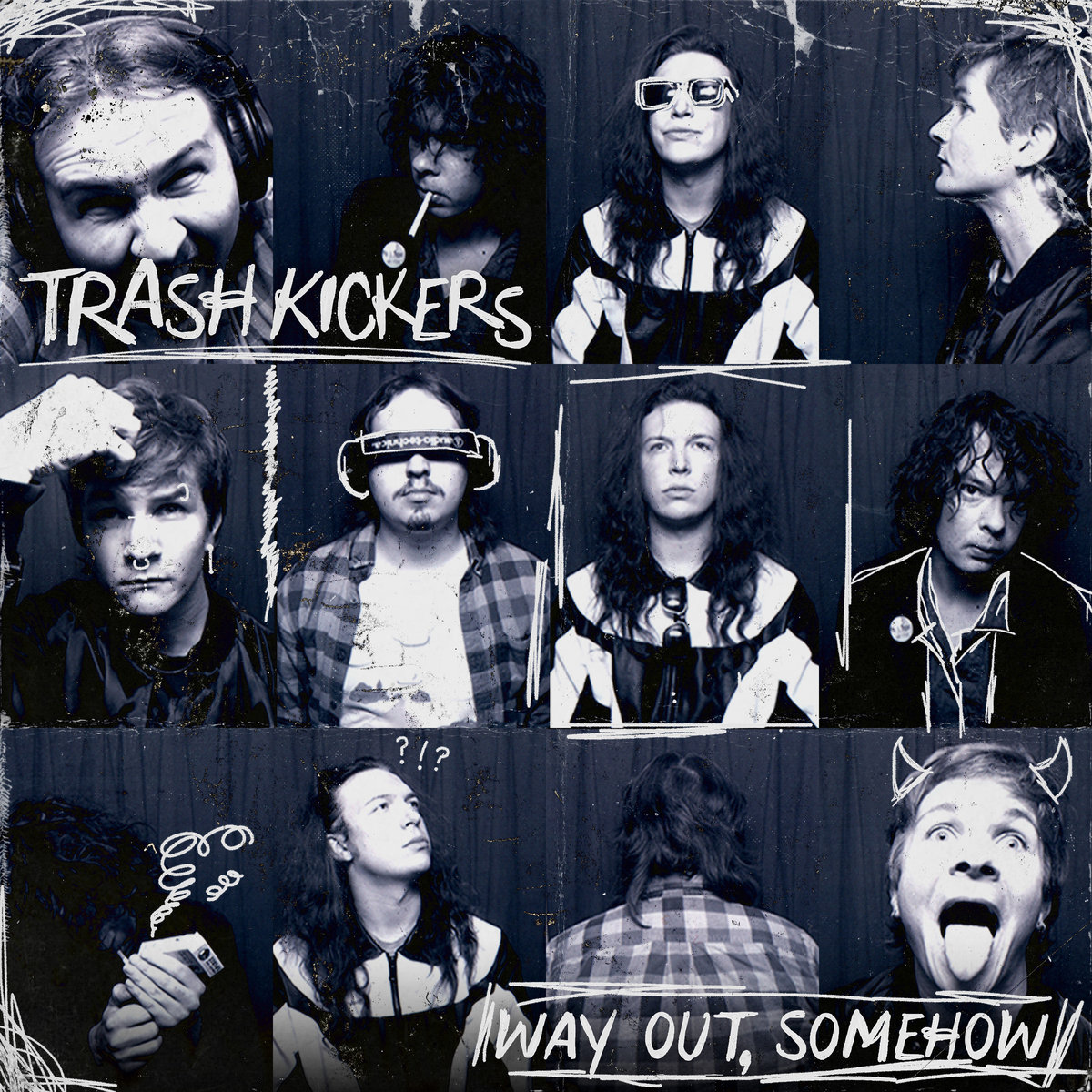
Their debut album, Way Out Somehow, is the sort of record that reminds you why rock and roll was never supposed to be a respectable profession in the first place. It is a record built on guitars, friendship, musical instinct, a healthy disregard for conventional wisdom, and the deeply subversive proposition that a band ought to make music people actually want to hear. Not music that somebody’s algorithm has determined will be suitable for your lifestyle. Not music that sounds as if it were assembled by a committee of anxious marketing executives. Songs. Riffs. Hooks. Surprises. A little sweat. Maybe a little blood. And enough life in the proceedings to make you want to turn the damn thing up.
When I sat down with the band for a conversation on Your Tuesday Afternoon Alternative, I was already playing tracks from Way Out Somehow on the radio. I had heard the Replacements in there, some Big Star, the Rolling Stones, and that glorious, somewhat disreputable strain of seventies guitar rock that never needed to ask permission before kicking down the door. What I didn’t hear was a band simply dressing up in its influences and pretending to be somebody else. The Trash Kickers have been listening to their records, all right. They’ve also been paying attention to the business of being alive.
And that makes all the difference.
The Junk Pickers Become the Trash Kickers
Every great rock-and-roll band deserves an origin story that sounds at least a little improbable. The Trash Kickers’ begins with a pile of songs, a Chicago music venue, a few friends, a conversation over drinks, and a great-grandfather who played in a folk trio during the 1930s.
Tyler, the band’s singer, guitarist, and principal songwriter, had spent more than a decade accumulating songs that had never made it onto a record. He wasn’t necessarily dreaming of conquering the world. He wasn’t even planning to start a band. He simply wanted to record the songs, put them somewhere, and have them for himself.
As origin stories go, that’s a refreshing lack of grandiosity.
Tyler already knew Danny through Chicago’s music and nightlife scene, and John was in the same orbit through Lincoln Hall, where the band members worked. The songs began to take shape as the musicians played together, and a project that had started as an archival exercise gradually became something with a pulse of its own.
Then came Stas, the lead guitarist, who entered the picture through the oldest and most reliable recruitment process in rock history: a conversation at a bar about records.
The discussion turned to Big Star, the Replacements, and the Rolling Stones. Tyler played Stas a demo on his phone. Stas offered to play guitar if the opportunity ever arose. The band invited him to rehearsal, and after a couple of hours, the question was essentially settled.
As the guys recalled it, there was “instant chemistry.”
You can’t manufacture that stuff. You can buy equipment, rent rehearsal space, hire a producer, and spend a fortune trying to convince the world that four strangers have some mystical connection. But sometimes four musicians simply discover that they speak the same language, and the rest follows.
The name required a little more deliberation, though not much more dignity. Tyler’s great-grandfather had played in a folk group called The Junk Pickers. The band liked the family connection but apparently felt that “Junk Pickers” had certain sanitary implications they would rather avoid. So junk became trash, pickers became kickers, and the name Trash Kickers was born.
There were two contenders for the final name, and the band settled the matter by rolling a die. Ladies and gentlemen, rock and roll has never needed a more elaborate constitution.
A Record Made The Hard Way
The story of Way Out Somehow is, in its own fashion, a small epic of modern working-class music-making. Not the romanticized kind where everybody quits their job, moves into a loft, and spends six months discovering their artistic truth on somebody else’s money. The real kind, where you work, you pay your bills, you try to coordinate four separate lives, and you squeeze the music in wherever it fits.
The Trash Kickers began recording in July 2025 at a practice space and studio in a warehouse on Chicago’s northwest side. Stas’s description of the building was one of my favorite moments in our conversation: it was a beautiful old warehouse that smelled like “bad things.”
That’s the kind of studio description I trust. Give me an old warehouse with questionable ventilation over a sterile room designed to make every musician feel as though they’re being audited by the Department of Professional Sound any day of the week.
The band members had day jobs, different schedules, and the usual adult obligations that make the fantasy of an endlessly available rock-and-roll life look rather ridiculous. Recording began whenever everyone could manage it. Eventually, Sundays became recording days. Then came weeknights. Then the deadline started looming, and Stas took two weeks off work to lock himself in the studio and get the record finished, telling the others to come whenever they could.
They had set a release date before the album was complete. Back in October 2025, May 2026 seemed comfortably distant. Then February arrived, as February tends to do, bringing the unpleasant realization that time is not a suggestion.
The final push became a race against the clock. Sessions stretched late into the night and sometimes toward four in the morning. The band slept on couches under moving blankets, which Stas helpfully described as “very itchy.” The album was finally uploaded to Bandcamp on the night of the release show, and the digital distribution process got its own last-minute adventure.
The band uploaded the record to streaming distributors just two hours before taking the stage. Two hours! The distributors recommend allowing something like two weeks. The result was a staggered release across platforms, compounded by a plagiarism allegation from the distributor involving a Green Day demo.
Because apparently finishing a rock album isn’t sufficiently difficult unless somebody makes you defend it against a ghost of Green Day. But the record got out. Against the calendar, against the schedules, against the itchy blankets and the warehouse air, Way Out Somehow made its way into the world.
And the title couldn’t have been more appropriate. Many of these songs had been around for over a decade. For Tyler, who had never released a record before, the phrase captured something personal about finally finding a path through the years of writing, waiting, revising, and wondering whether any of it would ever amount to something.
A way out, somehow.
There’s a lot of rock and roll in those three words.
The Replacements Are in the Room. So Are the Stones. Nobody’s Calling the Police.
Let’s get one thing straight: influences are not the same thing as imitation. Every musician worth listening to has stolen something, learned something, misunderstood something, and eventually transformed those things into a language of their own. The question is never whether a band has influences. The question is whether it has anything to say with them.
Tyler admits to being the band’s biggest Replacements devotee. As a younger songwriter, he says he “stole whatever tricks” he could from Paul Westerberg. That strikes me as a perfectly honorable education. Westerberg understood that a great rock song could be ragged and melodic, funny and miserable, tuneful and half a step away from falling apart. He knew that the most revealing things often happen when a singer sounds as though he might not quite make it through the next line.
The Trash Kickers also share a deep affection for Thin Lizzy, the Stones, and Big Star. You can hear the attraction to big guitars, chiming melodies, and the kind of rhythm section that understands a song doesn’t have to be played with laboratory precision to have muscle.
Stas brings his own musical history to the proceedings: seventies and eighties punk, nineties alt-country, Uncle Tupelo, Whiskeytown, Wilco, Son Volt, the Buzzcocks, the Sex Pistols, and the Undertones. His assessment of his own guitar playing is wonderfully self-deprecating. He jokes that “every lick” he played on the album is somewhere on an Uncle Tupelo song; he’s simply hiding it really well.
Danny’s bass-playing instincts lean toward the Clash and Paul Simonon, with a fondness for early-2000s indie rock. John brings the sort of drumming Tyler associates with Charlie Watts: not a lot of fuss, just the kind of feel that makes a band move.
What emerges is a record that understands the difference between playing rock and roll and dressing up as a museum exhibit called ROCK AND ROLL, CIRCA 1974.
The Trash Kickers aren’t trying to recreate some vanished golden age. They’re interested in what happens when four people with different musical histories get together and play the same song.
As Tyler explained, he generally brings in a finished song but gives the others room to find their parts. Unless he has something specific in mind, he lets the guitar, bass, and drums develop their own ideas. Sections get moved. Chords change. Arrangements grow in unexpected directions. The object isn’t to protect the songwriter’s original conception from interference. It’s to discover what the song can become.
That kind of openness is rarer than it ought to be. Too many bands confuse leadership with control, and too many songwriters mistake the first version of a song for its final and sacred form.
The Trash Kickers understand that a song is not a fragile heirloom. Sometimes it needs a good kick.
The Wrench in the Works
Here’s where things get particularly interesting. Tyler has a term for the little musical disruptions that keep his songs from becoming predictable. He calls them a “wrench.”
You know the feeling. A song settles into a familiar groove. Your brain starts predicting what comes next. The chorus arrives where you expect it. The guitar fills the space you’ve already mentally reserved for it. And then something shifts. A chord goes somewhere unexpected, a section takes a left turn, or the rhythm throws you just far enough off balance that you have to start listening again.
That’s the wrench.
“Angel,” Tyler says, is practically “the embodiment of a wrench.” The band jokes that it’s the only country song with a bar of 5/4 in it. The odd meter appears right at the beginning, and the listener is left trying to figure out exactly what happened.
Then there are the “tasters,” a term Stas picked up from an interview with Dean Ween. A taster is a small moment that occurs once or twice in a song, just enough to make you stop and think, Wait a minute. What was that? You go back and listen again. The moment works because it doesn’t happen constantly. If everything is a surprise, nothing is surprising.
This is a deceptively sophisticated way of thinking about rock songwriting. It isn’t sophistication for its own sake. Nobody is asking you to bring a calculator to the dance floor. The point is to keep the music alive, to make the listener a participant rather than a passive recipient of a sequence of familiar gestures.
On “Fly or Die,” a song Tyler identifies as a watershed in his development as a songwriter, the arrangement takes a turn roughly two-thirds of the way through. He remembers writing it after a long run of songs he considered unsuccessful and reaching the point where he finally thought he might actually be good at this.
That is a beautiful thing to hear from a songwriter. Not the triumphal proclamation that he has mastered his art, but the recognition that one song has opened a door he hadn’t been able to find before.
And “Come Undone,” the song that supplies the album’s title, has its own history. Tyler originally developed it with Ben Burns, a Chicago musician from his earlier band, the Weekend Lovers. The idea began with Tyler, hungover on his way to work, falling for a woman sitting across from him on a train. He mentioned the experience to Burns, who immediately recognized the possibility and sent him a phone-recorded demo about half an hour later.
The song was eventually carried into the Trash Kickers, where the new lineup made it their own.
A passing attraction on public transportation becomes a song. A song survives one band and finds a home in another. A riff supplied by an earlier collaborator lives on in a new arrangement. This is how rock and roll actually works: not as a neat sequence of intellectual property declarations, but as a long, messy conversation between people, places, memories, and sounds.
Sometimes you meet somebody on a train. Sometimes you meet your next guitar player in a bar. Sometimes the thing you have been carrying around for ten years finally finds the people who can make it work.
Nothing But Bangers
Every band has a philosophy, even if most of them would rather die than admit it. The Trash Kickers’ unofficial motto is admirably concise: “Nothing but bangers.” The meaning is straightforward. If a song doesn’t feel like a hit to the whole band, they move on. Every track has to earn a unanimous stamp of approval. They’re not interested in padding an album with filler just to reach some arbitrary number of songs.
It’s a simple idea, but it takes a certain amount of nerve to follow it. It means accepting that a song you’ve worked on may not be worth keeping. It means recognizing that the hours you spent writing something don’t automatically entitle it to an audience. It means understanding that a record is not a scrapbook of everything you’ve ever done; it’s a collection of the things you believe are worth sharing.
I brought up Guided by Voices’ Bob Pollard during our conversation, and the band’s willingness to work through a pile of ideas before committing to the best ones seemed entirely in keeping with that spirit. The object isn’t to produce a monument to your own productivity. It’s to find the songs that make people want to hear another song.
Stas described the larger philosophy behind Way Out Somehow as “trusting the process.” Trust the development of the songwriter. Trust the band with the material. Trust the recording. Trust the mixing and mastering. Trust the song itself. That last one may be the hardest.
Because making a record requires a songwriter to let go. First you let go of the song as it existed in your head. Then you let your bandmates get their hands on it. Then you record it, listen to it, revise it, and eventually release it into a world where people will hear it in ways you never anticipated.
The Trash Kickers have built that trust into the way they live and work together. They see one another constantly, often outside of rehearsal. Tyler and Danny live close enough to each other that their proximity has become part of the band’s everyday rhythm. The four musicians have developed a shorthand of looks and nods, a private musical language that doesn’t require a committee meeting every time somebody wants to change direction.
Tyler put it beautifully: “If I can’t trust them with my songs, how can I trust them with anything?” That’s the real story behind the record. Beneath the riffs, the jokes, and the last-minute upload panic, there is a band that trusts itself enough to take chances.
And if you want to hear what that sounds like, start with “Come Undone” and “Fly or Die.” Then play the record again. Those tasters aren’t going to find themselves.
Don’t Suck. Have Fun.
If the Trash Kickers’ recording process is an argument for trust, their approach to playing live is an argument for getting out of your own way. I asked the band about their live philosophy. The answer came back in the form of a concise commandment: “Don’t suck. Have fun, and look like you’re having fun.”
I would put that on the wall of every rehearsal space in America. The band isn’t interested in standing perfectly still while delivering an immaculate reproduction of a recording. Given a choice between playing every note flawlessly without moving and throwing themselves into a performance, having a good time, and taking a few chances, they’ll take the latter. They believe the audience is more likely to have fun watching musicians who are actually having fun.
And they mean it. The Trash Kickers say they’ve received that comment from audiences regularly: the band looks as though it’s having a great time. That’s because it is.
When the crowd doesn’t respond, Tyler admits he can get “combative in his head.” Rather than retreating into the performance, he plays harder. The rest of the band responds, and the energy builds. John has even been known to punch parts of his drum kit that don’t have a song written for them.
I admire this sort of thinking. Not because recklessness is inherently virtuous, but because rock and roll loses something essential when musicians become more concerned with avoiding mistakes than creating an experience. The Trash Kickers put it another way: “We’re a band that plays covers; we’re not a cover band.”
That distinction matters. A cover can be a way of paying tribute, testing your own musical instincts, or simply having a good time with a song you love. It doesn’t have to turn the band into a human jukebox. At their release show, the Trash Kickers tackled the Replacements’ “Can’t Hardly Wait” and an Iron Maiden number, a combination that tells you something about their musical appetite.
They don’t seem especially interested in respecting the boundaries between rock tribes. Punk, classic rock, alt-country, power pop, metal: these are different rooms in the same house, and the Trash Kickers are happy to wander around.
They also play every show the same way, whether there are twenty people in the room or two hundred. “20 people or 200 people, we play the exact same way,” they told me.
Think about that for a minute. It is a declaration of independence from the tyranny of audience size, a refusal to let the number of bodies in a room determine the value of what you’re doing. There are always a couple of people near the front who are losing their minds, the band says. That’s enough. And it should be.
Some of the most important nights in the history of rock and roll happened in rooms that were barely full. Some of the best bands in the world spent years playing to audiences small enough to count without removing your shoes. The point is not to pretend that a crowd of two hundred doesn’t feel different from a crowd of twenty. The point is to understand that the obligation to play your heart out doesn’t change.
The Trash Kickers understand the assignment.
Chicago, Dayton, and the Road Ahead
For now, Chicago is home base. The band members know the city’s music and nightlife scene from the inside, not merely as consumers of its cultural mythology. They’ve worked the venues, built friendships, and developed a band out of the everyday connections that make a local scene function.
But a band can’t live forever in its own neighborhood. Eventually, you have to load the gear into a vehicle, drive somewhere unfamiliar, find the venue, figure out where you’re sleeping, and convince a roomful of strangers that the songs you’ve spent years developing deserve their attention.
The Trash Kickers are beginning to do just that.
Their first out-of-town experience in Madison, Wisconsin, apparently went better than expected and “way dumber than expected.” Six people wound up sharing a hotel room, and the band hauled its equipment inside to keep it safe from possible theft out of the van, blocking the window in the process. The arrangements became sufficiently uncomfortable that some of their companions moved to another room the following night.
Now that’s touring. Not the glossy fantasy of backstage champagne and a personal assistant holding your jacket, but a bunch of musicians trying to protect their equipment, get some sleep, and make it to the next gig with their sense of humor intact.
The next stop is Dayton, Ohio.
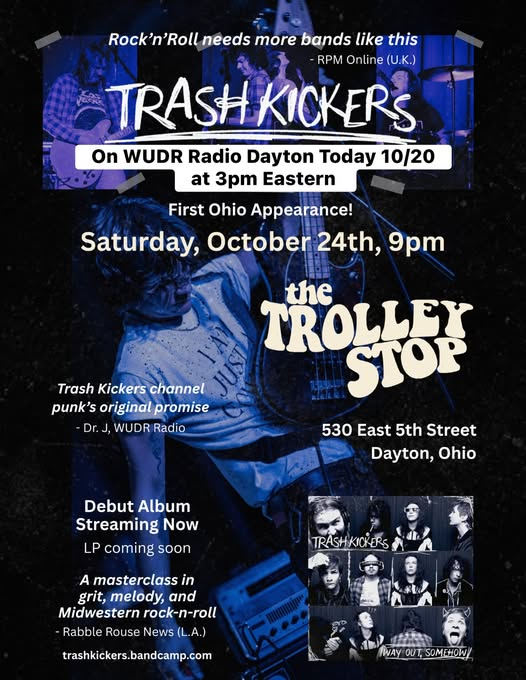
The Trash Kickers play the Trolley Stop Tavern on Saturday, October 24.
For those of us who spend our days and nights championing independent music, this is exactly the kind of show worth showing up for. Here is a band with a record we believe in, a set built around original songs, and the sort of live philosophy that makes a small club feel like the most important room in the world for an hour or two.
I’ve already got “Come Undone,” “Fly or Die,” and other tracks from Way Out Somehow in rotation on Your Tuesday Afternoon Alternative. I may or may not have entered a few of those songs into the station’s computer more often than strictly necessary, in the hope that the machinery of radio programming will do what machinery so rarely does on its own: give a good band a chance.
The Trash Kickers are also looking ahead to a spring run that, at the time of our conversation, included Cincinnati’s Comet Bar on March 11 and Columbus’s Space Bar on March 12, with additional Midwest dates being explored. The band jokingly referred to it as the “Ohio tour,” which is a fine thing for an Ohioan to hear. Perhaps they’ll become an Ohio band. We could do worse.
But before the spring comes, there’s a Saturday night in Dayton to consider. The Trolley Stop is the kind of place where a band can get close enough to an audience to find out what the songs really do. There are no arena-sized screens to distract you, no elaborate stage production to conceal the musicians, no distance between the people making the noise and the people receiving it.
There’s just the room, the band, and whatever happens when the first chord hits. That is where rock and roll still makes its best argument.
A Way Out Somehow
There is a tendency to talk about rock and roll as though it were a finished historical event, something that happened in the past and now survives as a set of reference points, vintage T-shirts, and reunion tours. We talk about the Stones, the Replacements, Big Star, and Thin Lizzy as if their greatest contribution were to provide a catalog of sounds for later generations to imitate.
But rock and roll isn’t a museum. It’s a living argument about what music can do when people take it seriously without taking themselves too seriously.
The Trash Kickers are part of that argument. They have the records, the influences, the riffs, and the hooks. They also have something harder to manufacture: the willingness to let the music change, the trust to let four people make decisions together, and the determination to keep playing whether twenty people show up or two hundred.
They began with a songwriter who wanted to preserve a decade’s worth of songs. They ended up with a band, a debut album, a release-day scramble involving digital distributors and an alleged Green Day resemblance, and a growing itinerary of clubs beyond Chicago.
Along the way, they learned that the songs became better when they stopped treating them as untouchable objects. They learned to trust the people standing beside them. They learned that a record could take years to arrive and still be worth the wait. And they learned that sometimes the best way to make a song memorable is to put a wrench in it.
Maybe that’s what Way Out Somehow is really about. Not escaping something in the grand, cinematic sense, but finding a way forward through the ordinary complications of life: the jobs, the schedules, the unfinished songs, the doubts, the long nights, the itchy blankets, the records you love and the records you hope to make.
You keep going. You keep playing. You trust your friends. You don’t fill the album with songs you don’t believe in. You don’t wait for a crowd of two hundred before you give everything you’ve got.
And when the moment comes, you turn up the amplifiers and get on with it. The Trash Kickers have a wonderfully uncomplicated motto for all of this: “Nothing but bangers.” Fine by me.
I’ll see you at the Trolley Stop Tavern on Saturday, October 24. Bring your friends. Bring your ears. Bring the kind of enthusiasm that makes a band want to play harder. And if you happen to find yourself standing near the front, losing your mind while the guitars roar and the drums come crashing down, don’t worry about looking cool. The band isn’t. That’s the whole point.
Trash Kickers — Way Out Somehow. Chicago rock and roll, made by four friends who trust one another, refuse to settle for filler, and would rather have a good time than stand still.