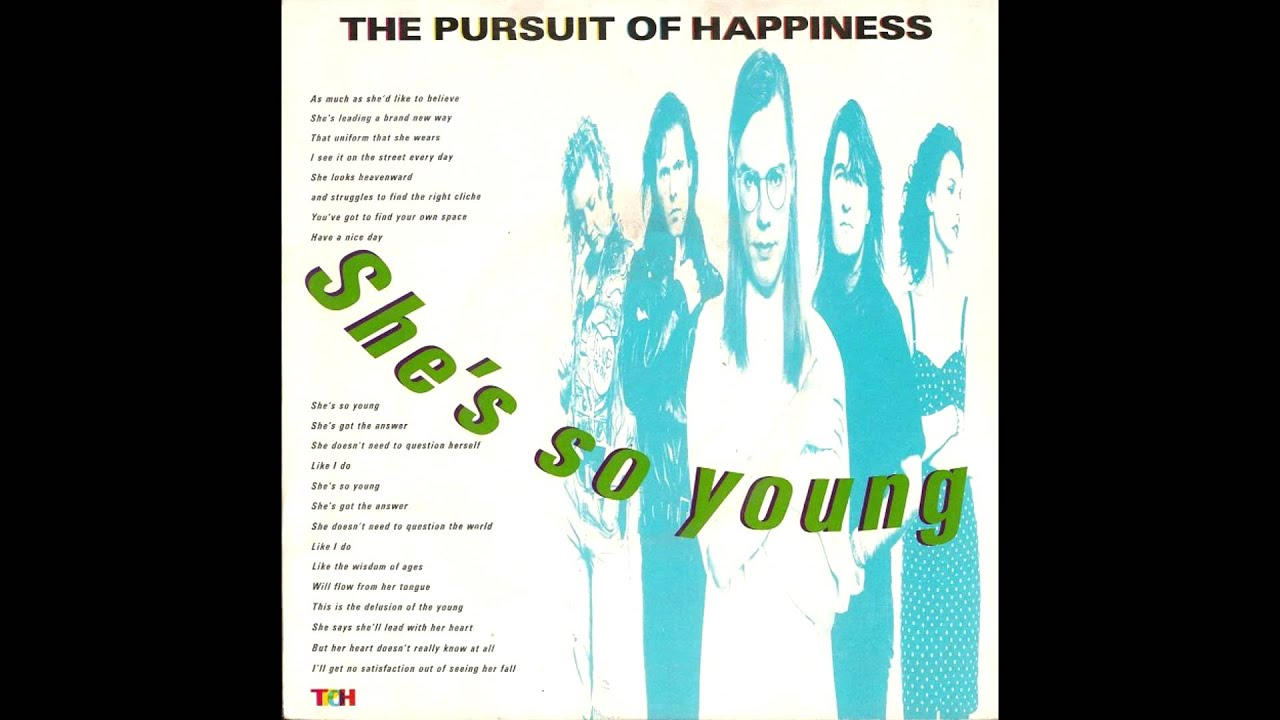
Video of The Day: The Pursuit of Happiness – She’s So Young

In the era of 90s alternative rock, The Pursuit of Happiness emerged as a jangly powerpop force, weaving tales of love, longing, and the tumultuous journey through a conflicted maze of human emotions. Among their repertoire of hits, “She’s So Young” stands as a beautiful jangly gem, capturing the essence of youthful passion and the bittersweet symphony of burgeoning adulthood versus the slow realization of growing older.

Released as a single in the same year as their debut album in 1989 as part of their Todd Rundgren-produced debut album “Love Junk.” The song from the Edmonton, Alberta band should have earned them much more critical acclaim and a much larger fan base across the world. Several decades later, this stunning melodic arrangement should have become an even more celebrated piece of music. Although the album was certified platinum in Canada, the band did not have similar success in the United States. Penned by band leader and lead singer Moe Berg in 1985, “She’s So Young” delves into the complexities of infatuation, desire, jealousy over the illusion of having everything figured out, and the rollercoaster of emotions that accompany the discovery of love in its most youthful, unadulterated form.

The track opens with an immediate vocal and jangly guitar riff that sets the stage for a sonic journey into the heart of lust, anxiety, and angst. Berg’s vocals, tinged with a perfect blend of vulnerability and raw passion, draw listeners into the narrative. As the lyrics unfold, a story of confused and unrequited love takes shape, encapsulating the universal experience of yearning for the unattainable and possibly unattainable for good reason.

Berg’s lyrical prowess shines through in lines like “Like the wisdom of ages, Will flow from her tongue, This is the delusion of the young, She says she’ll lead with her heart, But her heart really doesn’t know at all, I’ll get no satisfaction out of seeing her fall.” Here, he masterfully captures the paradox of youth—a time when the intensity of emotions often outweighs the depth of understanding. The song becomes a vessel for exploring the inherent contradictions of adolescence, where the naivety of youth coexists with the profoundness of burgeoning desires.

(Image credit: Jim Steinfeldt/Michael Ochs Archives/Getty Images)

The melodic cadence of “She’s So Young” mirrors the unpredictability of young love, seamlessly shifting between moments of exuberance and introspection. The instrumentation, marked by catchy hooks and a rhythm section that propels the narrative forward, mirrors the emotional turbulence of the song’s protagonist. It’s a musical engine where the energy of youth converges with the introspection of maturity, creating a sonic space that resonates across generations.

The chorus, a resounding declaration of unrequited love, encapsulates the universal theme of yearning that underpins the track. In fact, the original version of the song began with the chorus instead of the first verse. When re-recording the song for “Love Junk,” the band changed the order to build more tension in the song. Yet, the infectious chorus is power pop bliss: “She’s so young, She’s got the answers, She doesn’t need to question herself like I do” becomes a rallying cry for anyone who has experienced the all-consuming nature of a crush—an emotion that transcends time and space as it moves beyond rational understanding.

Beyond its musical allure, “She’s So Young” invites listeners to reflect on the transient nature of youth and the fleeting beauty of innocence. The song becomes a vessel for nostalgia, a sonic time capsule that transports the audience back to the moments of their own youthful infatuations. In this sense, The Pursuit of Happiness achieves a rare feat—capturing a specific moment in time while crafting a narrative that remains universally relatable.

While the song’s thematic elements resonate on a personal level, it also taps into the broader cultural landscape of the late 80s and early 90s. The alternative rock scene was undergoing a transformative phase, with bands like The Pursuit of Happiness contributing to the evolution of the genre. “She’s So Young” exemplifies the era’s preoccupation with introspective lyrics and a departure from the bombast of ’80s glam rock.

Decades after its release, “She’s So Young” endures as a song of authentic storytelling and infectious melodies. Its influence reverberates. “She’s So Young” stands as a compelling song that celebrates the complexities of human emotion, a reminder that the pursuit of happiness often involves navigating the labyrinth of love, loss, and the eternal quest for connection. This song remains a shining gem and a clear eyes wide-open statement of a collective memory of those who have embarked on the tumultuous yet beautiful journey of growing up.

Unveiling the Artistry of the Cover: A Deep Dive into the Enduring Allure of Cover Songs

In music, few phenomena encapsulate the intersection of homage, innovation, and reinterpretation as effectively as cover songs. These musical tributes, where an artist reinvents and reinterprets an existing piece of work, have been an integral part of the musical landscape for decades. Right now I am embarking on a journey through the annals of cover songs reading Ray Padgett’s “Cover Me: The Stories Behind The Greatest Cover Songs of All Time,” it becomes evident that these renditions are not mere replicas but windows into the soul of the artist, revealing layers of influence, creativity, and the timeless allure of the songs that resonate across generations. Sure, not every cover song works but when they do, its magic.

The roots of cover songs are deeply entwined with the evolution of popular music. In the early days of the industry, covers were often straightforward reproductions of popular tunes, serving as a means for artists to capitalize on the success of others. Pat Boone’s early career demonstrates this most clearly. However, as music evolved, so did the approach to cover songs. We have championed the idea that a cover song, when approached with artistic intent, has the potential to transcend its origins and become a unique piece of art in its own right; and to that end, we regularly share songs on Your Tuesday Afternoon Alternative with the tongue-in-cheek label #YourCovered.

One of the defining characteristics of a memorable cover is the ability of the artist to infuse the song with their own distinct style and personality. This is where the magic of reinterpretation comes into play. Trouser Press, with its keen eye for artistic innovation, has always celebrated cover songs that go beyond mere imitation, offering a fresh perspective that breathes new life into familiar melodies.

Consider Johnny Cash’s iconic cover of Nine Inch Nails’ “Hurt.” Don’t we all appreciate the pure and devastating raw emotion and vulnerability that Cash injected into the song, transforming it into a haunting meditation on his own mortality near the end of his days. The juxtaposition of Cash’s weathered voice against the industrial soundscape of the original creates a poignant contrast, turning the cover into a soul-stirring reflection on the passage of time and the weight of a life well-lived while still yearning to accomplish more before you leave. Most recently, Hello June’s cover of “Take Me Home Country Roads” — like Cash with “Hurt,” strip the song to its essence so that we can pause, if only for a few moments, and drink in the unadulterated emotion of the song.

We at YTAA commend artists who take bold creative risks with cover songs, pushing the boundaries of genre and style. Take, for instance, Jeff Buckley’s ethereal rendition of Leonard Cohen’s “Hallelujah.” We should laud Buckley’s decision to strip down the song to its honest bare essentials, allowing his haunting vocals and sparse instrumentation to convey a sense of intimacy and vulnerability. In this case, the cover transcends the original, becoming an iconic piece that stands as a testament to Buckley’s artistic prowess.

We also recognize the power of cover songs as a means of introducing audiences to different genres and eras of music. When a contemporary artist takes on a classic from a bygone era, it serves as a bridge between generations, fostering a deeper appreciation for the rich tapestry of musical history. Celebrated artists can pay homage to their influences while introducing these timeless tunes to new audiences. I immediately think of Uncle Tupelo’s version of “Sin City.”

Uncle Tupelo’s cover of “Sin City” by The Flying Burrito Brothers is a testament to the band’s ability to bridge the gap between generations and genres, infusing a classic country-rock tune with their distinct alt-country sensibilities. Released as part of the “I Got Drunk” single released in 1990, Uncle Tupelo’s interpretation of “Sin City” pays homage to the roots of country music while adding a layer of grit and authenticity that defines their unique sound.

At the core of Uncle Tupelo’s cover is an evident reverence for The Flying Burrito Brothers’ original version. “Sin City” was a defining track on The Flying Burrito Brothers’ seminal 1969 album “The Gilded Palace of Sin,” co-written by Gram Parsons and Chris Hillman. The song, with its poignant lyrics and twangy guitar riffs, became an emblematic piece of the country-rock movement of the late ’60s and early ’70s.

Uncle Tupelo, known for their role in shaping the alternative country (alt-country) genre, took on the challenge of reinterpreting this classic with a keen understanding of its historical significance. The result is a cover that pays homage to the roots of country music while injecting it with the raw energy and authenticity that characterized Uncle Tupelo’s approach to their craft.

The cover opens with a stripped-down arrangement, featuring acoustic guitars that echo the simplicity of the original. However, Uncle Tupelo adds their own signature touch by incorporating a raw, unpolished quality to the recording. The vocals, delivered with a sense of earnestness by Jay Farrar and Jeff Tweedy, convey a genuine connection to the song’s themes of disillusionment and the pitfalls of city life.

What distinguishes Uncle Tupelo’s version is the infusion of alt-country elements, seamlessly blending the traditional with the contemporary. The band’s choice to incorporate elements of rock, punk, and folk into the cover reflects their commitment to pushing the boundaries of the country genre. The twangy guitars are accompanied by a slightly distorted edge, providing a sonic element that captures the spirit of both eras—the original release and Uncle Tupelo’s early ’90s alternative country movement.

In true Uncle Tupelo fashion, the cover of “Sin City” is not merely a replication but an evolution. The band’s interpretation of the lyrics, sung with a sense of urgency, brings a renewed relevance to the timeless themes of the song. Uncle Tupelo’s cover serves as a bridge between the past and the present, showcasing the enduring power of well-crafted songs to resonate across generations. Uncle Tupelo’s cover of “Sin City” is a masterful tribute that highlights their ability to honor musical heritage while imprinting it with their own unique sonic identity. By infusing a classic Flying Burrito Brothers track with the raw energy and authenticity of alt-country, Uncle Tupelo pays homage to the roots of country music while paving the way for the evolution of the genre.

Another exemplary case is Amy Winehouse’s rendition of the jazz standard “Valerie,” originally by The Zutons (from their excellent 2006 album Tired of Hanging Around). I would commend Winehouse for infusing the song with her signature blend of soul and jazz, breathing new life into a classic and introducing it to a generation unfamiliar with its origins. In this way, cover songs become a form of musical education, connecting the dots between the past and the present.

Music critics would be quick to point out that not all cover songs are created equal. The success of a cover lies not only in the artist’s ability to reinterpret the material but also in their sincerity and authenticity. While YTAA champions artists who approach cover songs with genuine respect for the source material, eschewing mere mimicry in favor of a creative dialogue with the original work.

For instance, when The White Stripes tackled Dolly Parton’s “Jolene,” Jack White’s decision to bring a raw, bluesy edge to the classic country tune has been questioned by some. Is that sincerity in White’s delivery or simply his delivering the song in an almost sarcastic frame. We need to recognize that the most intriguing cover is not an attempt to overshadow the original but rather create a heartfelt homage that pays tribute to the timeless appeal of Parton’s songwriting.

In exploring the world of cover songs, the instances where artists use covers as a canvas for their own experimentation and subversion can be thrilling. Artists who challenge conventions and push the boundaries of genre, and cover songs offer a unique platform for such creative exploration. Consider Devo’s deconstruction of The Rolling Stones’ “Satisfaction.” We should revel in the avant-garde approach that Devo took, turning the iconic rock anthem into a quirky, electronic experiment. This kind of cover embodies the ethos of celebrating artists who fearlessly venture into uncharted territory, reshaping familiar tunes into something entirely unexpected in a way that is real from the perspective of the artist.

Cover songs can also carry socio-political significance. In times of social change, artists often turn to covers as a means of expressing solidarity, protest, or reflection. Cover songs that serve as a commentary on the zeitgeist, amplifying the voices of those who seek to inspire change through music can also be a powerful approach.

An exemplary case is Tracy Chapman’s rendition of Ben E. King’s “Stand By Me” during the “Freedom Now” concert in 1988. I want to highlight the powerful symbolism in Chapman’s choice of cover, turning a classic love song into a poignant anthem for justice and equality. In this instance, the cover becomes a vehicle for social commentary, aligning with a tradition of celebrating artists who use their platform to address pressing issues.

As we delve into the expansive realm of cover songs, it becomes evident that a commitment to artistic integrity and innovation would recognize the myriad ways in which artists breathe new life into existing material. From soul-stirring reinterpretations that tug at the heartstrings to avant-garde experiments that defy genre conventions, cover songs offer a canvas for artistic expression that resonates with Trouser Press’s dedication to celebrating the ever-evolving landscape of music.

Perhaps the allure of cover songs lies in their ability to transcend the boundaries of time, genre, and generation. Whether it’s a contemporary artist paying homage to their musical roots or a groundbreaking reimagining that challenges preconceived notions, cover songs continue to captivate audiences and serve as a testament to the enduring power of musical reinterpretation. We need to turn a discerning eye toward the nuances of artistic expression and recognize cover songs as a dynamic and integral part of the ever-evolving narrative of popular music.

Video of The Day: Fairytale of New York – The Pogues (featuring Kirsty MacColl)

As the holiday season wraps the world in its embrace, certain songs emerge as timeless classics that capture the essence of the Christmas season. One such masterpiece is “Fairytale of New York” by The Pogues, a ballad that has become synonymous with the festive spirit. Released in 1987, this iconic track has not only stood the test of time but has also woven itself into the fabric of holiday and seasonal celebrations around the globe. As we celebrate the music and spirit of Shane MacGowan, now seems a perfect time to revisit this evocative song.

At its core, “Fairytale of New York” is a love story set against the backdrop of a dark, gritty, and realistic Christmas in New York City. The Pogues, known for their fusion of traditional Irish folk and punk rock, bring a unique energy to the song, infusing it with equal parts melancholy and exuberance. The haunting accordion and tin whistle melodies, along with Shane MacGowan’s distinctive gravelly vocals, set the tone for a narrative that is as raw and painful as it is heartwarming and full of optimism.

Shane MacGowan’s voice has a distinctive tone, characterized by its raw authenticity and unconventional beauty. What sets MacGowan apart is not just his vocal range or technical prowess, but the sheer emotive power, a sense of brokenness embedded in his delivery. His gravelly, almost weathered voice possesses a rare ability to convey a myriad of emotions, from gritty defiance to heartfelt vulnerability. MacGowan’s vocal style is deeply rooted in his Irish heritage, channeling a feeling of being vulnerable, powerful, and carefree all at the same time. It carries the weight of experience and authenticity, echoing the struggles and joys of life.

It’s in the imperfections of his voice that MacGowan finds his uniqueness. The rough edges and unpolished quality lend a genuine and unfiltered quality to his singing. Whether he’s belting out energetic punk anthems or delivering poignant ballads, there’s an undeniable sincerity in every note.

MacGowan’s voice is inseparable from his lyrical strength. His storytelling prowess comes alive directly through his vocal delivery, turning each song into a vivid narrative. It sounds like each word is spit out from a hole deep inside himself. The words matter especially because of how much he feels them. The combination of his distinct vocal timbre and poetic lyricism creates a musical experience that is both timeless and unmistakably his own. Shane MacGowan’s voice is a testament to the notion that true artistry often lies in the embracing of individuality and authenticity rather than perfection.

The song’s opening lines immediately transport listeners to a cold, harsh Christmas Eve in the ‘Big Apple,’ with MacGowan’s vivid storytelling painting a picture of a city that is frustrating, enchanting, drenched in drink, and unforgiving. Kirsty MacColl’s response to MacGowan’s verses adds sonic depth and emotion, creating a duet that feels authentic and emotionally charged. Her tone cast again MacGowan’s almost growl fuse the vocals with sweet and unsavory in the same moment. The characters in the song, who appear to have seen better days together in the past, convey an unrelinquished sense of resilience and hope despite their struggles. One wonders if they continued to be together after the song ends. The narrative of the song creates a feeling that they should go their separate ways while knowing that deep in their hearts they will always care for one another.

What sets “Fairytale of New York” apart is its ability to encapsulate the bittersweet nature of the holiday season. It acknowledges the hardships and challenges that many face during this time while simultaneously celebrating the enduring power of love and the warmth that comes with it. The lyrics capture a spectrum of emotions, from nostalgia and regret to optimism and love, making it a song that resonates with a wide audience.

Musically, the arrangement is rich and dynamic, incorporating elements of folk, punk, and traditional Irish music. The orchestration, featuring instruments like the accordion and whistle, gives the song a distinctive Celtic flavor, infusing it with a sense of cultural authenticity. The orchestral crescendo in the instrumental break further elevates the emotional intensity of the song, making it a powerful listening experience.

Despite its sometimes somber tone, “Fairytale of New York” is undeniably a festive anthem. Its staying power can be attributed to its ability to capture the complexities of the holiday season and failed (or is that failing?) relationships making it a song that transcends time and resonates with listeners. As we celebrate the music of Shane MacGowan and the enduring legacy of “Fairytale of New York,” it remains a compelling statement to The Pogues’ artistry and their ability to craft a Christmas classic that is both timeless and unforgettable.

Shane MacGowan: A Poet of the Streets, a Balladeer of Rebellion

In musical history, certain figures stand out as rebels, challenging conventions and giving voice to the unspoken sentiments of their generation. Shane MacGowan, the enigmatic frontman of The Pogues, was undeniably one such luminary. With his gravelly voice, poetic lyricism, and unapologetic embrace of Irish roots, MacGowan became a defining force in the world of punk and folk fusion. As we celebrate the indomitable spirit of his artistic legacy, it’s essential to delve into the essence of the man who breathed life into timeless anthems of rebellion and romance with a bemused wry smile.

Shane Patrick Lysaght MacGowan was born on December 25, 1957, in Pembury, Kent, to Irish parents. Raised in Tipperary, Ireland, he absorbed the rich tapestry of Irish culture, folklore, and music from an early age. This upbringing would later weave its way into the fabric of The Pogues’ music, shaping the band’s distinctive sound and catapulting them to the forefront of the folk-punk movement in the late ’70s and 1980s.

The Pogues emerged in the early 1980s, a tumultuous period where punk’s raw energy collided with traditional Irish folk, giving birth to a genre-bending sonic landscape. MacGowan, with his unruly hair, torn clothing, and a perpetual cigarette dangling from his lips, embodied the rebellious spirit of the times. His persona was a paradox — a punk poet who found solace in the echoes of Ireland’s past while navigating the gritty reality of London’s streets.

At the heart of MacGowan’s brilliance lay his songwriting. His lyrics were a patchwork of vivid narratives, drawing inspiration from the struggles of the working class, the beauty of love, and the tumultuous history of Ireland. “Fairytale of New York,” arguably The Pogues’ magnum opus, encapsulates this duality. Released in 1987 and included on the excellent “If I Should Fall from Grace with God,” the song is a bittersweet tale of love, dreams, and disappointment, set against a backdrop of an Irish immigrant’s Christmas in New York City. MacGowan’s poignant lyrics, combined with Kirsty MacColl’s haunting vocals, created an enduring masterpiece that transcended genres and resonated across generations. The song is just as powerful today as it was when it was first shared with the world.

MacGowan’s ability to infuse punk’s rawness with traditional Irish folk melodies was a testament to his musical prowess. The Pogues’ sound was a collision of tin whistle, accordion, and mandolin, melding seamlessly with electric guitars and drums. This fusion created an anthemic quality that resonated with audiences far beyond the punk and folk scenes. The band’s discography, including albums like “Rum, Sodomy & the Lash” and “If I Should Fall from Grace with God,” became a sonic pilgrimage for those seeking a rebellious yet nostalgic journey through the Irish soul.

Beyond the music, Shane MacGowan’s stage presence was a spectacle itself. Often appearing disheveled and seemingly unbothered by conventional norms, he commanded attention with an almost hypnotic charisma. His performances were raw, unfiltered, and charged with an energy that mirrored the rebellious heartbeat of punk. Whether he was stumbling across the stage or bellowing lyrics with raw intensity, MacGowan’s presence was a visceral experience that left an indelible mark on anyone fortunate enough to witness it.

However, behind the chaotic exterior and raucous performances, Shane MacGowan grappled with personal demons. Substance abuse, particularly his well-documented struggles with alcohol, became a defining aspect of his narrative. It was a tumultuous dance with self-destruction that added an element of tragedy to his story. Yet, even in the midst of personal battles, MacGowan’s commitment to his craft remained unwavering. His resilience, coupled with an unyielding passion for storytelling through music, showcased the depth of his artistic dedication.

As the years passed, MacGowan’s physical appearance became a visual testament to the toll his lifestyle had taken. The once-youthful firebrand now sported weathered features, a visible testament to the battles fought both on and off the stage. Despite the toll of time and excess, his voice retained its distinctive rasp, a testament to the enduring power of his artistry.

The Pogues disbanded in 1996, marking the end of an era. While the band members pursued individual projects, MacGowan continued to make music and collaborate with various artists. His solo work, including the critically acclaimed “The Snake” album, showcased a more introspective and nuanced side of his songwriting. Even in the absence of The Pogues’ collective energy, MacGowan’s solo endeavors demonstrated his ability to evolve while staying true to his roots.

Shane MacGowan’s impact extends beyond the realm of music. His influence reverberates through the works of countless artists who found inspiration in the collision of punk’s defiance and folk’s storytelling. The Pogues’ legacy, anchored in MacGowan’s vision endures as a testament to the enduring power of musical rebellion and cultural fusion.

In the wake of his passing, the world mourns not just a musician but a poet, a storyteller, and a provocateur. Shane MacGowan’s journey was one of highs and lows, a tumultuous ride through the corridors of creativity and chaos. His legacy, however, is etched into the very fabric of musical history, an indomitable force that continues to inspire those who seek the unbridled spirit of rebellion and the timeless beauty of poetic expression.

Swaying in the Radio Waves

In a dimly lit space of my basement home studio, surrounded by an array of vinyl records, cassette tapes along a small wall, stacks of vintage vinyl 45s, piles of CDs, and an eclectic mix of posters from local and underground shows, I sit hunched over a laptop, ready to embark on music discovery. With a cat on my lap and another nearby, I listen to new songs, local music, and pieces of someone’s heart that they have kindly shared with Your Tuesday Afternoon Alternative. This is my sanctuary, the cockpit from which I navigate a vast sea of independent music. As an indie music radio DJ, I’ve made it my mission to curate and broadcast tunes that I believe in, music that resonates beyond the mainstream. There is no shame in loving the music that speaks to you, mainstream or not. But I want to find something new, something unique. Perhaps it is an overwhelming sense of fear of missing out on something incredible, something wonderful that was released and far too few have heard it. Providing a conduit for the amazing music that has gone overlooked has kept me interested in radio for over 19 years at WUDR and for many years prior.

My love affair with indie music began in the smoky corners of obscure spaces, crowded clubs, and hidden venues in Minneapolis in the 1980s. And that interest was heightened in 1983 when I joined KUMM Student Radio at the University of Minnesota at Morris. I had chosen a college a few hours away from home, Herman, Minnesota population 550. My graduation class only had 25 students in it. I was not sure what I wanted to become when I went to college, but I knew one thing quite clearly — I wanted to leave the confines of small-town Minnesota life. The albums that my classmates loved were not my music, they did not feel real and authentic to me. The music that I heard on the few radio stations — mostly country music — did not speak to me nearly as much as the obscure bands and music that I found on late-night TV shows or magazines like The Trouser Press, Cream, and Crawdaddy.

I had a few musically progressive friends and a cousin who was like a brother to me who broadened my music experience. I was exposed to so many unique bands and records by cool friends who introduced me to bands like The Ramones, Big Star, Alice Cooper, R.E.M., early KISS records, The Replacements, The Suburbs, Loud Fast Rules (who later changed their name to Soul Asylum), and Prince. I am still prepared to argue that his first three records were and are brilliant records that fused soul, funk, R&B, pop, and punk. While I enjoyed the British New Wave of Gary Numan and the Romance Wave of Roxy Music, it was Duran Duran who led me to Joy Division, Adam and The Ants, Spandau Ballet, and The Cure. From ‘Planet Earth’ and ‘Girls on Film,’ I found ‘Love Will Tear Us Apart,’ ‘Transmission,’ ‘Ant Music,’ ‘True’ and ‘Boys Don’t Cry’ — I then spent years over Robert Smith’s catalog. I was captivated one late night when David Bowie’s music video for Ashes to Ashes played on some obscure program. It was life-changing and led me to seek out music from Ziggy Stardust in all of his personas and identities.

While others were getting lost in the polished melodies of chart-toppers, I found solace in the raw, unfiltered sounds of independent artists. It wasn’t just about the music; it was about the stories told through the lyrics, the rebellion against conformity, and the genuine passion that fueled every chord, every snap of the drum, every note that was delivered with passion. These sounds and bands were authentic and real to me. I read a story in a music magazine — Melody Maker, New Music Express, Smash Hits… to be completely honest I do not remember — about a band named after a plane, U2, and that eventually led me to their first album ‘Boy’ and that again, led me to be changed. Now, to be fair I was listening to a seriously concerning amount of Pink Floyd, Nick Drake, Television, and Patti Smith. The gateway of The Ramones led to The Sex Pistols, The Clash, Blondie (especially those early records), and more. While I did enjoy some truly strange fascination for some rock and pop groups, I had records and the usual posters on my bedroom walls of Scandal, Rick Springfield, Journey, Styx, Hall & Oates, and a brief fling with The Eagles’ Hotel California and Long Run (that led me to The Flying Burrito Brothers and Graham Parsons — thanks for sharing your records, mom!).

When I got to college, I decided to take this passion to the airwaves, embracing the role of a sonic designer. Armed with a microphone and a collection of gems that I could not wait to share, I set out to carve a niche for myself in the crowded world of radio, one that would champion the unheard and challenge the established norms. It helped tremendously that bands like R.E.M., U2, Ministry, Depeche Mode, Red Rockers, The Cure, and far more than I have the time (or you dear reader – the interest in reading) to recount here were releasing amazing records in the 1980s. The time period of 1983 to 1988 was not only my college years but an amazingly fertile time for what became known as College Rock then was labeled as Alternative or Post-Punk.

It has not always been easy trying to build bridges with the unknown for me. Being an indie music DJ is more than just spinning records or pushing play or fading sounds in and out; it’s about building bridges between artists and listeners. In a world saturated with predictable playlists, my goal is to be a conduit for the undiscovered. I sift through submissions from garage bands in Brooklyn to folk troubadours in the Pacific Northwest, searching for that spark of authenticity that sets them apart. We have a policy at YTAA, anything shared with us gets a listen. And in those perfect moments when we want to hear a song again, that captures our attention when there are so many records to preview, there is magic in the sound waves.

It’s not always about polished production or catchy hooks; it’s about the genuine emotion that reverberates through the music. Each song is a unique brushstroke on the canvas of the YTAA show, painting a sonic landscape that moves beyond the conventional. The thrill of introducing listeners to a hidden beauty, the adrenaline of playing a track that might just become someone’s favorite song – that’s the heartbeat of our radio station. I cannot express how much joy is experienced when someone requests a song we have played or calls the station to ask who was that amazing musician or band that they heard.

In the sprawling landscape of commercial radio, where playlists are often dictated by corporate interests or worse an inhumane algorithm, maintaining independence is a dance on a tightrope. Yet, this dance is the very essence of the existence of Your Tuesday Afternoon Alternative and my role as a DJ. There’s a certain liberation in knowing that a YTAA playlist is not dictated by market trends or corporate interests. Sometimes it is an accident of happenstance or from a connection on social media. Whatever the reason, it’s a rebellion against the formulaic, an assertion that there’s value in the unconventional, the unknown, the liminal. I would like to believe that we have built a community of listeners who crave the unexplored, and who trust this program to guide them through sonic places and spaces of undiscovered music.

Behind every track played lies a story – the struggle of an indie artist trying to be heard, the triumphs and tribulations of navigating an industry that often favors the polished over the genuine. It’s not just about the music; it’s about the people who create it. It is a privilege to interview artists whose stories are as compelling as their melodies. From the indie folk singer who busked on street corners to fund her first album to the punk rock trio that converted an abandoned warehouse into a recording studio, each narrative adds depth to the sonic tapestry we weave on the airwaves. These stories resonate with our listeners, connecting them to the music in ways that transcend the superficial. These are real experiences told by real people about the authentic music they have made to present some feelings, emotions, and ideas — the search for solidarity and connection through music is important and it should be protected at all costs.

One of the joys of indie radio is the freedom to be unpredictable. While commercial stations follow rigid playlists curated by algorithms, YTAA revels in the spontaneity of crafting a playlist that mirrors the ebb and flow of emotions. From ethereal dream pop to gritty pop-punk anthems, the playlist is a rollercoaster ride that keeps listeners on the edge of their seats wondering what is coming up next. One of the most exciting experiences in music is when we are surprised.

On YTAA we are not afraid to delve into uncharted territories, juxtaposing genres in a way that challenges preconceived notions. A haunting acoustic ballad might be followed by a raucous electronic track, or a looking-back indie classic creating a musical journey that mirrors the unpredictability of life itself. It’s a sonic adventure that invites listeners to step outside their comfort zones and embrace the diversity of the indie music landscape.

As an indie music DJ, my connection with the audience goes beyond the confines of the radio waves. Social media has become a virtual extension of the studio, a platform where listeners can engage in real-time discussions about the music they love. We endeavor to play as many requests that we receive as possible. Sometimes a request can take the show in a different, unplanned direction, and isn’t that an opportunity? The sense of community that has emerged is a testament to the power of indie music to unite diverse souls under a common sonic umbrella. It has been a rare honor to connect with other music fans on Twitter, Instagram, Facebook, and on this page. From virtual album listening parties to live Q&A sessions with artists, the digital realm has allowed us to amplify the sense of camaraderie that defines the indie music scene. It’s not just about broadcasting music; it’s about fostering a community where passion for the unconventional is celebrated.

Navigating the indie wilderness is not without its challenges. Limited resources, the constant struggle for visibility, and the ever-present threat of obscurity are hurdles that indie artists face daily. As a DJ, I’ve witnessed the frustration of talented musicians grappling with a system that often seems designed to favor the established. Yet, it’s precisely these challenges that fuel the fire of the indie spirit. The tenacity of artists who refuse to be silenced, and the resilience of a community that thrives on the fringes – these are the stories that inspire me to keep pushing boundaries and championing the cause of the independent. It is possible that the unknown music can be even more captivating than the known.

As I peer into the future of my journey as an indie music DJ, the horizon is both exciting and uncertain. The music industry is in a state of constant flux, with new platforms and technologies reshaping how people find music. Yet, one thing remains constant – the hunger for authenticity, the craving for sounds that defy the cookie-cutter formulas of mainstream music. I envision a future where indie music continues to be a beacon of diversity and creativity. Whether through virtual concert experiences or immersive audio storytelling, the indie spirit will find new avenues to flourish. My role as a sonic guide will evolve, adapting to the changing currents of technology while staying true to the essence of independent expression. Maybe in some way, I am still the same person who knew that there was exciting and cool music waiting to be discovered, the only question was how to find it. Perhaps now the problem is how to find that music in an oversaturated culture of the moment; the internet is both friend and foe.

In the closing moments of every radio show, as the last notes of an indie anthem fade into the ether, I reflect on the journey that brought me to this point. From the dimly lit venues of my youth to the expansive world of radio waves, it’s been a ride fueled by passion, rebellion, and an unwavering belief in the power of independent music. In the vast sea of sonic possibilities, I continue to navigate the waves, a lone captain on a ship of indie music treasures. As long as there are artists pushing boundaries, as long as there are listeners hungry for the unconventional, the journey will endure. For in the realm of indie music, every note is a declaration of independence, and every DJ is a storyteller weaving tales of sonic rebellion. Now, let’s go listen to some interesting music we have not heard before.

All station photos by Tom Gilliam Photography. Photos used with permission.

Resonance in Sound: 22 Years of Echoes at Artstreet

Normally, I am busy preparing for a radio show on Tuesday afternoons. Busy typing song titles into a computer that feels both like a friend and a reluctant companion. This Tuesday however, I am not doing any of that prep work because the radio station is preparing to move to its new home.

In the heart of the University of Dayton campus, nestled among the hustle and bustle, there exists a sanctuary that transcends the usual boundaries and divisions that we make for ourselves every day. For 22 years, a humble student-run radio station has occupied the same space, etching its mark on the airwaves and the souls of those who have tuned in whether they be students at the University of Dayton or community members looking for something captivating on the airwaves. In 2001, WUDR moved from cramped quarters in Kennedy Union to the then newly opened Artstreet complex creating a harmonious resonance that defies the transience of our ever-evolving world. The Artstreet experiment was untested on campus. It was a living, learning, creative space that playfully yet intentionally used architecture, design, and flexible classroom spaces to encourage applied creativity. WUDR Flyer Radio and Street Sounds Recording Studio shared the end of one of the buildings next to an open amphitheater for outdoor events. Before the radio station added online broadcasting, this came a few years later, the station provided a space for those with a passion for radio broadcasting, indie music enthusiasts, and students applying what they were learning in classes to come together toward a common goal of making radio shows.

While I was not a student for quite some time, I have long explored the role of a radio DJ. After receiving a positive tenure decision from the University of Dayton, I balanced my teaching, writing, and administrative obligations with a hunger to do radio again. For 19 years I tried to passionately advocate for local music balanced with an interest in new music and the development and evolution of indie and alternative music. For almost two decades that interest has animated Your Tuesday Afternoon Alternative. I wrote a personal essay about my sense of doing radio in September.

As I prepare to leave the studio that I have called my second office for 19 years, a wave of nostalgia washes over me. The worn-out carpet beneath my feet bears witness to the countless footsteps of other DJs — student and faculty — that have trodden this path before, each imprint telling a story of passion, dedication, and an unwavering commitment to the art of sound at WUDR. The walls, once adorned with posters of Dayton bands, amazing local shows, a few legendary musicians, and faded memories, seem to whisper tales of late-night broadcasts, whispered confessions, and the transformative power of music.

In an era where change is the only constant, the endurance of this student-run radio station becomes an anthem of constancy, a lighthouse guiding lost ships through the stormy seas of life. The comforting hum of the equipment, the familiar creaks in the chairs, the colors of the ENCO systems alongside the soft glow of the control panel all bear witness to the enduring spirit of a station that has weathered the storms of technological upheaval and the fickle tastes of an ever-evolving audience. The dim light and just barely audible hum of a computer to my right that sends the radio signal to the web is a constant companion.

It’s not just a radio station; it’s a time capsule, preserving the essence of an era long past while evolving with the pulse of the present. The student DJs who have graced this sacred space have become custodians of emotions, weaving the soundtrack of our lives through the carefully selected notes and melodies that have graced the airwaves for over two decades in this space (and over fifty years in total).

The connection between the station and its listeners is not merely a broadcast; it’s an intimate conversation that transcends the limits of physical space. You cannot see the people who are listening. The voices that have resonated through these speakers have been companions during late-night drives, all night cramming before a big test, solace during moments of solitude, and the soundtrack to celebrations and heartbreaks alike. The station has become a confidant, a friend, and a silent witness to the ebbs and flows of our collective experience on and off campus.

As the world around us races forward, this radio station through the various slogans and themes over the years — “rock in the gem city,” “music in all directions,” and “support your local music scene” — remains a constant, a testament to the enduring power of music to bind us across time and space. We come together even though we cannot see each other in that moment when a great song plays. It’s a reminder that, in the transient nature of life, some things are built to last. The 22 years encapsulated in these walls are not just a marker of time but a celebration of the resilience of the human spirit to create, connect, and find solace in the embrace of familiar melodies. Songs mean something beyond the notes, chords, voices… as they remind us what we feel.

In a society that often values the shiny and new, this radio station serves as a poignant reminder that there is beauty in the worn and weathered, in the stories etched into every scuff and scratch. It’s a living testament to the belief that, sometimes, the most profound expressions of art and emotion arise not from the pursuit of the novel but from the nurturing of what already exists.

Live, intimate performances in a radio station hold a profound significance in the realm of music and broadcasting. Unlike large concerts in arenas or stadiums, these intimate sessions offer a unique and up-close experience for both the artist, the DJ, and the audience. The confined space of a radio station creates an atmosphere that fosters a sense of connection, an all too quickly fleeting and personal bond allowing the artist’s emotions and musical nuances to be experienced with unparalleled intimacy. And I have been unbelievably fortunate to have so many guests in the studio.

From the audience’s perspective, the intimacy of a radio station performance offers a rare chance to witness their favorite musicians in an unfiltered setting. It forges a more profound bond between the listener and the artist, creating an environment where the nuances of the performance are not lost in the vastness of a large venue. Live, intimate performances on a radio station bring artists and audiences together in a way that transcends the traditional concert experience. They celebrate the essence of music, fostering a connection that resonates on a deeper level, making these performances invaluable in the rich tapestry of musical expression.

From Thrasher Cadillac to Ghost Town Silence’s Tom Gilliam, who joined me for our annual YTAA Indie Holiday program, several artists in Dayton, the region, and national touring acts have shared their music with our listeners. Incredible songwriter and musician Charlie Jackson made his very first radio interview and performance in the WUDR studio space at Artstreet. Remember his name, a songwriter with that much talent and lyrical richness is perfectly made for a large, national audience. There is not enough patience to list all of the musical acts who have shared their time and music with us but let’s try that perseverance just a touch: The New Old Fashioned, Amber Hargett, Oh Condor, Cricketbows, Brainiac, Age Nowhere, Smug Brothers, The 1984 Draft, K.Carter, Kris N., XL427, Team Void, Matt Moran, Librarians With Hickeys, Rossonian, Bottlecap Mountain, Renaissance, Serin Oh, Motel Faces, Avalon Park, Josh Thrasher, Nicholas Johnson, Nate Peters, Me & Mountains, David Payne, Mike Bankhead, Harold Hensley, Neo American Pioneers, Zack Sliver, Nasty Bingo, Khyrs Blank, The Boxcar Suite, Brian Wells, Trees and Wells, Jennifer Taylor, Sharon A. Lane, Scary Hotel, Jetty Bones, Heather Redman, Sadbox, The Nautical Theme, Tod Weidner, Ike B., Max B. Greene, Tim Gebard, Manray, Mandy Jewel, The Typical Johnsons, Ricky Terrell, Kevin Serey, Windsor Knotts, Kyle Byrum, Dave Zup, Bill Wendell, Paul Monin, Seth Canan and The Carriers, Don Thrasher, Dead Licks, Sam King, Far From Eden, Andrew Hunt, The Paint Splats, Emory Road, Achilles Tenderloin, Curse of Cassandra, Rich Reuter, Nick Kizirnis, Kyleen Downes, Goodnight Goodnight, Charles Hartman, Kurt Lee Wheeler (who traveled from Georgia to be on our show that day), Lisa Gain & The Rusty Silos, Mack McKenzie, Steve Shockley of the Original Lakeside, and so many more. Still here? That is far from a complete list because those are just some of the artists who were in the studio. The magic of the phone call-in provided for so many more artists to share their gifts with all of us.

For the artist, performing live on a radio station provides an opportunity to showcase raw talent and authenticity. Stripped of elaborate productions, the focus shifts to the purity of the music and the artist’s ability to connect with the audience on a personal level. It becomes a platform for artists to experiment, improvise, and unveil new dimensions of their creativity.

As I exit the studio, the faint strains of a timeless song linger in the air, I play The New Old Fashioned – Radio Waves. It is fitting. As David Payne sings, I carry with me the echoes of my 19 years in my second office, resonating not only in the frequencies of the music but in the very fabric of my being. This radio station is more than a collection of songs; it’s a living, breathing entity, a guardian of memories, and a symbol of the enduring power of music to transcend the limitations of time and space. It was home.

WUDR will move to its new space in the Roger Glass Center for the Arts over the next several weeks. We will set up shop in an exciting new space that was specifically designed with the station and student media in mind, but we carry with us the incredible music experiences, history, and warm embrace of a building that was the radio station’s home for 22 years. Here’s to many more.

Video of The Day: Real Estate – Water Underground

In a music industry often dominated by bombastic beats and electronic wizardry, Real Estate has carved a niche for itself with their distinctive brand of indie rock, characterized by dreamy melodies and introspective lyricism. With their latest single, “Water Underground,” from the forthcoming album ‘Daniel’ – the band’s sixth record, the New Jersey-based quintet reaffirms their mastery of crafting serene sonic landscapes that invite listeners to wade into the depths of their introspection.

From the first strum of the guitar, “Water Underground” unfurls like a gentle current, drawing the listener into its tranquil embrace. The opening harmonies, signature to Real Estate’s sound, resonate with a timeless quality that harks back to the heyday of jangle-pop. There’s a certain effortlessness in the way the instrumentation converges, creating a shimmering pool of sound that serves as the perfect canvas for the band’s lyrical exploration. The song is a ripple of melodic grace.

Martin Courtney’s vocals, soft and contemplative, guide us through the submerged depths of emotion. The lyrics, much like a quiet current, weave a narrative that touches upon themes of introspection and self-discovery. “Water Underground” is a lyrical exploration into the recesses of the soul, navigating submerged depths of emotion, and exploring the quietude beneath the surface of our daily lives. The words are poetic yet accessible, inviting the listener to reflect on their own internal challenges.

Real Estate has always excelled in creating intricate yet accessible instrumental textures, and “Water Underground” is no exception. The interplay between Julian Lynch’s intricate guitar work, Matt Kallman’s Keyboards, and Alex Bleeker’s melodic basslines is a testament to the band’s collaborative prowess. The drumming, courtesy of Sammi Niss, provides a steady undercurrent that propels the song forward, like a gentle stream flowing through a serene meadow.

The instrumental breaks showcase Real Estate’s ability to balance complexity with simplicity. The guitar solos, while understated, add a layer of richness to the overall composition. It’s in these moments that the band’s chemistry truly shines, creating a sonic tapestry that envelops the listener in a comforting warmth.

The production of “Water Underground” demonstrates the band’s commitment to melodic clarity. The mix is pristine, allowing each instrument to occupy its own space within the musical spectrum. The production choices echo the thematic elements of the song, providing a sense of clarity amidst the complexities of life. It’s as if the band has distilled their sound to its purest essence, inviting the listener to immerse themselves in the crystal-clear waters of Real Estate’s musical vision.

In a world that often feels turbulent and chaotic, Real Estate’s “Water Underground” offers a respite – a tranquil oasis where one can wade into the soothing waters of introspection. The song is a testament to the band’s ability to evolve while staying true to their sonic roots. Real Estate continues to be a beacon in the indie rock scene, guiding listeners through landscapes of sound that are as comforting as they are thought-provoking.

The video for the song is a tribute to the much-loved ’90s Nickelodeon series ‘The Adventures of Pete & Pete,’ with visual references to specific episodes, and the actors who played ‘The Petes’ themselves, Danny Tamberelli and Michael Maronna, frequently appearing in different roles in the video. This visual love letter to a fantastic series that would probably not be made today because of its elliptical and often surreal storylines was brilliantly directed by Edmond Hawkins. The idea for the music video was a team effort, coming from the fertile imaginations of Tamberelli and Maronna, with ‘Pete & Pete’ creators Chris Viscardi and Will McRobb which undoubtedly explains the incredible attention to detail.

“Water Underground” is not just a single; it’s an invitation to explore the depths within ourselves while we relive some of the fun of a past adventurous television show. Real Estate has once again demonstrated their prowess in crafting music that transcends the ephemeral trends of the industry, leaving the listener with a sense of serenity that lingers long after the final notes have faded away. As we navigate the currents of our own lives, “Water Underground” stands as a reminder that, sometimes, it’s in the quiet depths that we find the most profound revelations.

Video of The Day: David Payne – Best Intentions

Once upon a time country music was made with an eye toward capturing authentic experience and real storytelling reigned supreme. David Payne’s latest release, “Best Intentions,” stands as a testament to the genre’s ability to capture the complexities of life. With its poignant yet accessible lyrics, soul-stirring melodies, and raw, unfiltered sound, Payne invites listeners on a profound sonic journey that delves into the depths of human emotion. The music video made to accompany the single deftly captures the feeling of the song.

The song opens with a twangy guitar riff that immediately sets the tone for what’s to come, the guitar lines bounce with a syncopation that reminds the listener of The Buckaroos’ Don Rich. Payne’s vocals, weathered by experience, carry the weight of the narrative, creating a sense of sincerity that resonates with the listener. It’s a classic country setup, but as the lyrics unfold, it becomes evident that “Best Intentions” is not just another run-of-the-mill country song. Instead, it navigates the intricacies of relationships, regrets, and the inevitability of life’s unpredictable twists. Sometimes we all need to step out for just a minute as the song reminds us.

At its core, the song explores the universal theme of good intentions gone awry. Payne’s lyrics paint a vivid picture of a protagonist grappling with the consequences of choices made with the purest of motives. The verses unfold like pages from a personal journal, revealing a depth of self-awareness and vulnerability rarely found in mainstream country music.

The driving rhythm and syncopation are where “Best Intentions” truly shines. A blend of heartfelt sincerity and a touch of melancholy, the refrain captures the essence of the human experience. Payne’s delivery is both soulful and genuine, carrying the weight of the narrative with every note he sings. It’s the kind of song that lingers in the mind, inviting introspection and resonating with those who have faced the complexities of relationships and the bittersweet nature of good intentions. Why do we need time away from those we care about? How does the time get away from us and suddenly — at least to us it seems a surprise — it’s “last call.”

The instrumentation plays a crucial role in shaping the song’s emotional landscape. The twangy guitars and fuzzy bass evoke a sense of nostalgia, paying homage to the traditional country sound, especially Buck Owens and The Buckaroos while infusing a modern edge. The arrangement is masterfully crafted, allowing each instrument to breathe and contribute to the overall sonic palette. Payne’s decision to keep the production stripped down and authentic enhances the song’s emotional impact, creating an intimate connection between the artist and the listener. The video enhances that idea by keeping the visual narrative of Payne in a bar drinking by himself.

It’s worth noting that “Best Intentions” stands out in the country music scene for its refusal to conform to formulaic trends. In an era where many artists prioritize commercial success over artistic integrity, Payne embraces the roots of country music, blending tradition with innovation. The song harkens back to a time when storytelling was at the forefront of the genre, and each note carried the weight of genuine emotion.

One of the most compelling aspects of “Best Intentions” is its ability to transcend the confines of country music and appeal to a broader audience. The themes of love, loss, and redemption are universal, making the song relatable to listeners across genres. Payne’s genuine approach as a storyteller shines through, creating an emotional resonance that extends beyond the boundaries of a single genre. Moreover, the song’s narrative depth opens the door for interpretation, allowing listeners to find their own meaning within the lyrics and the reason that the narrator needs some space to think. Whether reflecting on personal experiences or simply appreciating the artistry of the storytelling, “Best Intentions” invites a level of engagement that goes beyond casual listening.

David Payne’s “Best Intentions” is a standout addition to contemporary country music. Through its authentic storytelling, soul-stirring vocals, driving rhythm, and refusal to conform to industry norms, the song encapsulates the essence of a commitment to celebrating genuine artistic expression. As a sonic journey through the heart of a modern country, “Best Intentions” serves as a reminder of the power of music to connect us all through the shared experiences of the human condition.

Video By Brandon Berry at Broken Tape, LLC. The song was written by M. D. Payne Jr. It was produced, engineered, and mixed by Patrick Himes and David Payne on 2″ analog tape at Reel Love Recording Company in Dayton, Ohio. The song was mastered by Tim Pritchard at Great Horned Audio, Dayton, Ohio. Thanks to Magnaphone Records for releasing this country music gem.

Facebook Twitter Instagram

The players:
David Payne: Vocals, Acoustic Guitar
Patrick Himes: Precision Bass, Percussion
Brian Hoeflich: Drums
Dan Spaugy: Electric Guitar
Matt Spaugy: Tic Tac Bass, Fuzz Bass

11 Questions with… Greg Humphreys

In American music, there are artists whose regional roots run deep, intertwining with the cultural fabric of their home state. Greg Humphreys, the charismatic frontman of Dillon Fence, has spent decades carving out a musical niche that echoes the soulful resonance of North Carolina. His solo endeavors, marked by a fusion of rock, blues, jazz, and Americana, showcase a maturity that comes from a life dedicated to the pursuit of authentic sound.

Humphreys’ musical journey began in the late ’80s with the formation of Dillon Fence, a Chapel Hill-based alternative rock band that became synonymous with the burgeoning music scene in North Carolina. The band’s sound, characterized by jangly guitars, introspective lyrics, and Humphreys’ powerful, soulful emotive vocals, contributed to the distinctive Southern sound emerging from that fertile music community that also gave rise to The Connells, The Veldt, Fetchin’ Bones, Superchunk, Let’s Active and The dBs.

Fast forward to the present, and Humphreys has embarked on a solo career that demonstrates both evolution and continuity. His 2021 release, “Spanish Steps,” stands as a testament to his ability to navigate diverse musical waters while maintaining a distinct Southern sensibility. His most recent single, “Take a Trip (Catch a Plane)” crosses soul, ’70s pop, jazz, and smooth strands of rock and roll. Humphreys’ voice, weathered by years of musical exploration but never beaten down, lends a richness that serves as the perfect vehicle for the emotional weight carried by his lyrics. The song weaves a narrative that touches on love, loss, and the inexorable pull of life’s forces, creating a compelling experience.

Humphreys skillfully blends genres, drawing from the deep well of American musical traditions. He is equally comfortable channeling a rootsy, folk vibe with acoustic guitars or when creating a sonic laid-back atmosphere. He is also just as skillful when letting everything hang out in a full-blown rock song. Humphreys’ ability to seamlessly integrate elements of the South’s musical heritage into a contemporary framework is one reason out of the many characteristics of his songs that make them feel like lifelong friends.

Whether one is listening to Greg’s solo work or his efforts in Dillon Fence and Hobex, the songs he makes allow him to flex his songwriting muscles, delivering introspective lyrics with a raw vulnerability that resonates with listeners. “Take a Trip (Catch a Plane)” stands out as a poignant exploration of the complexities of life and the enduring power of hope, driven by Humphreys’ soulful crooning and the subtle, never forced, instrumentation that accompanies it. Humphreys’ guitar work, a hallmark of his style, shines throughout the tune, demonstrating both technical proficiency and an intuitive understanding of the emotional nuances embedded in his compositions.

In a musical landscape often dominated by trends, the passing ‘sound of the moment’, and fleeting fads, Greg Humphreys stands as a beacon of authenticity, his music is tangibly real… it resonates. Greg’s music not only pays tribute to the distinctive musical heritage of North Carolina but also adds another chapter to Humphreys’ ongoing exploration of sound and emotion. His most recent music invites listeners to journey through the landscapes of the South, guided by a seasoned troubadour whose passion for music burns as passionately and brightly as ever.

Dr. J: What can you share with us about when and how you started writing music?

I started writing songs in high school. My high school garage band “The Trash” decided to start playing our original music… our members would bring songs in to try. My early songs make me wince a bit, but you have to start somewhere. Dillon Fence bass player (and fellow The Trash member) Chris Goode and I will often sing a line or two from these old songs for a few chuckles. 

I have to say, my basic appreciation and understanding of songcraft came from my dad. He was always listening to his favorite songs learning them and playing them on his guitar in his spare time.

I also think that my strong desire/need to create, expressed through art and music, comes from my mom. She’s been a visual artist for as long as I can remember and has had some different, interesting periods to her artistic expression.

Dr. J: What first led to your recording music? How do you approach production? 

I started recording on a boombox, then a couple of boomboxes. I remember re-creating the harmony solos on Boston’s “Peace of Mind” with two boom boxes in High School. 

After a couple years of this, my parents helped me get a Fostex 4 track recorder, which was my constant companion until I started learning ProTools / DAW recording in the late 90s. I have boxes and boxes of songs and music ideas I recorded in the 90s on that 4 track.

Of course, I learned a lot from the professional engineers and producers I worked with early on when making records with Dillon Fence and Hobex: Steve Gronback, John Plymale, Lou Giordano, Ron St. Germain, Mark Williams, David Leonard. I’ve also been lucky to sit in/take part in sessions with pros like John Wood, Joe Boyd, Al Kooper, Bill Symczyk, Chris Stamey, Mitch Easter, Don Dixon, and Jim Dickinson. 

As far as my production approach, I think my main attitude is, that there’s no “correct” way to do things. All that really matters is do you have an end result that is compelling and/or worthy of listening to over and over. If budget was no issue, I’d probably do a more collaborative recording with other musicians/engineers/studios, but I do enjoy making records on my own. 

I try to keep in mind that some of my favorite records were made with some of the most basic recording technology. I believe that what is going on in front of the mic is usually the most important factor in recording most musicians or singers. 

Dr. J: ‘Take a Trip (Catch a Plane)’ is your most recent music, what led to the making of that song? What were the main influences on your recording of this song? 

I talked about it at length in my bio over greghumphreys.net if you’d like to pull from that/peruse that. but essentially it’s a song I wrote for my wife kind of trying to express one of those feelings that’s personal yet universal. Hopefully, the song has the same quality.

Dr. J: The song Take a Trip (Catch a Plane)’ seems to capture a remarkable constellation of musical influences. The song seems to have a 1970s soul feel. Is that a correct interpretation? If that is correct, did you intend to create a song that connects to that style? If that is not correct, how would you describe the feeling of the song?

The rhythm section definitely has a ’70s soul vibe – Marvin Gaye records are always a North Star for me. I played bass guitar on this track, which is also a lot of fun and something I haven’t been doing on my trio records. This track is basically a taste of an approach I’ve been taking. Using drum machine sounds to create grooves. Building songs around a melody, groove, or musical idea using a looper. Then, building the arrangement over time either in live performance or in the studio.

 It’s not really that different from a songwriting approach I’ve used for bands I’ve fronted over the years. It’s just that I am able to create more of a “keeper” version on my own these days.

Dr. J: How did the song Take a Trip (Catch a Plane)’ come together musically for you?

The song really started from being inspired by a moment in a George Shearing “Lullaby of Birdland” recording where the musicians play the melody (Jazz terminology would be “the head”) together. I wanted to use that vibraphone sound, and I wrote a melody that is vaguely reminiscent of the Shearing tune – not as harmonically sophisticated, but still good. After that, I just followed my instincts to complete the song.

Dr. J: Where do you often derive inspiration to make music?

Looking back on my songwriting path, I’d say my main wellspring of music-making has been expressing myself – getting out all those feelings I have difficulty manifesting any other way. The confessional songwriting thing has definitely been a big part of who I am as a writer. That being said, I like switching it up and trying different approaches, and that shows up in my songs as well.

Dr. J: How would you describe the music that you create? How has that process evolved or changed over time (especially as you think about your journey in the last few years)?

I feel like in the back of my mind I’m always trying to create something that is timeless and universal. The quality that a great piece of music or song has – if you take it out of its cultural context, does it still resonate? I think that’s why I enjoy going down the wormhole with music from different eras or time periods and finding songs that grab me.

Dr. J: What is next for you musically? How would you describe your thoughts at this point for your next project or release?

I am close to the finish line on a couple of recording projects. One is a Dillon Fence live album that we recorded in April 2023. I think it captures the energy of the band in a good way and I’m looking forward to sharing it with our fans. I am proud of that catalog of music. 

The second is another solo album in the same fashion as my 2021 album “Spanish Steps,” using a lot of the approaches and techniques I mentioned earlier. “Take a Trip (Catch a Plane)” will be included on this album, as well as some other songs I’ve been writing over the last 3-4 years. I find that these days with my family life taking precedence I’m not nearly as prolific as I used to be. The songs that I do complete tend to be real “keepers” – songs that I keep coming back to over time. 

Dr. J: What is your favorite song to perform live? What is your favorite song to perform in general? What makes that song a current favorite in your performances? 

I think the song that I usually enjoy performing live most is usually my most recent song that I really believe in – the song that fits that category lately is called “Fall into the Sea.” That being said, I’ve gotta give props to a song I co-wrote with my old friend Jim Smith, “Windows,” which was originally on the Hobex LP “Back in the 90s.” I still play that song in almost every show. It just works, it connects, it makes people happy, and that makes me happy. 

Dr. J: What is one message you would hope that listeners find in Take a Trip (Catch a Plane)’?

Hopefully, they’ll find inspiration to renew their love for their significant other. That’s what it’s really about. The ‘Take a trip’ part is just an impetus to do that.

Dr. J: As a musician, how are you adapting to the challenges of creating music? What are your biggest challenges in creating music? 

That’s a big question. Honestly, I don’t really know which way to go. The sheer volume of music produced these days and the torrential nature of media consumption are obviously on my mind, as far as what is ahead. I consider myself lucky I have an (admittedly boutique) audience that still comes to see me play and listen to my music online, but obviously, the Internet disruption is real and it has affected my life. It has always been a rollercoaster ride and a struggle to pursue a creative life, though. 

I think my biggest challenge is managing the balance between my family life and my desire to pursue my art and music. There’s just not enough time in the day to do what I’d like to do. Once I have the time, I’m often too tired to do it! 

We want to extend our sincere gratitude to Greg Humphreys for answering our questions and continuing to make some really excellent music! Click on the links throughout the article to visit his social media or to listen to various songs that were discussed! If any musicians or artists would like to participate in future ’11 Questions with…’ columns, please feel free to email us at drjytaa@gmail.com. All photos and images courtesy of Greg Humphreys.

Facebook Youtube Bandcamp Take a Trip (Catch a Plane) Website Twitter Instagram Soundcloud Linktr.ee

‘I’m In Love With That Song’ – Tail Lights Fade

The allure of a particular song is a multifaceted phenomenon, weaving its magic through a combination of emotional resonance, relatability, and the intricate interplay of melody and lyrics. As subjective as musical taste is, the reasons people fall deeply in love with a specific song are as diverse as the songs themselves. How often do music fans argue about a band’s best song or best album?

At the heart of this enchantment lies the emotional connection. People feel that connection in a direct visceral way. Music, as a universal language, has an unparalleled ability to evoke feelings and memories. A song that we love feels like a part of us. It can feel like a part of our body. A song can transport us to a specific moment in time, rekindling the flames of nostalgia or unlocking emotions long buried, whether they should have stayed there or not. The melody becomes a vessel for sentiments that words alone might struggle to express. Whether it’s the joyous melody that accompanies a carefree summer (consider the body of work of The Beach Boys) or the melancholic strains of a breakup (Taylor Swift, Adele, and far too many singers and bands come to mind), people gravitate towards songs that serve as emotional anchors in their lives.

Relatability plays a crucial role in why we love the songs that we do. A song becomes a personal anthem when its lyrics resonate with the listener’s experiences, beliefs, or aspirations. When an artist articulates something the listener has felt but couldn’t put into words, an instant connection forms. It’s this shared human experience that allows a song to transcend its role as mere entertainment, transforming it into a companion on life’s journey. The lyrics become a mirror reflecting the listener’s own narrative, fostering a sense of understanding and kinship; perhaps the relatable song helps us become better people.

The melody itself, with its power to evoke mood and emotion, is another pivotal factor. A well-crafted melody possesses the ability to bypass the conscious mind, directly influencing the listener’s emotional state. We emote alongside the song. Whether it’s the soaring crescendo of a powerful ballad or the infectious rhythm of an upbeat pop song or that jangle that refuses to let us go, the melody is the sonic fingerprint that distinguishes one song from another. People fall in love with a song because its melody or rhythm is ingrained in their minds, creating a sonic imprint that resonates long after the final note has faded. This is the reason that people hear or hum or feel a song long after it is done.

Songs are also tied to places. The cultural and societal context in which a song emerges contributes to its appeal. Certain songs become anthems for entire generations, encapsulating the spirit of an era. Classic rock songs or pivotal albums wield an oversized influence because of their connection to time and place. The social and political climate during the release of a song can imbue it with additional layers of significance, turning it into a symbol of its time. Did Bruce Springsteen mean for ‘Born in the USA’ to become an anthem that its lyrics would dispute? As a result, people develop a profound connection to songs that encapsulate the collective experiences and sentiments of their generation. The Who’s ‘Won’t Get Fooled Again’ or R.E.M.’s Everyone Hurts illustrate such a generational charge.

The artist’s persona and authenticity also play a crucial role in cultivating a love for a song. When listeners perceive that an artist is genuine and transparent in their expression, it fosters a deeper connection. Did Nirvana’s ‘Smells Like Teen Spirit’ become such a transcendent hit because listeners were drawn to the idea that Kurt Cobain meant every single word with boundless passion? Authenticity resonates, and when an artist’s sincerity aligns with the listener’s values, it creates a bond that extends beyond the music itself. Most of Neil Young’s or Bob Dylan’s catalog demonstrates this idea.

In essence, the reasons people fall in love with a particular song are as complex and diverse as the human experience. Whether through emotional resonance, relatability, melody, cultural significance, or the authenticity of the artist, a song’s ability to captivate and enthrall lies in its capacity to tap into the myriad facets of the human soul. Ultimately, the love affair between a listener and a song is a testament to the profound impact that music, as an art form, can have on the human spirit.

In this new column, ‘I’m In Love With That Song’ — clearly a reference to The Replacements tune ‘Alex Chilton,’ we are going to explore songs that we love and the reasons we love them so much. The first song we consider is Buffalo Tom’s Tail Lights Fade from their 1992 record ‘Let Me Come Over.’

In the tapestry of my musical memories, there exists a thread that glows with the hazy warmth of nostalgia and the bittersweet tinge of unspoken emotions. It’s a thread spun by the melodic enchantment of Buffalo Tom’s “Tail Lights Fade,” a song that has embedded itself in the very fabric of my musical existence. As the needle of time etches its marks on the vinyl of my life, this track remains a constant groove, its resonance undiminished by the years. I remember the first time I heard it while working a lonely internship in a city far from my home. I was listening to a radio station that played “college rock” and in between R.E.M., Green Day, Nirvana, INXS, and The Gin Blossoms, late one night I heard a song with a brilliant jangly guitar and impressive passionate voice that picked me up and shook me.

Buffalo Tom, a band that emerged from the indie rock scene of the late ’80s, had an uncanny ability to distill the essence of emotional turbulence into their music. “Tail Lights Fade,” a standout track from their 1992 album “Let Me Come Over,” encapsulates this prowess with an immediacy that resonates far beyond its initial release. In the spirit of sharing, let me unravel the layers of affection I harbor for this song. It is not at all an overstatement to say “I love this song.”

The opening chords of “Tail Lights Fade” announce themselves with a quiet insistence, like the distant murmur of a storm on the horizon. Bill Janovitz’s vocals, a blend of raw vulnerability and raspy resilience, invite the listener into a world where heartache and hope collide. I immediately and wholeheartedly appreciated the way Buffalo Tom seamlessly wove elements of indie rock, alternative, and even hints of Americana into a sonic tapestry that defied easy categorization.

The song’s narrative unfolds like a poignant short story, each verse a snapshot capturing the ephemeral beauty of moments, people, and things we need slipping away. “Sister can you hear me now, The ringing in your ears, I’m down on the ground, My luck’s been dry for years,” sings Janovitz, painting a vivid tableau of a relationship marked by a subtle disconnect. It’s a narrative that immediately invites dissecting the intricacies of the writing in this song. What were the experiences that led someone to say their luck has been dry for years? The lyrics, sparse yet evocative, leave ample room for the listener to project their own experiences onto the canvas of the song. Maybe we all feel like we are sitting on the ground, looking around ourselves and wondering what happened to that luck that people seem to find so easily in the movies.

As the chorus (of sorts) arrives, the guitars surge with an emotional intensity that feels like a sonic catharsis. I believe that anyone with a discerning ear for musical craft can feel the way Buffalo Tom made a chorus that serves as both a melodic climax and an emotional release. The chorus is an anthem for those caught in the undertow of fading love — the powerless feeling of driving away. It is a refrain that reverberates with universal resonance. As Janovitz sings: “I’ve hit the wall, I’m about to fall, But I’m closing in on it, I feel so weak, On a losing streak, Watch my taillights fade to black.” And while the lyrics in this part of the song change with each telling, the loss only grows. It feels tangible. This is not just the reaping of an imaginary whirlwind, this loss is mine.

“Tail Lights Fade” has a distinctive sound, a blend of jangly guitars and melodic hooks that straddle the line between indie rock, alternative, and alt-country. The band clearly has a commitment to exploring the fringes of musical genres. Part of what draws me into the song is the way the band’s ability to seamlessly blend elements of Americana into their sound. The guitars can be loud and evoke wide-open spaces and dusty highways, adding a layer of nostalgia that enhances the song’s emotional weight. The sound of the instrumentation is heavy. Burdened with passionate yet unsuccessful purpose and lost hope. The narrator has already lost. They know they have lost. Anything else they tell themself as they drive away is a lie and they know it’s a lie.

The movement of “Tail Lights Fade” is full of sonic departure, and moments of introspection within the song’s dynamic journey. bands that dared to experiment, would likely commend Buffalo Tom for this unexpected twist. The bridge, with its stripped-down arrangement and Janovitz’s plaintive vocals, provides a brief respite before the song surges back into its anthemic chorus.

But beyond the musicality, it’s the emotional honesty of “Tail Lights Fade” that cements its place in my heart. Buffalo Tom doesn’t romanticize heartbreak; they lay it bare, unadorned, and achingly real. Anyone with a commitment to authenticity in music would appreciate the way Buffalo Tom captured the messy, imperfect beauty of love in its twilight. I must acknowledge the cultural and historical context of “Tail Lights Fade.” The early ’90s were a tumultuous time for alternative music, with the underground bubbling to the surface of mainstream consciousness. Buffalo Tom, nestled in the bosom of this musical revolution, embodied the spirit of a generation searching for meaning in the dissonance of the post-punk landscape.

“Tail Lights Fade” was a beacon for those navigating the emotional terrain of the era. Being open to contextualizing music within the broader cultural landscape would likely celebrate the song’s role as a soundtrack for a generation caught between the fading echoes of the ’80s and the impending roar of the grunge era.

As I reflect on my enduring love for “Tail Lights Fade,” I realize that my affection for the song extends beyond its musical attributes. It’s a talisman, a sonic artifact that has accompanied me through the various chapters of my life. When I have felt that no matter how hard I have tried to accomplish something I have failed at, this song has always been there for me. In that way, this song has become a marker of my personal history. It is alright to fail.

We all want to believe that given an opportunity we would champion the underdogs and celebrate the mavericks of the world, but do we? The power of Buffalo Tom and “Tail Lights Fade” is in its stark reveal that we lost, we were always going to lose and life continues. One of the reasons that I hear and feel the song long after listening to it is because it creates an image of loss, but also of endurance. “Tail Lights Fade” is a timeless testament to the power of music to capture the ineffable complexities of the human experience.

11 Questions with… Trapper Schoepp

In the tapestry of rootsy Americana music, Trapper Schoepp emerges as a singular and unyielding thread, weaving tales that resonate with a raw cinematic voice of American storytelling. Hailing from the heartland of Wisconsin, Schoepp is not just a musician; he is a troubadour, a poet, and a chronicler of the human experience. In April of this year, Trapper embarked on a journey and invited us to come along. His last album remains a fast drive on a gravel road through lyrical landscapes and melodic realms. Of his album, Siren Songs,’ — perhaps more a collection of stories from the heart and bone of life — we can feel the distance in time, place, and relationships.

Schoepp’s music is an alchemy of tradition and innovation, a fusion of folk, rock, and Americana that defies easy categorization. Schoepp’s work is imbued with a sense of timelessness, a nod to the roots of American music while fearlessly exploring his own territories. His songs are not mere compositions; they are living entities, breathing and evolving with each note, each chord, and each carefully chosen word.

The lyrical prowess of Trapper Schoepp is reminiscent of the great storytellers who have graced the American musical landscape. It is clear that Schoepp is a connoisseur of lyrics that cut to the core of the human experience and find solace in vivid portraits with words. Whether unraveling the complexities of love or navigating the tumultuous waters of contemporary society, Schoepp’s lyrics are a mirror reflecting the question of where we go from here, when we are not even sure what that means.

Yet, Schoepp is not content with resting on the laurels of tradition. Schoepp fearlessly tackles pressing social issues, offering poignant commentary on the state of the world. His music becomes a vessel for introspection and societal critique, echoing the sentiments of an artist committed to using his craft as a force for change.

Trapper Schoepp stands as a beacon. Through his unwavering commitment to authenticity and unrelenting passion for storytelling, Schoepp not only pays homage to the roots of American music but also pushes the boundaries, leaving an indelible mark on the ever-evolving tapestry of sound. Thank you for taking the time to answer our questions, good sir!

Dr. J: What can you share with us about when and how you started writing music?

I herniated a disc in my back when I was fifteen. My mother signed me up for guitar lessons and here I am! Still at it. My dentist at the time also gave me and my brother a box set of early Bob Dylan CDs. I think it was just serendipitous timing that I found music. Also, the stillness of a small town makes any kid start looking for a world outside of the one they see. 

Dr. J: What first led to your recording music? How do you approach production?

Songs first! I just did an album at Johnny Cash’s Cabin and I used the same two mics for 14 songs. Granted, very nice mics! But I try not to obsess too much on the technical side of recording. Leave it to the pros! We had two really great producers on my latest album – Patrick Sansone of Wilco and John Jackson of The Jayhawks. Both brought a lot of wisdom and joy to the recording process. 

I recorded my first album along Lake Pepin in Wisconsin with a group called Patchouli. I stripped the paint off their house in exchange for recording time. However ya gotta get it done, it gets done. I think a lot of artists feel this need to do it. That’s important. 

Dr. J: The cover of Lefty Frizzell’s ‘Long Black Veil’ is your most recent music, what led to the making of that song? What were the main influences on your recording of this song?

Obviously, Johnny Cash! You’ve heard of him?! I think he’s the last thing we Americans all agreed on…It’s a beautiful and haunting tune we’ve been ending our shows with. The story of a love triangle gone wrong with a public hanging in the town square… Classic folk music. Sign me up!

Dr. J: The song ‘Cliffs of Dover’ is the lead track on your last full-length album, Siren Songs seems to capture a remarkable constellation of musical influences. The song seems to have a pop feel. Is that a correct interpretation? If that is correct, did you intend to create a song that connects to that style? If that is not correct, how would you describe the feeling of the song?

I’m obsessed with classic pop music from the 60s and 70s. Stuff like Paul McCartney, Gilbert O’Sullivan, Harry Nillson, Randy Newman…Songwriter’s songwriters. Those singers inspire me a lot but I’m also listening to old-school hip-hop, Brian Eno’s ambient records, and early folk and blues music. I try to be open to any kind of music as long as it moves me.

Dr. J: How did the song ‘Cliffs of Dover’ come together musically for you?

I think I was listening to the song “Ca Plane Pour Moi” by Plastic Bertrand while news of the end of the Afghanistan war was on the TV. I felt so heartbroken for all those lost, as well as those dealing with PTSD. The lyrics describe a veteran struggling and the chorus takes us back to Vera Lynn’s WW2 anthem. 

Dr. J: Where do you often derive inspiration to make music?

As a songwriter, I’m always hot on the trail for the next song idea. It could be anything. A TV show, a good meal, an overheard conversation…Anything can inspire a song if you let it. 

Dr. J: How would you describe the music that you create? How has that process evolved or changed over time (especially as you think about your journey in the last few years)?

 For better or worse, I’m an inspired writer. I’m typically not sitting down, hammer and nail, pounding out songs every day. I try to write and sing what I’m excited about at that moment. There’s no particularly great mystery to it. It can be thought of as a trade as anything else. There is a magic to it, though.

Dr. J: What is next for you musically? How would you describe your thoughts at this point for your next project or release?

I’m interested in the classic country now but we’ll see if I still have my old boots around…

Dr. J: What is your favorite song to perform live? What is your favorite song to perform in general? What makes that song a current favorite in your performances?

Typically whatever is the newest to the set. Going into that great unknown musically can be a thrill. We play a Dylan song “Meet Me In The Morning” after the song I published with Bob Dylan, “On, Wisconsin.”

Dr. J: What is one message you would hope that listeners find in ‘Cliffs of Dover’?

It’s a call to peace in a sense. We’re living through difficult times now and I think music can be good balm. Despite the darkness and war in the world right now, I’m hoping we find some light through art and music. 

Dr. J: As a musician, how are you adapting to the challenges of creating music? What are your biggest challenges in creating music?

Finding the time! I think performers of all kinds are pulled in a lot of different directions and it’s good to make that time for yourself to write.

We want to extend our sincere gratitude to Trapper Schoepp for answering our questions and continuing to make some really excellent music! Click on the links throughout the article to visit his social media or to listen to various songs that were discussed! If any musicians or artists would like to participate in future ’11 Questions with…’ columns, please feel free to email us at drjytaa@gmail.com. All photos and images courtesy of Trapper Schoepp.

Facebook Youtube Bandcamp Long Black Veil Website Twitter Instagram Soundcloud