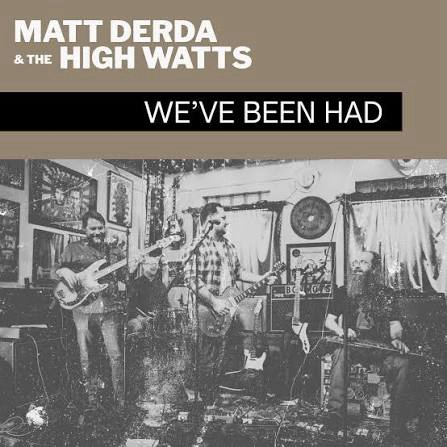
We’ve Been Had Again: Matt Derda and The High Watts Find the Beautiful Exhaustion Inside an Uncle Tupelo Classic

There are songs that do not age so much as they sink deeper into the American soil, collecting ash, heartbreak, rusted-out Buicks, and the smell of bars where the neon has been buzzing since the the 1970s. “We’ve Been Had,” by Uncle Tupelo from their last studio album, Anodyne, is one of those songs. It always sounded less like a performance than a high energy Jeff Tweedy penned confession sung into a kitchen table at 2 a.m., after the fight, after the layoffs, after the dream has already packed its bags and left town.

And now comes Matt Derda and The High Watts, stumbling gloriously into that sacred Midwestern wreckage with a cover that understands the central truth of the song: this is not music for winners. This is music for survivors.

A lot of bands cover Uncle Tupelo like they are handling a museum artifact. They treat the song with reverence, polish it up, preserve it in climate control. That is exactly the wrong instinct. Uncle Tupelo never sounded preserved. They sounded like they were coming apart at the seams in real time. The original version carried the exhausted genius of Jay Farrar and Jeff Tweedy trying to invent an entirely new American language out of punk rock, Woody Guthrie, and recession-era despair.

Matt Derda and The High Watts wisely avoid trying to “improve” any of that. Instead, they lean into the bruised humanity of the track. The guitars ring with the kind of weathered sincerity that modern Americana often tries to imitate but rarely earns. There is no pure algorithmic precision here, no sterile Nashville overproduction with twenty-seven tracks of digitally perfected authenticity. The song breathes. It sways slightly. It feels inhabited.

Most importantly, Derda sings like somebody who has actually lost things.

That matters.

Too much contemporary roots music is performed by people who seem like they discovered hardship through expensive vinyl reissues and prestige television dramas about coal miners. But this performance carries the emotional fatigue the song demands. His voice does not chase grandeur. It settles into resignation. And resignation, in a song like this, becomes its own strange kind of wisdom.

The beauty of “We’ve Been Had” has always been its refusal to explode. Lesser bands would turn this into an end of the show over-the-top cathartic anthem, all crashing drums and emotional release. Uncle Tupelo knew better. Real disappointment rarely arrives with fireworks. Usually it arrives quietly, in bills stacked on counters, relationships going cold, and the realization that adulthood is mostly a long negotiation with compromise.

This is not to say that the original does not rock and hit hard, it does. The song is not an anthem, it is a sonic recognition that you can feel the bad times and curse into the headwinds.

Matt Derda and The High Watts understand depth and restraint. Their version simmers rather than detonates. The arrangement leaves space for silence and ache. That takes confidence. In the streaming era, where every song is engineered to grab attention within eleven seconds before listeners drift away to TikTok videos of raccoons stealing donuts, restraint can feel almost radical.

And maybe that is why this cover works so well right now.

Because we are once again living in an America that feels profoundly exhausted. The economic anxieties, the cultural fragmentation, the sense that ordinary people are forever getting conned by institutions, corporations, politics, and sometimes by their own dreams — all of it hums beneath this song like electrical interference. “We’ve Been Had” remains painfully current because America remains painfully current.

That was always the secret engine beneath Anodyne. Released just before Uncle Tupelo imploded, the album sounded like a band realizing both the promise and failure of the American project simultaneously. Alt-country would later become a genre industry unto itself — beard oil, boutique guitars, curated authenticity for upscale audiences — but Uncle Tupelo came from somewhere real. Their music had dirt under its fingernails.

Matt Derda and The High Watts reconnect the song to that lineage. Their cover does not feel nostalgic. It feels lived in. There is an enormous difference.

And that may be the highest compliment possible for a song like this. Because “We’ve Been Had” was never supposed to make you feel good. It was supposed to make you feel less alone.

Video of the Day: The Pinkerton Raid – A Long December

All too often critics apply a sharp, snarky perspective on music, and approach covers with a detached cold perspective. And sometimes that separation would truly miss the point. The Pinkerton Raid’s cover of Counting Crows’ A Long December needs recognition of both the emotional core and the transformation of the song. A good review would highlight the poignant ways in which the cover reimagines the original, focusing on the evolving resonance of the song in the hands of a different band, and the way the passage of time deepens its meaning.

The original A Long December, with its aching melancholy and sense of yearning for resolution, comes from Counting Crows’ Recovering the Satellites, a record defined by its bittersweet reflection on personal pain and recovery. Adam Duritz’s vocal performance, simultaneously raw and hopeful, narrates a painful yet comforting nostalgia. However, when the Pinkerton Raid takes on this track, they strip it down, peeling back the layers of polished production, leaving space for vulnerability in their own rendition.

A critic would likely notice how the Pinkerton Raid, often associated with a more stripped-down Americana sound, injects new textures into the song. Their version transforms the hopeful melancholy of the original into something a little more haunting, a little more restrained, while the song is given room to breathe the emotional release feels suffocating — it is literally breathtaking. The arrangement, grounded in folk instrumentation, slows the pace, allowing the lyrics to move, perhaps breathe, and resonate in a way that invites even deeper introspection than the original, and that is saying something. The spaciousness of the arrangement highlights the sense of emotional isolation, with each guitar strum and piano/organ note echoing a quiet sense of longing.

How covers interact with their originals is a common discussion among critics. These critics would also note how this version of A Long December recontextualizes the meaning of the song for listeners in the 2020s, giving the track a new sense of grief. In a time when shared emotional experience is often overshadowed by fragmentation, the Pinkerton Raid’s version of A Long December offers a gentle, bittersweet reminder that despite everything, we still carry the weight of our pasts with us. You can pre-save or pre-add the studio version on APPLE, SPOTIFY or DEEZER, download it on BANDCAMP, or order the physical CD or vinyl.

Age Nowhere with a Great Cover Song!

Age Nowhere surprised Dr. J with a cover of ‘New Madrid’ from Uncle Tupelo’s last record Anodyne when they visited on March 19th of this year. The Jeff Tweedy penned song references the New Madrid fault which is south of St. Louis where Uncle Tupelo members Jeff Tweedy, Jay Farrar and Mike Heidorn grew up. The band hailed from Belleville Illinois which is across the river from St. Louis. The New Madrid fault is the location of one of the most powerful earthquakes in the United States. The line about rivers running backwards is taken from a result of the massive earthquake in 1812. Another line in the song was based on a prediction made by Browning that predicted a massive earthquake would strike the fault and surrounding area in 1990.

Allow us to set a scene. Imagine stepping in for a drink at a bar where Sticky Fingers era Keith Richards is hanging out with his Nudie Cohen Suit wearing pal Graham Parsons and a world weary Chris Robinson of the Black Crowes. They are all sitting in a booth commenting on the passing musical fancies of the day. That is the experience of Age Nowhere! Imagine a true double guitar attack from Identical-twin brothers Matt and Dan Spaugy paired with smoky evocative lyrics sung by Paul Monin propelled by driving drums from Seth Gilliam and pounding bass of Matt Terry. That is the experience of Age Nowhere.The band takes it’s nom de plume from one of the standout tracks on Dayton’s own Shrug‘s 2005 record ‘Whole Hog For The Macho Jesus.’

your-tuesday-afternoon-alternative-color copy

Age Nowhere with a Special Uncle Tupelo Cover!

Age Nowhere surprised Dr. J with a cover of ‘New Madrid’ from Uncle Tupelo’s last record Anodyne. The Jeff Tweedy penned song references The New Madrid fault which is south of St. Louis where Uncle Tupelo members Jeff Tweedy, Jay Farrar and Mike Heidorn grew up. The band hailed from Belleville Illinois which is across the river from St. Louis. The New Madrid fault is the location of one of the most powerful earthquakes in the United States. The line about rivers running backwards is taken from a result of the massive earthquake in 1812. Another line in the song was based on a prediction made by Browning that predicted a massive earthquake would strike the fault and surrounding area in 1990.

Allow us to set a scene. Imagine stepping in for a drink at a bar where Sticky Fingers era Keith Richards is hanging out with his Nudie Cohen Suit wearing pal Graham Parsons and a world weary Chris Robinson of the Black Crowes. They are all sitting in a booth commenting on the passing musical fancies of the day. That is the experience of Age Nowhere! Imagine a true double guitar attack from Identical-twin brothers Matt and Dan Spaugy paired with smoky evocative lyrics sung by Paul Monin propelled by driving drums from Seth Gilliam and pounding bass of Matt Terry. That is the experience of Age Nowhere.The band takes it’s nom de plume from one of the standout tracks on Dayton’s own Shrug‘s 2005 record ‘Whole Hog For The Macho Jesus.’

your-tuesday-afternoon-alternative-color copy

Video of the Day: Atmosphere

Cover of a classic Joy Division song, written by Ian Curtis. Taken from the acclaimed album Songs For Suicidal Lovers. Buy the CD at http://cdbaby.com/cd/shamusdark

One of the cool musicians Dr. J met last year in London was Shamus Dark!  His noir take on the Joy Division classic is a must listen.