
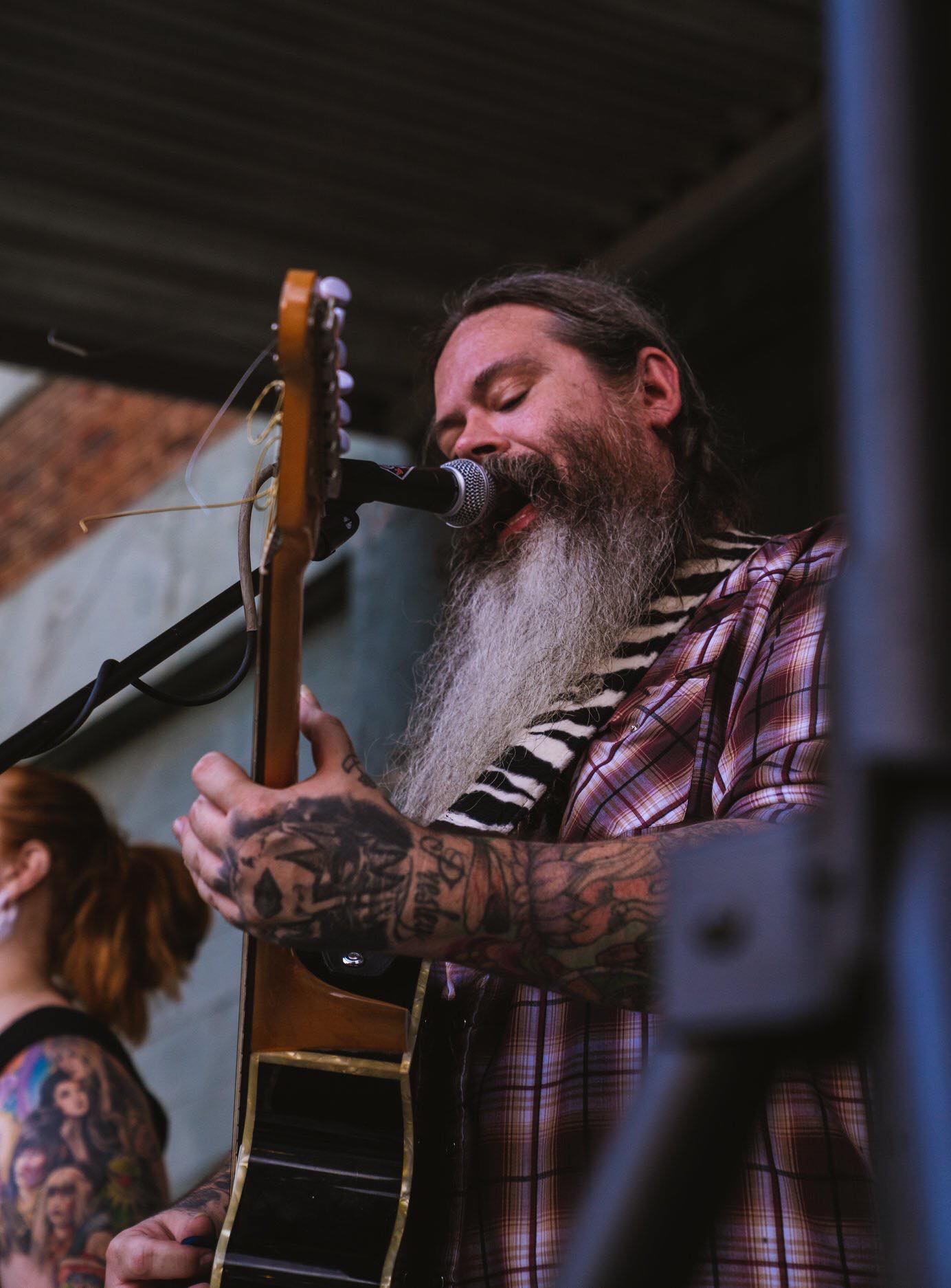
Tod Weidner is an institution in his home town of Dayton, Ohio. Tod is a visionary songwriter making music that drives a listener to tap their toes without realizing the impactful lyric until one has been hooked. Tod has led the incredible band Shrug for decades. The admiration for Tod’s music has been well earned from a songcraft that brims with a direct and honest rock and roll that veers across rock, indie, folk and more. Tod’s gift for writing catchy songs that open an honest dialogue is one of the most important characteristics of his music! While Tod has relocated to the Bay Area, his music continues the sonic journeys he started in Dayton.
Dr. J: What can you share with us about when and how you started writing music?
Lyrically speaking, I’ve been hugely influenced by my dad. He was a high school English and Literature teacher for over 30 years, and he passed on to me a love of words and how to put them together.
Musically Speaking, I started playing guitar in my sophomore year of high school, in January of 1986. I grew up in a rural area of Ohio, about 25 miles geographically and a thousand light years philosophically from Dayton. Underground rock (“college rock” as it was known then) was a thing, but it hadn’t really reached our sheltered little school to any real extent. We just had the radio – AOR or Top 40. If I had been more familiar with punk and DIY indie bands of the day, it may have occurred to me that I could write my own music as soon as I had a couple chords under my belt but, as it was, those radio formats instilled a feeling that these artists were untouchable superhuman beings descended down from Mt. Olympus, so the best we mortals could do was to learn how to play their music and- maybe, if we were good enough- join a cover band.

At some point around 1990, I began to realize that I didn’t have to play covers of other people’s music. The early “gateway drug” bands that lured me from the flashy ‘80s hard rock into more organic, underground stuff were Jane’s Addiction, Soundgarden, Mother Love Bone, Screaming Trees, Masters of Reality, Faith No More, and bands like that. I started coming up with riffs and developing them into truly dreadful early attempts at songs. Those bands led me to early R.E.M., Robin Hitchcock & The Egyptians, and other groups that had a little more “jangle” to their sound, and that was a turning point in my sense of songcraft. In 1993 I joined a short-lived Dayton band called Tim, which is where I first started contributing my own songs. After a year or so, I left Tim and started Shrug, and that’s where I really shifted into a higher gear. I was a sponge- I was devouring music as fast as I could find it, and learning about songwriting along the way.

Dr. J: What first led to your recording music? How do you approach production?
TW: When I was just starting out writing songs, my bandmate and I found this huge monstrosity of a stereo called a Sinclair Studio 100 at a close-out furniture store in Columbus. It was about the size of a window unit air conditioner, with a turntable, a tuner, and a dual cassette deck. The thing was, though, that it also had a setting where you could use it as a four-track recorder- the EQ sliders turned into faders, and you could record multitrack demos on it. My buddy and I each bought one, and I developed some extremely rudimentary recording chops, by trial and error. I haven’t listened to any of those cassettes I made for years and years; it would be somewhere between amusing and horrifying to hear them again.
How do I approach production? That’s a complicated question. It’s always evolving. My favorite way to do it is to get everyone in a room together and just play live. Let some happy accidents and mistakes happen- that’s where the good stuff lives. That’s not always doable, though. Sometimes space or noise limitations force you to build songs one or two instruments at a time, which gives you more control over the finished product and opens up the song to some interesting possibilities for experimentation.
There’s a time and a place for both approaches. Ideally, I like to let the song dictate the method. Having said that, I’ve been writing and recording demos alone on GarageBand lately, so building the song piece by piece is kind of the default mode for me at the moment, at least as far as pre-production goes.
The solo singles I’ve released so far and the ones in the immediate pipeline- aside from “The Boys of Summer” (which was done by myself at home) have been mostly recorded in a beautiful, big, spacious studio in Los Angeles, and I’ve been blessed to have some monster musicians on the sessions, so the lion’s share of the music gets tracked live, with vocals and some extra guitar overdubs added later. It’s a good mix of the two methods.
Dr. J: Boys of Summer is your most recent music, what led to the making of that song? What was the main influence on your recording this cover?
TW: It was serendipity- pure happenstance. I’ve always adored the original version, written by Mike Campbell and Don Henley. It’s such an evocative song about nostalgia, and it resonates with me more and more the older I get. I always thought it would be cool to cover it at some point.
So it happened that, this past New Year’s Day, 2022, I was at home, in my music room, with a few hours to kill, so I just started messing around with the song, kind of flying by the seat of my pants. I didn’t want to do a copy of the original; I never understand it when artists do that. What’s the point? I had an idea to keep it sparse- dark and skeletal, kind of turning the upbeat mood of the original into something that delivers the same sentiment in a more brooding way. Don Henley’s version is, in my eyes, sung by a successful alpha-type guy who’s reminiscing about an old flame. But he never really gets close to owning up to taking any blame in why the relationship ended. The narrator of my version of the song is a loser. He let the best thing that ever happened to him drift away, and he knows it.
I had no intention of doing anything with my version- it was just sort of something to do for a few hours. I sent it to my manager on a whim, because I knew he liked the original as much as I did. He really liked my version, and convinced me that we should release it. I have a song coming out soon that we really want all the pieces in place for, so releasing a version of a song that people are already familiar with makes a certain amount of sense from a business standpoint. We figured a cover would reach a few new ears to give us that much bigger of an audience when the “real next course” gets served up. How that goes remains to be seen, but the response to “The Boys of Summer” has been really great so far, so I’m already considering it a win.
I’m actually glad I recorded the song with no lofty goals for it to be released, because there’s a vulnerability in the vocal performance that probably wouldn’t have survived all the overthinking I would have done had I been trying for “a single”. “Quick, dirty, and instinctive” is the way to go sometimes.
Dr. J: The song ‘City of San Jose’ captures a remarkable constellation of musical influences. The song seems to have an almost 1970s feel. Is that a correct interpretation? If that is correct, did you intend to create a song that connects to that time period? If that is not correct, how would you describe the feeling of the song?
TW: No, I’d say that’s a very accurate assessment. Most of what I do is rooted in the music of the 60s and 70s, either directly or one generation removed, and most of my favorite artists were doing their best work back then.
Dr. J: How did the song ‘City of San Jose’ come together musically for you?

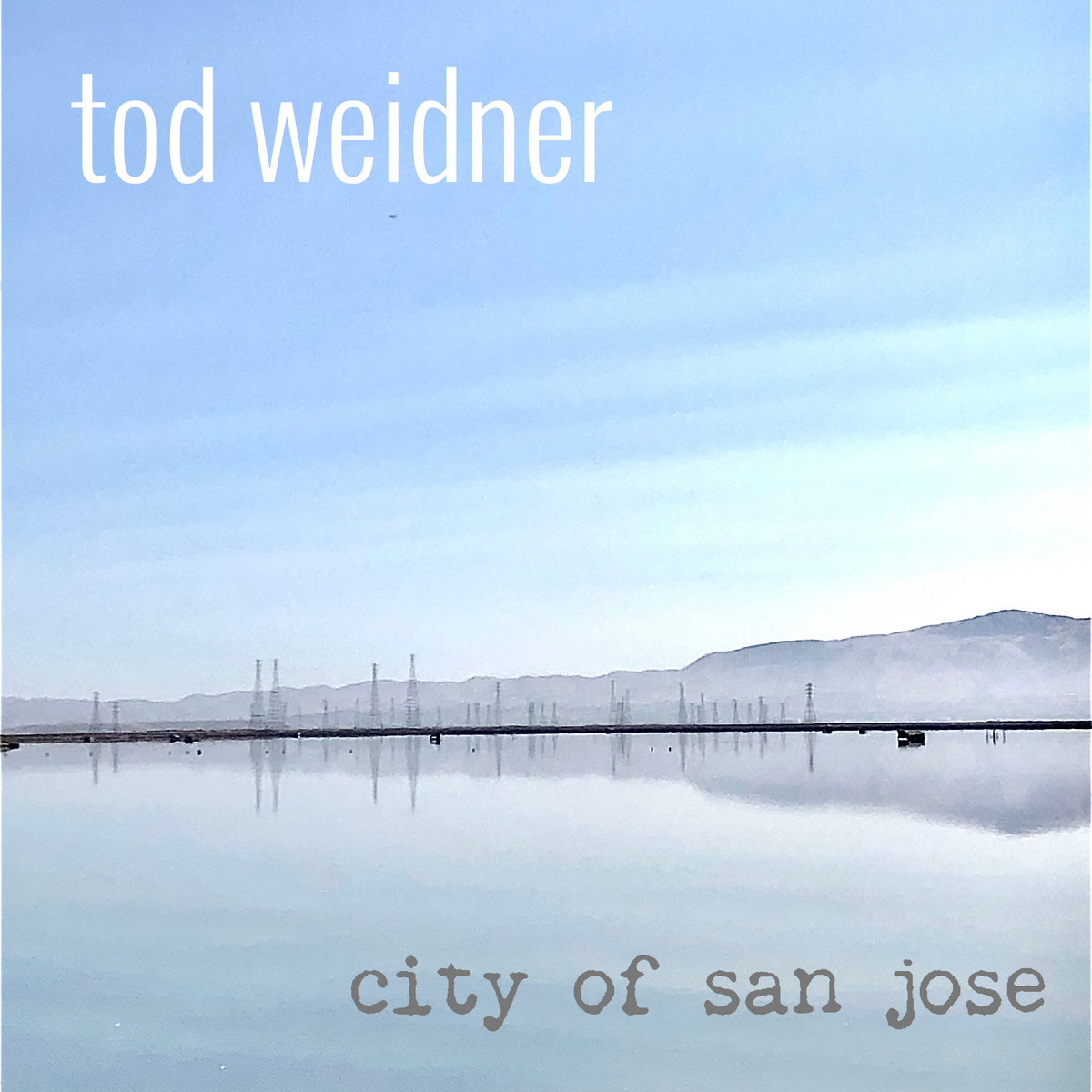
TW: The song is kind of a love letter to a section of the San Francisco Bay Trail near where I live. During the peak of Lockdown, it was a great place to get some exercise away from a lot of other people. I also came up with a lot of lyrics for this current batch of songs out there.
I used an alternate tuning on my guitar for that one- DADGAD, a tuning that a lot of British artists gravitated towards in the late 60s and 70s; people like Bert Jansch, John Martyn, and Nick Drake. Jimmy Page used DADGAD on a lot of Led Zeppelin tracks, as well. My original demo for the song was very much in the British Folk vein- a bit quieter, more pastoral. When we got in the studio to record the actual version it became much more upbeat, but I’m not mad about that at all. I like both approaches a lot, and the final version we did in the studio served as a good introduction to the world of “Tod Weidner as a solo artist.”
Dr. J: Where do you often derive inspiration to make music?
TW: Well, it’s a compulsion, really. Playing guitar is really the one thing in my life that never fails to make me feel better. If I’m depressed, anxious, or out of sorts, there’s nothing I like better than to just pick up the guitar and lose myself for an hour or two. It’s my form of meditation. More often than not, a kernel of an idea will pop up somewhere in the course of my aimless noodling. The “voice memos” app on my phone is overflowing with minute-long ideas that either eventually will or already have become full-fledged songs.
Lyrically, I’ve been really making an effort over the past few years to simplify. In the beginning, I delighted in using big flowery words in my songs just for their own sake. While there’s certainly nothing wrong with that, per se, I’ve been fascinated lately with the songcraft of people like John Prine, Johnny Cash, or Tom Petty: songwriters who can lay down a simple truth that everyone can relate to, but with a clever little spin on it that just makes it land like a bomb. There’s a deceptively fine art to that, and I’m always trying to get better at it. Fewer words, more impact.

Dr. J: How would you describe the music that you typically create? How has that process evolved or changed over time (especially as you think about your journey in the last few years)?
TW: My standard line about my music is “songs about Love, Loss, The Loss of Love, and The Love of Loss”. There tends to be a touch of yearning, or wistfulness, a bit of melancholy in most of my music- “Sad Bastard Music”, as some people call it. It’s not dark all the time, but I think most artists have a tendency to ruminate about things, at least the ones I gravitate to.
Moving to California from Ohio was already a big new chapter in my life in and of itself, but the prospect of starting a solo career with a new tribe of people also definitely represents a turning of the page. Dayton will always be home, and I thank my lucky stars that I got to learn how to be a musician and writer in such an amazingly fertile music scene as Dayton’s, but there comes a time when a nurturing, close-knit environment runs the risk of becoming an insular echo chamber-type situation. In all honesty, that’s what Dayton started feeling like toward the end of my time there. It was time to get somewhere new and try my stuff out on people who hadn’t known me for decades. It’s a healthy thing to do.
My dear old friend, and now manager, Jack Piatt, has always championed my music, and through him, I’ve gotten to meet and work with people out here from very different backgrounds than mine. Which is also a healthy thing to do. Nomad, the gentleman who has produced my first five singles, has a resume that includes- among other things- a long stint as Babyface’s musical director. So he has a strong background in Soul and R&B, and that gives him a much different perspective than I have, coming from a more-or-less strict rock background. The “me” from 10 or 15 years ago would’ve been very skeptical of working with someone like that. But, as I said, this is a major new chapter of my life and career. I told myself, “Tod, you’ve been doing things a certain way for over 25 years. If you want to continue in the same bubble you’ve been operating in, you might as well just go back to Dayton and record the usual stuff with the same people at the same places.” If I want to get somewhere new, it’s a good idea to take some new outside advice, be open to change, and let go of some of my innate urges to control every aspect of the situation. I decided to start saying “yes”, instead of, “I dunno, that’s not how I usually do it.” And I have to say- it’s been working out really well so far. It’s refreshing, and exciting.
Dr. J: What is next for you musically? How would you describe your thoughts at this point for your next project?
TW: The next single is coming out sometime in February, and I think it’s going to really surprise people who are familiar with my back catalog. I’m very excited about this track, and the people I recorded it with. That’s all I want to say about it for now.
The plan is to release a digital single at a rate of about one a month, and eventually end up with enough songs for a full, physical album. I’m still old school enough that I like to hold a record or a CD in my hand and read liner notes and whatnot.
I came out of Lockdown with about 20 new songs, and I’m as proud of them as any I’ve ever written; I really believe it’s some of my best work, and I am dying to get on the road and play them for people.
Dr. J: What is your favorite song to perform live? What is your favorite song to perform in general? What makes that song a current favorite in your performances?
TW: I don’t know if I have a favorite song to perform. I have favorite types of songs, maybe. I love playing a song that lets me stretch out and go somewhere on the guitar because, at the end of the day, I still think of myself as a guitar player.
And I love a song that I can crawl inside and live in while I’m singing it. I just want to play something that moves people. That’s the objective: to play with sincerity and move people. There’s not much point in doing anything else.

Dr. J: What is one message you would hope that listeners find in the unique nature of your latest music?
TW: Well, as I said earlier, I tend to lean toward the darker end of the emotional spectrum with my songs, but lately- with this latest batch of songs, especially- I’ve been making more of a concerted effort to include a little ray of sunlight here and there in the songs. With the last several years of trauma and uncertainty, I think Hope is a valuable, rare commodity, and people need as much of it as they can get.
Music, and Art in general, serves multiple purposes: it can provide a feeling of escape for the listener, a chance to forget their troubles and go somewhere else for a few minutes. That’s a lovely thing.
But Music can also be a hand to hold in the dark. It can tell the listener, “You’re going through some painful times. I know how you feel, I feel that way, too. Let’s feel that way together.” That can be a beautiful thing, too- letting the listener know they’re not alone. I know Music has gotten me through some dark days and nights, and if my songs can help someone in that way, then I’ve done my part.
Dr. J: As a musician, how are you adapting to the challenges of the Coronavirus?
TW: Same as everyone, I suppose. It depends on the day. I miss playing shows, I know that. I hope that, sooner than later, I can get back to playing a gig without worrying about people going home sick. I’m also very aware of the privileged position from which I’m speaking.; my wife has been working from home, and we’re getting by alright. A lot of folks don’t have that luxury.
The silver lining for me, as a musician, has been the enforced down time. As I mentioned, it’s allowed me to really buckle down and work and produce a lot of songs I’m proud of. I’m thankful that I have songwriting as a way to work out my fear, dread, and anxiety. Again, a lot of people don’t have an outlet like that.
I guess it comes back to what I touched on in the previous question. As a singer/songwriter during this whole mess, I have a responsibility to reflect the times, relate to the listener, and provide them with some degree of solace. All things considered, it’s not a bad job to have.

We want to extend our sincere gratitude to Tod for answering our questions and continuing to make some really excellent music! Click on the links throughout the article to visit his social media or to listen to various songs that were discussed! If any musicians or artists would like to participate in future ’11 Questions with…’ columns, please feel free to email us at drjytaa@gmail.com. All photos and images courtesy of Tod Weidner.
Bandcamp Youtube Instagram Website TikTok


 The 11 Questions with… column returns with guitarist, songwriter Nick Kizrinis! He graciously answered these questions about his latest music projects. We want to publicly thank him for taking the time to answer these questions!
 The Distance demonstrates Kizirnis’ remarkable skill as a guitarist and a songwriter. Bridging musical spaces that make for an emotional listening experience, the record reveals lessons to be learned about the affairs of the heart. The collaborative process that Nick undertook allowed him to move past any limitations of his own perspective and voice and give flight to songs that drew stories about life, love, loss and the discontinuity of connection that is universal to all of us.
 Nick Kizirnis (NK): I started writing the songs for the album back in 2016 as a challenge to myself to see if I actually could do it. I’d written a lot of songs before, but most of them were actually instrumentals.
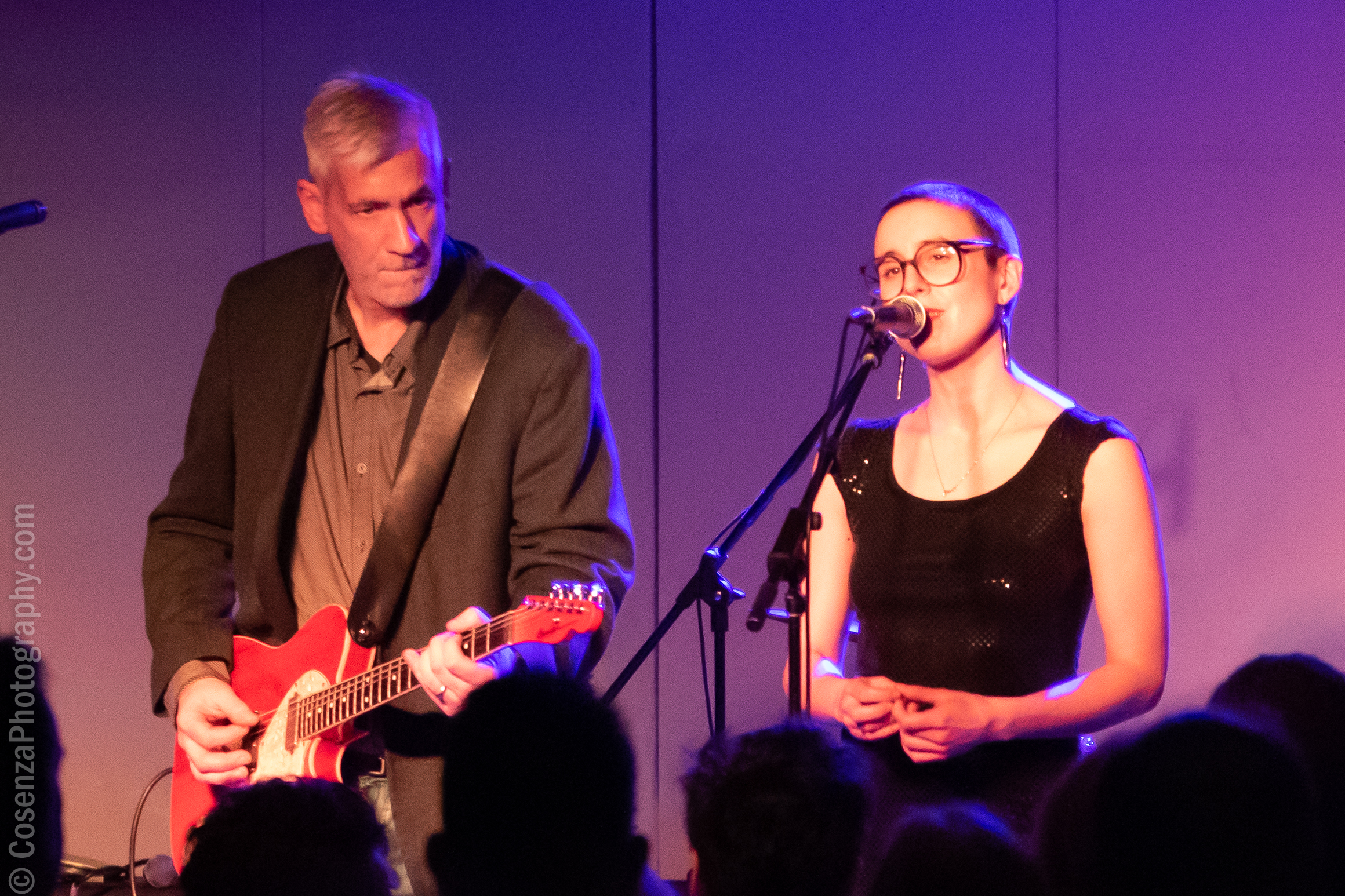 Dr. J: You worked closely with several local musicians, especially Kate Wakefield, what led to your collaborations? Can you discuss your partnership with Kate?
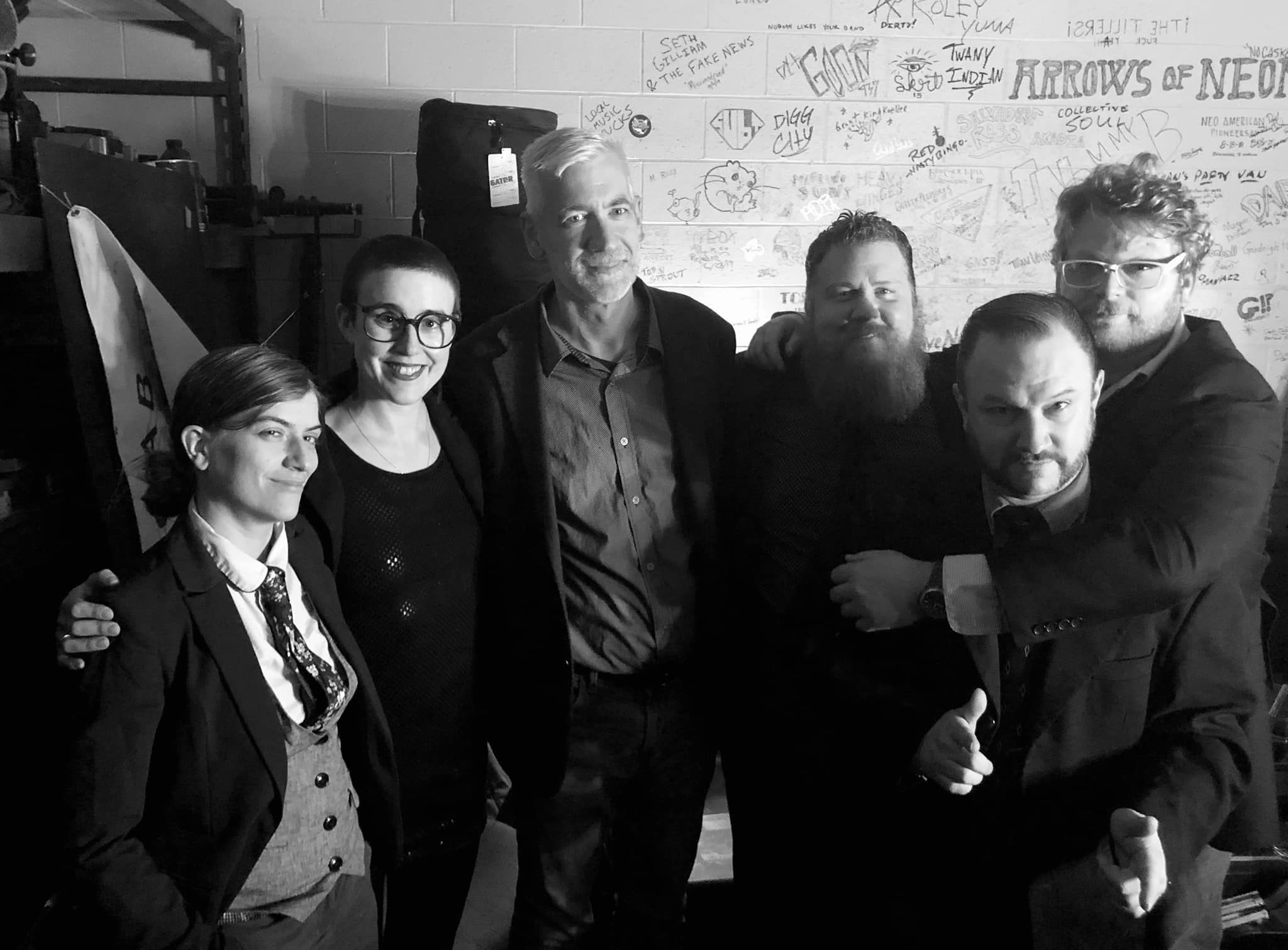 The band (or part of the band) would record a few songs, scheduled around Mark’s tours with Son Volt. Kate was also on tour with Lung during this time so she would record vocals and cellos separately. Between
  I want to mention here how amazing and generous everyone was, and how grateful I am for the help and support and their friendship. Patrick is an amazing multi-instrumentalist and studio magician and really know how to work with me through the process of making album. Mark taught me all about touring and running a band when I was a teenager, and through his years in Austin is this brilliant “song-writers drummer” … he helped coach me through the song arrangements and that alone was an amazing experience. Tod has been a friend and I’ve long admired his singing, playing and writing. Kate is my favorite singer in the world, and I think she’s an amazing cellist with a really unique voice and also a great songwriter. Then of course there is Joe who has been my friend and musical partner for years. Joe. The brilliance and “effortlessness” in his playing is so inspiring, and I feel very lucky to have played, recorded and travelled with him over the years.
 Dr. J:
  Dr. J: As a musician, how did you adapt to the challenges of the Coronavirus? Is that changing for your now as music events are opening up again?
 We want to extend our sincere gratitude to Nick Kizirnis for answering our questions and continuing to make some really excellent music! Click on the links throughout the article to visit Nick’s social media or to listen to various songs that were discussed! If any musicians or artists would like to participate in future ’11 Questions’ columns, please feel free to email us at drjytaa@gmail.com. All photos and images courtesy of Nick Kizirnis, Andy Valeri, Chris Cosenza and

 If you do not know the music of
  The latest Cricketbows album ‘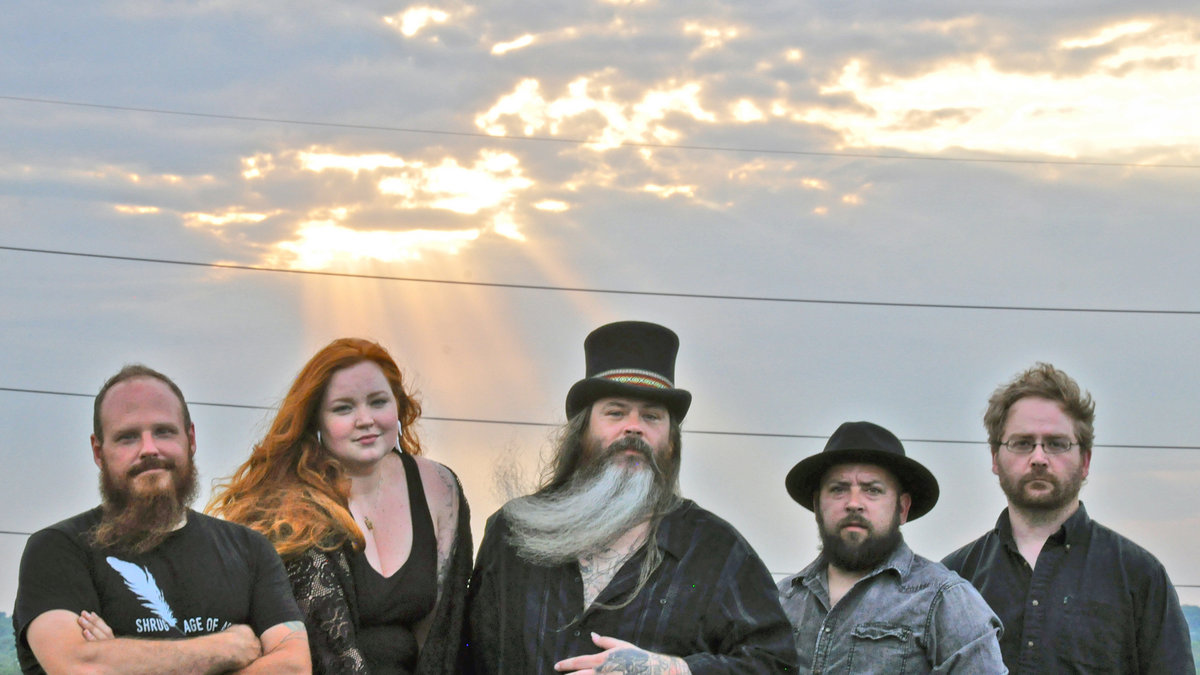
 CW: I definitely didn’t start with a list or motive to include all of those specific artists, songs or albums. I had the first line “I speak electric guitar, in fire orange and bright blue” which was a nod to the fact that Aarika and I both suffer from or are gifted with a bit of Synesthesia – a condition where sounds may be experienced in the brain as a color or shape or taste instead of just as sound. From there, I wanted to expand on that line in a direction that talked about how my mind works the way it does because I was raised in a world where Rock And Roll music was not just a backdrop to life, but was an important element of life. We weren’t religious really and we weren’t sports or military people. Everything that a so-called “normal” person might get from those family traditions and lifestyles, I got from Rock And Roll – so I tried to touch on some of the cornerstones and recurring images and symbols of that part of my upbringing. So I reference the “lightning” of “Elvis and Bowie and Frehley” as well as referring to The Beatles as the “Saints” I say prayers to along with nods to everything from Fats Domino to Pink Floyd.
 Dr. J: Where do you often derive inspiration to make music?
 CW: I have no idea how we’re going to move forward with a new record in the current state of the world. I hope that vaccines work and that we’re eventually able to be in a room together again. If not, it’s going to be some interesting home recording stuff. We have been playing around with some cover songs recorded remotely. We released a Black Crowes (“Good Friday”) cover back around the beginning of the Pandemic and lockdowns and it was pretty fun and interesting. We have a couple others in the can that we may or may not release. One is a cover of “I Think We’re Alone Now” that is pretty fun. Side projects are also a thing. Aarika and I do a couple different projects together that work well as far as remote recording and things like that – New Way Vendetta, a new-wave influenced electro-punk band and Wells & Watson – a darker Americana themed acoustic project. We have plans to release a bunch of stuff under a bunch of different names in the near future. As for Cricketbows, we’ll just be patient and see where it all goes.
 your tuesday afternoon alternative