One of my favorite things about doing Your Tuesday Afternoon Alternative is discovering a band that somehow slipped under my radar and then wondering how on earth that happened.

That was exactly my reaction when a friend pointed me toward Lips Speak Louder.
The Minneapolis-based duo—guitarist and vocalist Rachel Brandsness and drummer Angela Lese—make the kind of rock records that remind you why guitars still matter. Big riffs. Bigger hooks. Songs that are melodic without losing their edge. Their album Consolation Prize has been getting plenty of spins on the show, and after talking with Rachel and Angie over Zoom, I came away even more impressed by the thought and intention behind the music.
Ironically, the band’s name began with another favorite band.
“We’re huge Yeah Yeah Yeahs fans,” they told me. “Lips Speak Louder” comes from a lyric buried inside the song “Soft Shock.” They loved the phrase because it sounded “anthemic,” but over time it took on a deeper meaning.
“It feels like permission to say what you really mean,” Rachel explained.
That philosophy runs through everything the band does.
Rock music, they argue, shouldn’t apologize for existing. It should be loud. Honest. Imperfect. It should refuse to shrink itself to make other people comfortable. “Rock music refuses to be quiet. It’s loud and kind of in your face. You’re saying what you mean, when you mean it, how you mean it.” That isn’t simply a philosophy about music—it’s a philosophy about life.
Angela pointed out that, particularly for women, there is often enormous social pressure to be agreeable and not “take up space.” Playing in Lips Speak Louder became an opportunity to reject that expectation. Angela explained that, particularly for women, there is often enormous social pressure to be agreeable and avoid drawing attention to yourself.
Rachel shared that “I feel like, especially as women, you’re raised to be polite and don’t step on anybody’s toes. Playing and singing is my chance to be loud and take up space.” It’s my chance to be loud and take up space.”
That statement may be the best summary of the band you’ll ever hear.
Of course, the music industry has not always made it easy. Both Rachel and Angie laughed while recounting stories of loading heavy equipment into venues only to have someone ask whether the gear belonged to their boyfriend. They’ve repeatedly encountered audiences and industry professionals who seemed surprised that two women could walk onstage and deliver unapologetically heavy rock music.
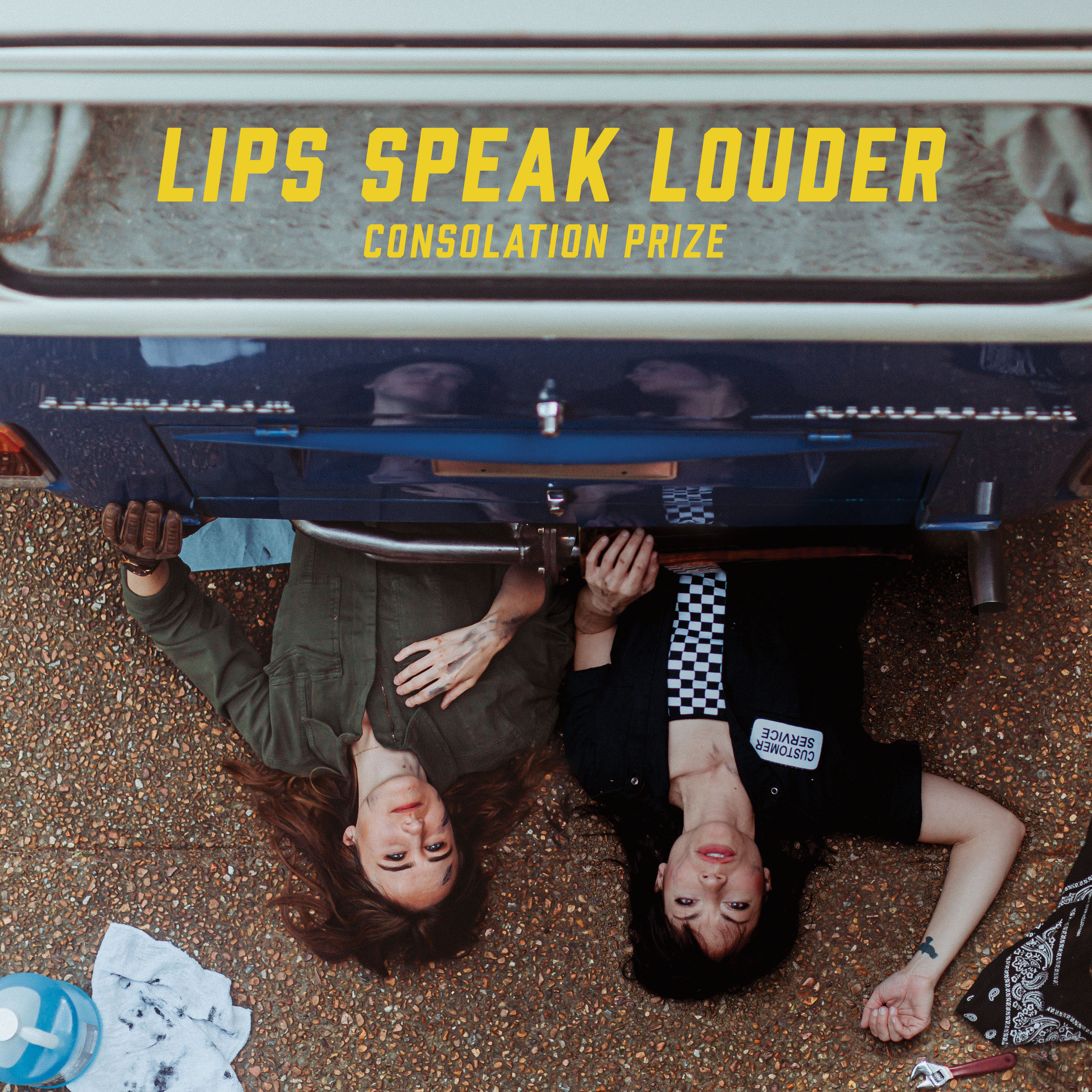
Those experiences even inspired the title of Consolation Prize.
The title is more than a clever phrase. It’s a tongue-in-cheek response to years of being passed over simply because they didn’t fit someone else’s expectations of what a rock band should look like. Angie noted that “we named our album Consolation Prize because we can’t tell you how many times we’ve come up short for a gig…just because we were women.”
The satisfying part, they admitted, comes after the music starts.
Angie observed the transformation on the faces of the audience: “We can actually watch people’s expressions change. Watching everyone’s eyes turn from a place of doubt to just being super into it—that’s pretty cool.”
Or, as Rachel put it, “If you can win a crowd over by being two females playing rock and roll, that’s a fun feeling.”
The audience goes from skepticism to raised fists, phones in the air, and enthusiastic applause. Few things are more satisfying than dismantling assumptions with a great performance.
Listening to Consolation Prize, one thing immediately stands out: this is an enormous-sounding record. That becomes even more impressive once you realize only two musicians are creating all that sound.
Rachel has developed an ingenious live guitar setup that simultaneously covers guitar and bass parts while Angela’s powerful drumming provides the foundation. Instead of treating the duo format as a limitation, they’ve embraced it as a creative advantage.
“It forced the vocal melodies to have to be better. It forced the songs to be better,” Rachel said.
Without multiple guitars and layers of studio overdubs to hide behind, “there wasn’t going to be a bunch of extra fluff” – the vocal melodies had to become stronger. The riffs had to matter. Every note had to earn its place. It’s a refreshing philosophy in an era when technology can often become a substitute for songwriting.
As we talked about their writing process, another theme emerged. Neither musician seems interested in showing off. They are interested in making great songs. Every note has to matter. Every hook has to earn its place. Rachel noted that “if I have that chorus hook, I feel like I can build whatever I need around that.” Because, as she admitted, “If the chorus doesn’t really anchor it, the song is only ever going to be okay.”
That’s a remarkably disciplined way to think about songwriting.
Rachel usually begins with a chorus because, in her words, if the chorus isn’t memorable, the rest of the song rarely comes together. From there, the pair trade demos back and forth, constantly refining arrangements while giving one another room to contribute new ideas.
What struck me most was the trust between them. Sure, there are disagreements. Different versions get recorded. Feelings occasionally get bruised. But they always arrive at the same destination because they’re pursuing the same goal.
“We both have the same end goal—trying to make a great song.”
That mutual trust is one reason the record sounds so cohesive. Their move from Nashville to Minneapolis also says a great deal about who they are as musicians and performers.
After years of working in one of America’s music capitals, they wanted something different. Nashville is full of extraordinary musicians, they told me, but it has also become crowded, expensive, and increasingly geared toward hired-session work.
The Midwest kept calling them back.
Every tour through Wisconsin, Minnesota, and surrounding states reinforced the same impression: audiences simply love rock music. “The whole region seems thirsty for some rock, so we’re just excited to be here.”
So, they relocated. The gamble appears to be paying off.
The Minneapolis music community has welcomed them warmly, local radio has embraced their songs, and they already feel at home in one of America’s great rock cities.
One observation Rachel made really stuck with me. Independent artists experience time differently from listeners.
While Consolation Prize no longer feels “new” to the band, it is brand new to nearly everyone discovering them for the first time. “To us the songs don’t feel brand new anymore…but to 99.9 percent of the population they’re brand new.” That’s an important reminder that great records never really have an expiration date.
When I asked about working with Emily Wolfe as producer, Rachel immediately emphasized something every artist hopes to find. “She helped us get the sound we wanted but preserve who we are.” Angela added that Wolfe pushed them creatively without changing their identity. The result is a record that feels polished but never sterile.
As Rachel explained, “We wanted it polished enough to sound professional, but we wanted to harness that raw energy.” That may be the single best description of Consolation Prize.
When I asked about favorite songs from Consolation Prize, the answers revealed another side of the record. Angela chose “Handle With Care,” partly because it lets her unleash an extended barrage of double-kick drumming that she had always wanted to play.
Rachel highlighted “Dog Days of Summer” and “Loser,” two emotionally cathartic songs that build from intimate moments into soaring, full-throttle rock anthems.
I understand exactly why.
“Loser” may have become my favorite track on the record. Every time I hear it, I find myself singing along before I even realize I’m doing it. That’s what good songwriting does.
Toward the end of our conversation, I asked about performing live. Their answer wasn’t about gear or logistics. It was about creating an experience. “How can we make it larger than life? How can we create a moment?” That’s exactly what every great rock band should be asking before walking onstage.
I asked the most important question of the afternoon as we neared the end of our conversation: “When are you coming to Dayton?” The answer was encouraging and promising.
Angela actually has family in Kettering, the band is working with a booking agent, and Midwest touring is very much in the plans. I immediately began recommending venues like Blind Bob’s, The Brightside, and South Park Tavern. Hopefully, we’ll see them here sooner rather than later.
If they do make it to Dayton, I’ll probably have a classroom full of University of Dayton students earning extra credit by attending the show. Going to local concerts is the only extra credit assignment I offer students.
After spending an hour talking with Rachel Brandsness and Angela Lese, it became obvious that the name Lips Speak Louder isn’t just clever. It’s a mission statement that encourages all of us to be authentic. Don’t apologize. Write great songs. Turn up the amplifiers. Let the music flow.
Let the music do the speaking.



 your tuesday afternoon alternative