I conducted this interview several months ago, but its ideas have lingered in ways that feel increasingly relevant with time. Returning to the conversation now, what stands out is not just the detail of Richard Flierl’s creative process, but the clarity of his artistic philosophy—one grounded in patience, emotional honesty, and a refusal to chase immediacy at the expense of depth. In the months since, as musical culture continues to accelerate toward shorter attention spans and algorithmic visibility, his commitment to making music that asks listeners to slow down and “lean in” feels even more quietly defiant. The distance has given the interview a different weight; what first read as reflective now feels almost prescient, capturing a mode of listening and creating that risks becoming increasingly rare.
There is a particular kind of indie music that never really leaves the people who discover it. It is not music designed for stadiums, algorithms, or fifteen-second clips floating through social media feeds. It belongs instead to late-night drives, college radio broadcasts, old record stores, and solitary moments when somebody puts on headphones and disappears into sound. The music of Dotsun Moon exists squarely within that tradition.


Dotsun Moon is the Buffalo-based project and brainchild of multi-instrumentalist Richard Flierl. Active since 2011, the project creates dream-laden shoegaze, atmospheric indie rock, and synth-inflected dream pop, with Flierl gradually evolving from producer into a one-man band handling nearly all instrumentation and vocals himself.
In a long and thoughtful interview, Richard described a creative life shaped by post-punk, dream pop, shoegaze, synth-pop, comics, cinema, and decades of obsessive listening. What emerged most clearly was not simply a catalog of influences, but a philosophy of music rooted in curiosity, emotional honesty, and the belief that songs can become deeply personal companions for listeners.
I initially framed Dotsun Moon’s sound through the lens of The Cure and New Order, hearing “eighties influences” and “synth-rock hybrid bands” in the music. Richard agreed while explaining that the newest record, Tiger, intentionally pushes further toward guitars and dream-pop textures. “I thought I wanted to make a shoegaze album,” he explained, “but honestly, this is more dream pop.”
For Richard, the distinction mattered. Shoegaze, in his telling, is not merely a label but a dense sonic architecture associated with bands like My Bloody Valentine. “I didn’t come up with an all-encompassing washing-machine guitar sound,” he admitted modestly, though the influence remains audible in the buried vocals and layered guitars throughout the record.
What makes Dotsun Moon compelling is the way these influences are filtered through lived experience rather than nostalgia. Richard recalled how the project originally began with just himself and a friend performing alongside prerecorded tracks because they lacked a full band. “We were like, what can we do? We don’t have a drummer,” he said. “If you have to wait for a band, you’ll never play out sometimes.” The comment captures something central to independent music culture: creativity often emerges through limitation rather than abundance.
That DIY sensibility still shapes the project. Richard spoke warmly about collaborating with producer Doug White at Watchmen Studios in Lockport. White, who had worked with punk, metal, and dream-pop bands alike, became a crucial creative partner. “Some of those songs I went in half done,” Richard explained, “and we walked out with them finished in a day.” Rather than imposing commercial polish, the process sounded exploratory and collaborative. Guitar parts evolved spontaneously. Songs changed shape organically. “You just don’t know what you’re gonna come up with,” he said.
The interview became especially fascinating whenever it turned toward songwriting itself. Richard repeatedly rejected romantic myths about composition arriving fully formed through sudden inspiration. Most songs begin with loops, keyboard parts, rhythms, or melodic fragments. “Keyboard is just so good to me,” he explained. He often improvises lyrics over music before fully understanding what the song is emotionally about.
That process is evident in “Bring Love,” which emerged almost unconsciously from a painful relationship experience. One lyric — “We’ll talk sometime when the future is not around” — reflected his emotional uncertainty entering a relationship involving children. “You should go into a relationship with excitement and love,” he admitted, “and I went in with apprehension and fear.” Other imagery came from a trip to Japan, where standing above a sudden ocean drop became metaphorically linked to emotional vulnerability and risk.
The songs rarely function as literal confessions; feelings dissolve into atmosphere and texture, producing something closer to dream logic than diary writing.
That emotional ambiguity becomes central on Tiger, particularly on “Never Had a Heart.” Richard described wanting the opening guitar line to feel “like yelling and punching forward,” while producer Doug White pushed for drums that felt enormous and physical. Richard enthusiastically described experimenting with layered loops and drum software: “The drums were really powerful. Doug loves powerful drums, and I like it too, a lot.”
Yet beneath the aggressive sonic architecture lies an unexpectedly warm song. Richard pointed to Roads by Portishead as an inspiration for that tension between melancholy and intimacy. He described hearing the lyric “Nobody loves me like you do” and realizing that what initially sounds mournful is actually deeply intimate. That realization shaped “Never Had a Heart,” particularly the line “Heaven never had a heart like yours.”
“This person has just got the most warm-hearted person in the world,” Richard explained. “So to have a positive message like that, but have it with a real punch — that’s how that came.”
The song gradually reveals itself not as despair, but as gratitude and emotional rescue:
“All the troubles you’ve ever known gripping you tight by the throat — a love that you’ve never known before.”“It’s like this person’s just saving you from these negatives,” Richard said.
That layered emotional quality extends into the album’s production philosophy. Richard resisted the contemporary tendency to push vocals aggressively to the foreground. Referencing bands like Slowdive, he described wanting listeners to “kind of listen” and “lean in a little bit.” Vocals on Tiger function as another texture within the mix rather than its center.
Our conversation drifted into compression, loudness wars, and the production legacy of Nevermind by Nirvana. Richard argued that many modern productions sacrifice dynamic range in pursuit of impact. Instead, he admires records where arrangements retain depth and space. “A well-made song is powerful,” he insisted, regardless of whether the vocals dominate the mix.
That emphasis on songcraft runs throughout Tiger. Richard spoke admiringly about seventies arrangements, sophisticated chord structures, and lush harmonies, citing influences ranging from Barry Manilow to yacht rock. “Inspiration can come from anywhere,” he said while discussing studying Manilow chord changes through sheet music archives. It is a refreshingly unpretentious approach in a musical culture often obsessed with “acceptable” influences.
The same openness extends to artists like Electric Light Orchestra, whose orchestral pop textures Richard deeply admires. In many ways, Dotsun Moon reflects a generation of listeners less interested in rigid genre tribalism than emotional resonance, drawing equally from post-punk melancholy, dream-pop atmosphere, synth experimentation, indie rock structure, and classic pop craftsmanship without feeling nostalgic or revivalist.
The album’s sequencing also reflects a cinematic sensibility. Richard described “Piano Trailer Melody 4” as an intentional dividing point — almost like flipping from side one to side two on vinyl. The abrupt transition from “Never Had a Heart” into the sparse piano instrumental creates a moment of deliberate disorientation.
That cinematic impulse surfaced repeatedly during our conversation, especially when Richard discussed Mercury Rev and their album All Is Dream. Hearing its opening track, he said, felt like watching “a John Ford western” unfold onscreen. Songs, for him, should create visual and emotional space rather than simply deliver hooks.
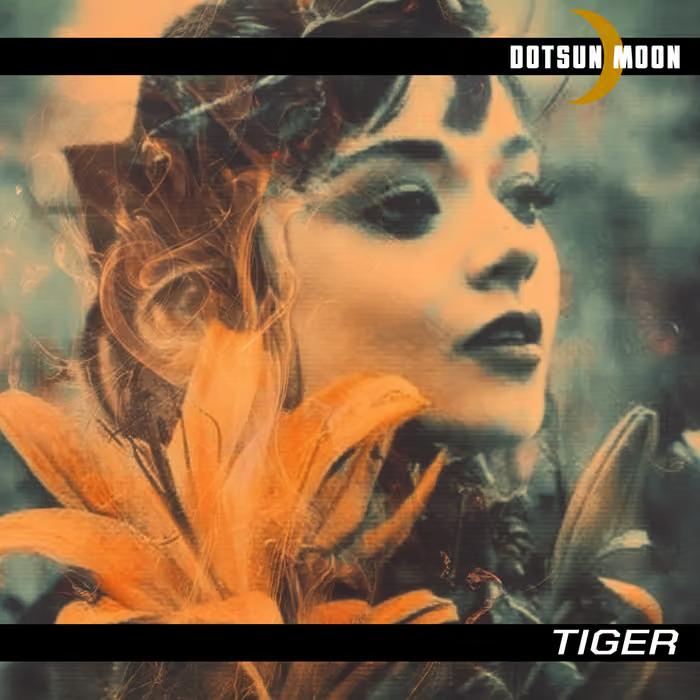
That same sensibility shapes the album artwork. Richard credited artist Doc Smith, working under the name Orb, with creating the cover image featuring a woman holding a tiger lily flower — a subtle visual pun connected to the album title Tiger. Richard admitted the title itself was intentionally playful, inspired partly by albums like Crocodiles and partly by comic-book references, especially Mary Jane Watson’s famous “Face it, Tiger…” line from Spider-Man comics.
The conversation frequently drifted into comic books, revealing another important aspect of Richard’s worldview. We bonded over the emotional resonance of eighties-era Marvel Comics storytelling, particularly The Uncanny X-Men and the outsider identities embedded within mutant narratives. Richard described how those books shaped him emotionally as a young reader. Like many listeners drawn toward dream pop and shoegaze, he gravitated toward stories about alienation, identity, and belonging.
Importantly, though, Tiger ultimately resists despair. Even its saddest moments remain grounded in warmth, connection, and endurance. “Give Up the Tears,” despite its title, is explicitly about release and emotional survival. “It’s about feeling good,” Richard said. “It’s about letting that hurt go.” He described the song as an invitation to briefly escape despair long enough to appreciate moments of peace — whether “at the beach” or simply “for the duration of a song.”
The one major exception, Richard admitted, may be “Winter Street,” which he described bluntly as “definitely a song about hurting.” Yet even there, the pain feels observational rather than performative — less spectacle than memory.
Perhaps the most moving moment of the interview came when Richard explained why he makes music at all. As a teenager, he discovered Heaven Up Here by Echo & the Bunnymen almost accidentally. Initially uncertain about the album, he gradually fell in love with its atmosphere, sequencing, and guitar work. That experience permanently shaped his artistic ambitions.
“Because that had that effect on me,” he said, “I wanted to create music that would do the same thing for someone else.”
It is an extraordinarily simple statement, but it explains nearly everything about Dotsun Moon’s music. Beneath the guitars, haze, and layered textures lies a fundamentally human desire: to create songs that matter deeply to strangers.
In an era increasingly dominated by disposable digital noise, that aspiration feels both old-fashioned and quietly radical.

 your tuesday afternoon alternative