A Still Life Revisited arrived not just as an album, but as a shared moment. Presented by WXPN, the release show felt patient, generous, and deeply communal—songs given room to breathe and collaborators invited fully into the frame. Recorded live by Secret House Recording, beautifully mixed by Kevin Marcoux, and captured on video by Tom Whaley, every detail reflected care rather than spectacle. Danielle Ciampaglia’s cover photo set the tone, intimate and unforced.
Across the set, voices and instruments wove together in ways that felt organic and earned. Katie Hackett’s vocals brought quiet power to “Second Sign,” while Kyle Swartzwelder’s pedal steel threaded nearly every song with warmth and restraint. An MJ Lenderman cover, “She’s Leaving You,” and a Tom Petty take on “Walls” sat easily alongside originals, reimagined rather than replicated. The Tisburwives Singers added depth and lift, the Schuylkill River Orchestra expanded the emotional palette, and each collaboration felt less like a feature than a conversation.
By the end, it was clear this wasn’t just a release show, it was a reflection of a musical community showing up for one another. No flash, no rush, just careful listening, shared attention, and songs presented with trust. A Still Life Revisited landed exactly as it should have: thoughtful, collective, and quietly unforgettable.
If rock & roll really is supposed to be dead, then The Tisburys clearly didn’t get the memo, becauseA Still Life Revisited sounds like the kind of record made by people who still believe guitars can change your pulse rate and a chorus can rescue you from the beige grind of everyday life. It’s big-hearted, jangly, melodically drunk on its own hookiness, and just earnest enough to make cynics roll their eyes—right before quietly admitting that, okay fine, this rules. In an era where “indie rock” has become an algorithmic suggestion instead of a real-time human exhale, The Tisburys are writing songs that swing for transcendence without pretending they’re saints. They’re too busy making music that actually moves. And that might be the most subversive thing any band can do in 2025.
There’s a delicate alchemy in making music that sounds both freshly urgent and comfortably familiar. With A Still Life Revisited, The Tisburys — a Philadelphia band led by singer-songwriter Tyler Asay — manage that trick across ten tracks that feel immediate, carefully arranged, and, surprisingly, wise. The album moves with the confidence of a band that’s learned how to translate small domestic crises (turning thirty, marriages, memory, the peculiar ache of hometowns) into classic, hook-driven indie rock: chiming guitars, harmonized choruses, and narratives that reward close listening. In other words, this is modern power-pop with a conscience, and it may be the Tisburys’ sharpest collection yet.
What makes A Still Life Revisited sound like more than a solo songwriter backed by colleagues is the apparent solidity of the lineup and the way each instrumental voice gets its moment. The Tisburys cohere around Tyler Asay’s warm, slightly plaintive voice and his knack for melody, but the record belongs to a group: guitarist John Domenico’s tasteful leads, Jason McGovern’s keyboards and co-production instincts, Ben Cardine’s steady bass and Dan Nazario’s drums. The band’s website and press materials emphasize that this is “a band record,” one where arrangements were built by people who have been playing together for years and know how to leave space for each other. That chemistry is audible: the guitars converse, the rhythm section moves like a unit, and the keys add texture rather than crowding the mix.
Sound and lineage: power pop, indie rock, and a Philly-Jersey DNA
If you trace the DNA of A Still Life Revisited, you’ll find a lineage that ranges from jangly 90s college rock to the more melodically ornate sides of the early 2000s indie wave. The Tisburys wear those influences proudly — there are echoes of The Replacements’ emotional bluntness and Beatles-style melodic craft, but also the stadium-ready shimmer of bands who balanced grit with sheen. Yet the album never sounds like a pastiche. It’s unmistakably contemporary: production is bright without being slick, vocal harmonies land with the immediacy of a live show, and arrangements are built to make choruses stick. The band explicitly cites its Philly and Jersey Shore influences, and that regional grounding shows up in the record’s blend of small-town narrative detail and seaside, sing-along energy.
What makes The Tisburys special — and what lifts A Still Life Revisited above many power-pop records — is their attention to lyrical detail. Tyler Asay writes about ordinary moments in a way that strips them of cliché. Songs on the record address the “first half” of life — relationships, nostalgia, homecomings — without falling into mawkishness. Lines about family photographs, local landmarks, and the strange combination of comfort and claustrophobia that comes with returning to familiar places make these songs feel lived in. The best of the album pairs those specifics with anthemic choruses: you can sing along, but you can also listen closely and discover a story unfolding. Critics have singled out the band’s knack for marrying hooky arrangements with narrative songwriting as a central strength. And, you know, they are absolutely right.
Ordinary lives, big choruses
A Still Life Revisited isn’t a concept album in the strict sense, but the sequencing creates a coherent emotional arc — from longing to reflection to a kind of defiant hope. Several tracks stand out for the way they crystallize the band’s gifts.
“Forever” opens the record with a declaration:
“April days are forever Nineteen days not together Show my flaws through a camera lens No more lies waiting to forget”
Armed with a chorus designed to lodge in the skull. It’s a song built slowly: clearly, Asay rewrote and revised the arrangement until the parts clicked, and that patience shows. The song’s telescoping structure — verse to pre-chorus to a cathartic refrain — demonstrates the band’s skill at sculpting dynamics so that the chorus lands like a communal exhale. It feels right.
Elsewhere, the album dips into more reflective territory. Tracks rich in harmonies and piano offer moments of tenderness: memories, small defeats, and reconciliations appear in detail rather than in sweeping generalities. The sonics are dynamic, bloom with backing vocals and subtle keyboards — a technique the band uses repeatedly to give emotional weight to otherwise modest lines.
Other songs lean into the band’s power-pop muscles. Hooks here are not mere commercial concessions but emotional amplifiers; when the group sings together, the effect is immediate and communal. The closing track “Here Comes the Lonesome Dove” — described in reviews as an “urgent, upbeat” send-off — mixes strong harmonies, urgent rhythm, and slightly darker lyrical shades to finish the album on a note that feels both celebratory and bittersweet. It’s a perfect closer, an effective summation of the album’s themes: growth, memory, and the ambiguity of home.
Production and studio choices: warm, direct, human
Recorded at Mt. Slippery (Dr. Dog’s suburban studio) with longtime engineer/producer Justin Nazario, the album’s sonic identity favors clarity and warmth over gimmickry. That environment — a comfortable, band-friendly studio with analog sensibilities — helps the band capture immediacy without losing fidelity. The drums snap, guitars shimmer, and the vocal center is forward without being overly compressed; harmonies sit naturally in the room rather than stuck on top of a slick production. Listeners who prize the feeling of a live band in a room will find much to like here.
If you know The Tisburys’ older releases, the evolution on A Still Life Revisited is noticeable but not jarring. Earlier records leaned more heavily on 90s radio rock and could feel rawer in places; here, the songwriting feels tighter and more collaborative. Reviews suggest this is the band’s “most collaborative effort to date,” with multiple members contributing production and arrangement ideas — a shift from a single songwriter model to a more democratic studio approach. The result is songs that are fuller in texture but no less intimate; the details of domestic life are still central, but the band now frames them with broader, more anthemic musical gestures.
Importantly, the Tisburys haven’t abandoned their core voice. Where some bands try to “grow up” by abandoning what made them distinctive, The Tisburys have expanded their palette while preserving their melodic instincts and narrative focus. That balance — between continuity and growth — is what makes this album feel like a genuine step forward instead of a rebrand.
Who will love this album?
A Still Life Revisitedwill appeal to a broad swath of listeners: fans of modern power pop, devotees of literate indie rock, and anyone who finds comfort in songs that sound like they were written by people who noticed life’s small edges and decided to sing them out loud. In 2025, when many records either chase novelty or hide behind irony, there’s a particular pleasure in music that foregrounds craft and communal warmth. The Tisburys offer both: the skill of well-constructed pop songs and the feeling of a band that wants to connect, not merely perform.
Sure, everyone says that no record is perfect, and A Still Life Revisited has modest limits. For listeners looking for radical sonic innovation that avoids melody or confrontational protest-based lyrical stances, this is not the album for you. The album’s strengths: finely tuned melodies, thoughtful narratives, and a band that clearly knows how to shape a song’s emotional arc make this record a stellar release for 2025.
A band refining its craft
Ultimately, A Still Life Revisited reads like the work of a group that has learned how to harness its influences — The Beatles’ melodic sense, 90s power-pop energy, and early-aughts indie bombast — and direct them toward songs that feel honest and communal. The album isn’t trying to shock or to invent an entirely new style; it’s trying to do something arguably harder: write memorable songs that respect the listener’s intelligence and reward repeated listening.
For a modern band based in a city with a cultural identity as rich and complicated as Philadelphia’s, making an album this warm, melodic, and grounded is no small feat. A Still Life Revisited is The Tisburys at their most assured: a record of small truths and big choruses, sung by a band that understands the difference between a catchy line and a song that stays with you. If you like your indie rock crafted, communal, and emotionally direct, this is an album worth putting on repeat.
My caffeine-fueled thought about last night’s amazing rock and roll show — By a Lapsed Believer Dragged Kicking and Screaming into Rapture at The Spacebar (May 29, 2025) aka Dr. J.
It started with the silence.
Not the good kind—the pregnant pause before the snare cracks or the breath before a chorus explodes—but the stifling, suffocating kind. The kind that crept in during the pandemic and never fully left. The kind that replaced feedback with buffering wheels, pit sweat with couch inertia, and the sacred communion of the club with the sad, soft glow of your phone or laptop screen.
We all said it was temporary. Just a phase. A pause button. But then people stopped going back. Live music—the lifeblood, the altar, the therapy session-meets-street fight that had once given life to every meaningful moment of youth—was suddenly an option, not a necessity. A niche. A “might”, an “interested” instead of a “must.” Streaming replaced sweat. Earbuds replaced speakers. Watching someone strum a guitar in portrait mode while you folded laundry became the sad parody of what used to be a spiritual act.
And yeah, I bought in. Who didn’t? We got older, softer, more afraid. Netflix kept churning, Spotify never ran dry, and the couch never charged a cover. They had my favorite snacks. Maybe we forgot. Or maybe we chose to forget—because remembering what it was like to feel something, shoulder-to-shoulder with strangers, might have been just too much.
But then, on a random Thursday night in Columbus, Ohio, in a cinderblock joint that still smells like 1994 and regrets, it all came roaring back like a freight train with a grudge. Three bands. A tiny stage. A room. And somewhere in the middle of it all, I found what I didn’t even know I’d lost: the magic.
Maybe we have all been a bit burnt out lately with every morning bringing menace and dread, a thin-skinned attack built on ego, narcissism, and a culture of outrage.
These past few years have felt emotionally scabbed over by years of algorithmic playlists, music discovery if it happens at all is toed strivtly to our personal past choices. And in 2025 so many mainstream limp bands more concerned with brand aesthetics than the beautiful noise of guitar feedback.
Rock and roll has become a ghost in a shaken Polaroid, a relic of denim-scraped memories buried beneath held up poster board ironic mustaches and Instagram filters. The whole thing felt embalmed, pickled, taxidermied—played through boutique pedals and boutique egos, an infinite loop of tasteful mediocrity.
But then came Last Night. One of those nights that swings down from the cosmos like a flaming power chord, grabs you by the lapels, and reminds you why you ever gave a damn in the first place. It happened at The Spacebar in Columbus, Ohio—a cinderblock cathedral tucked between bars, food joints, and a laundromat — the kind of dilapidated storefronts that might still sell VHS tapes or lottery tickets. A venue that smelled of rock and till fightingg for relevance or at least survival. The smell of the grease of good intentions.
The perfect place for resurrection.
Enter Super City.
Super City hit the stage like a lightning bolt fused with a math equation — too tight to be this wild, too wild to be this tight, like if Devo and Thin Lizzy got into a car crash and left the wreckage bleeding glitter and BPMs.
These guys didn’t play songs so much as detonate them, launching off the stage like human fireworks, synchronized like a goddamn robot army but with all the twitchy, unhinged soul of a band that knows every note could be their last. Guitars traded licks like knife-fighters in a Baltimore alley, drums cracked like whips in a circus gone feral, and the whole thing pulsed with that rare, raw urgency—the kind that makes your brain light up and your spine want to sprint straight through the drywall. It was art-damaged rock and roll with a future-funk death wish, a sound so electrified you could taste the ozone in the room.
And hell, the choreography—yes, choreography—but not in some “industry plant showcase” way. No, this was choreography as combat, synchronized movement not to seduce but to bludgeon, to commit to a kinetic madness so complete it looped around into transcendence.
One minute they were locked in like Kraftwerk with heart palpitations, the next they were thrashing their bodies across the stage like the floor was lava and the only salvation was dance. The whole room went from “I don’t know this band” to “I want to join this band” in under three minutes. They didn’t restore your faith in rock and roll—they reminded you that maybe it had evolved into something new, something faster, weirder, sweatier. Something that lives not in the past but right here, right now, sweating all over you in a bar on a Tuesday night like salvation with a tremolo pedal.
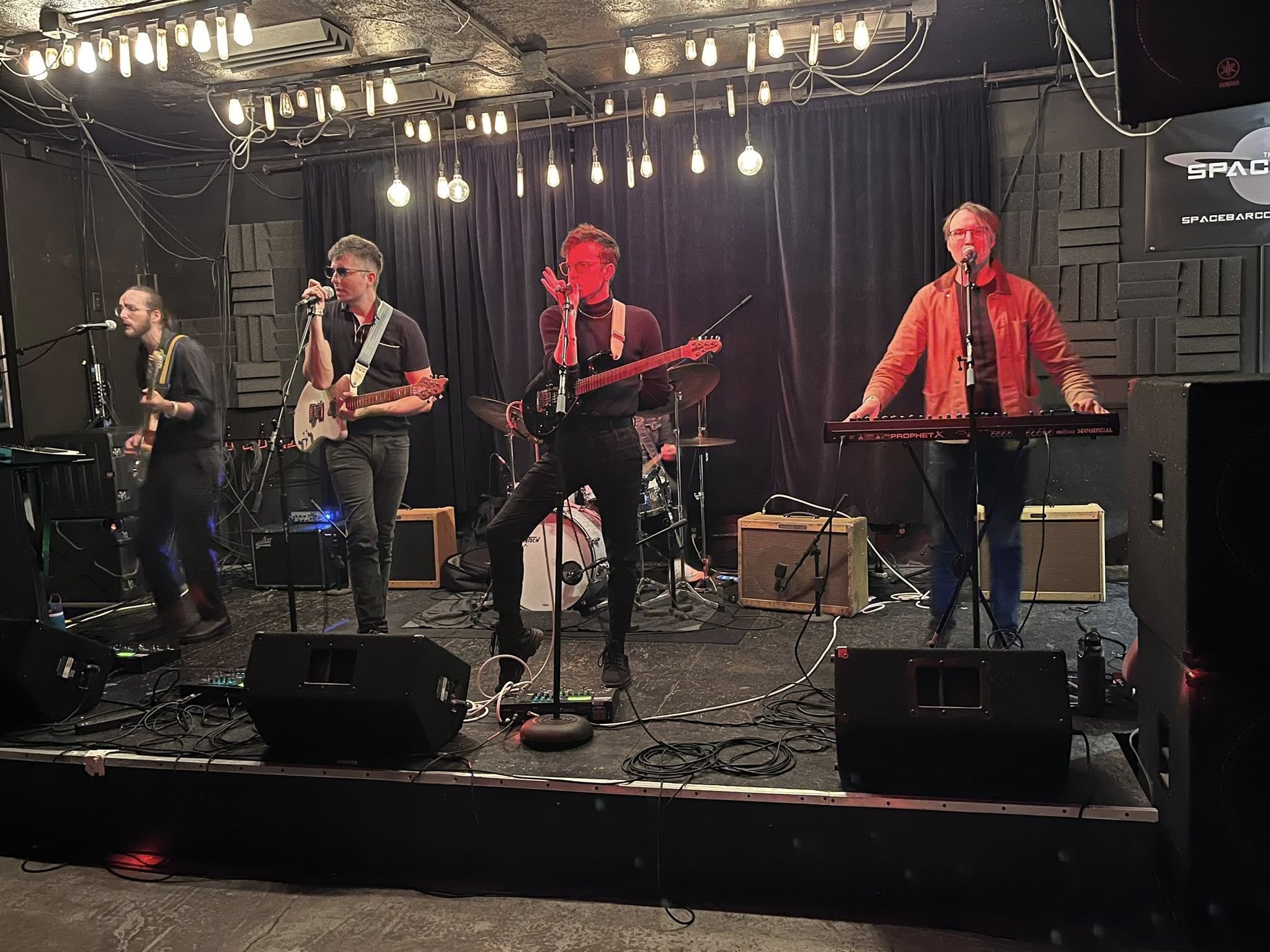
And then The Tisburys took the stage.
You ever see a band that walks out looking like maybe they’re just some regular dudes, guys you know, your co-workers at the local record store or your trivia-night competition—and then proceed to absolutely decimate your soul with rock and roll? That’s the Tisburys. They have that thing. The thing you can’t name without sounding like a lunatic or a prophet. The thing that separates the lifers from the LARPers.
From the first note, they tore into their set like a pack of dogs breaking into a butcher shop—joyful chaos, unrelenting passion, the sonic equivalent of smashing glass just to hear the sound. Think Springsteen’s storytelling welded to Big Star’s chiming melancholia, dragged through the gravel of Philly punk grit and splattered with just enough modern neurosis to feel like now. The guitars rang out like church bells for the godless. The rhythm section didn’t just keep time—they commanded it, like Kronos punching the clock with a snarl.
There was one song—title lost to the ecstatic fog of the moment—that built up slow, with this patient, pleading guitar line that felt like someone whispering secrets at the edge of the world. And when it broke? Jesus. It was like the roof lifted six inches and the universe cracked open just wide enough for all of us—sweaty, cynical, slack-jawed—to catch a glimpse of what music is for.
The Laughing Chimes.
Two minutes into their set, I was already sweating through my cynicism. These kids (and yes, kids—the kind that probably still think Hüsker Dü is a weird Scandinavian joke until they learn better) came out swinging with jangle-pop hooks like they’d just stumbled out of a time portal from Athens, Georgia, circa 1985, blinking into the fluorescence with nothing but Rickenbackers and righteous intention. There was no ironic detachment, no arch knowingness—just melodies sharp enough to slice through the smog of apathy I’d been inhaling since 2016.
They played like they meant it. You know what that means? Probably not. Because meaning it is a lost art. Meaning it is standing in front of twenty-something beer-slingers and 40-year-olds wearing Dinosaur Jr. shirts with a rhythm section that gallops like a dog finally let off the leash and singing about small towns, lost dreams, and heartbreaks that aren’t filtered through TikTok.
I felt young. Not “young” like your skincare ad says—you know, dewy and delusional—but young like: I want to start a band tonight and scream into a microphone until the cops come.
By the time The Laughing Chimes slashed through their final number—a feedback-drenched love letter to the Replacements that made me want to punch the air and cry at the same time—I was halfway converted. I could feel the old hunger stirring, the one that used to wake me up at 2 a.m. with a desperate need to play “Radio Free Europe” at bone-rattling volume.
Not money. Not TikTok virality. Not Spotify streams.
Connection. Defiance. Salvation.
And it wasn’t just the bands. It was us, the crowd—pressed together marinated in secondhand dreams, all there for the same unspoken purpose. To feel something real. I saw a guy in a vintage Guided by Voices tee taking it in like a benediction. I saw a girl lean her head on her girlfriend’s shoulder during a bridge that could have melted glaciers. I saw the bartender nodding along in the back like they’d forgotten they were on the clock. Magic. Not sleight-of-hand, not showbiz gloss—but ancient, electric, and utterly earned.
By the end, I was a puddle. Broken down and rebuilt by the raw, gorgeous power of three bands who didn’t need a light show or viral video to get through to me—just guts, melody, and an unshakable belief in the redemptive fire of a great song, played loud, in a room too small to contain it.
I walked out into the Columbus night buzzing like a man struck by divine lightning. My ears rang with the ghost-echoes of feedback and harmony. My body ached in that holy way, the kind you feel after love, surviving a riot, or finally remembering who the hell you are if even for a fleeting moment.
Rock and roll isn’t dead. It’s just waiting for you at a place like The Spacebar, on a night like that, where belief is possible again. Super City, The Tisburys and The Laughing Chimes didn’t just play a show.
Streaming Forward, Powered By The Past - if you love the 80s music, new music, Eurovision, cheesy pop and awesome playlists then let's get this pop party started!




 your tuesday afternoon alternative