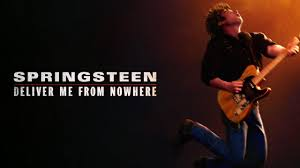
I have been watching a lot of music movies and documentaries. One of the most interesting music films I have seen is Deliver Me From Nowhere.
So, sure… I’m supposed to talk about a movie here, Deliver Me From Nowhere, which already sounds like a bootleg lyric scribbled on a diner napkin at 3 a.m., which is exactly right, because if you’re going to make a movie about Bruce Springsteen and you don’t start from the place where he’s half-lost, half-feral, recording songs alone with ghosts rattling around the room, running around his mind, then you’re just making another shrine, another museum exhibit with the volume turned down.
The trick with Springsteen—especially for film—is that he’s been embalmed while still breathing. Bandanas, stadiums, flag-waving, the myth of blue-collar transcendence with a backbeat you can chant to while buying merch. All of that is real enough, but it’s also the loudest, safest version of him. Deliver Me From Nowhere wisely points the camera in the opposite direction: toward the guy sitting alone with a cheap recorder, a harmonica, and a head full of the past that we all are trying to outrun from when we were kids, running as much from as well as to American dread. Toward Nebraska.
Let’s get this out of the way right now: Nebraska is one of the best albums Bruce Springsteen ever made. Maybe the best. And before the E Street choir starts humming “Born to Run” in protest, understand that this isn’t a knock on the big stuff. Those records are monuments. Nebraska is a crime scene. And crime scenes tell you more about a culture than monuments ever do.
The movie—at least in spirit, and somewhat in execution—gets that Nebraska wasn’t a detour or a demo tape that accidentally escaped. It was a confrontation. Springsteen stares straight into the cracked mirror of American masculinity and says, “Okay, let’s not lie about this.” No big band. No catharsis-by-chorus. Just flat voices telling flat stories about people who don’t get saved, or don’t even believe in salvation anymore (honestly, which is worse?).
If you want to understand why Deliver Me From Nowhere matters, you have to understand that Nebraska is a record made by someone who had already “won.” The success machine was humming. He could have turned the crank again and printed another anthem. Instead, he made a record where the American Dream shows up already foreclosed, the lawn brown, the marriage strained, the highway leading nowhere in particular.
That’s not an accident. That’s a choice. And it’s a deeply uncommercial one, which is what makes it all the more meaningful.
What the movie seems to grasp—again, fingers crossed as it doesn’t chicken out—is that Springsteen’s genius isn’t just empathy. A lot of critics stop there, because empathy is safe. Empathy doesn’t ask uncomfortable questions. But Nebraska isn’t just empathetic; it’s accusatory. Not in a preachy way, but in the way a good true-crime story accuses you by refusing to tidy itself up.
Take the title track. A killer talks. No moral lesson. No orchestral swell telling you how to feel. Just a voice explaining itself, almost bored, almost numb over the fact that the world is a place full of mean, anger, and hostility. That’s radical. Rock music, especially in the early ’80s, wasn’t supposed to do that. Rock was about triumph, even when it pretended to be about suffering. Nebraska lets suffering sit there without redemption, like an unpaid bill that you read in the dark after the electricity has been turned off.
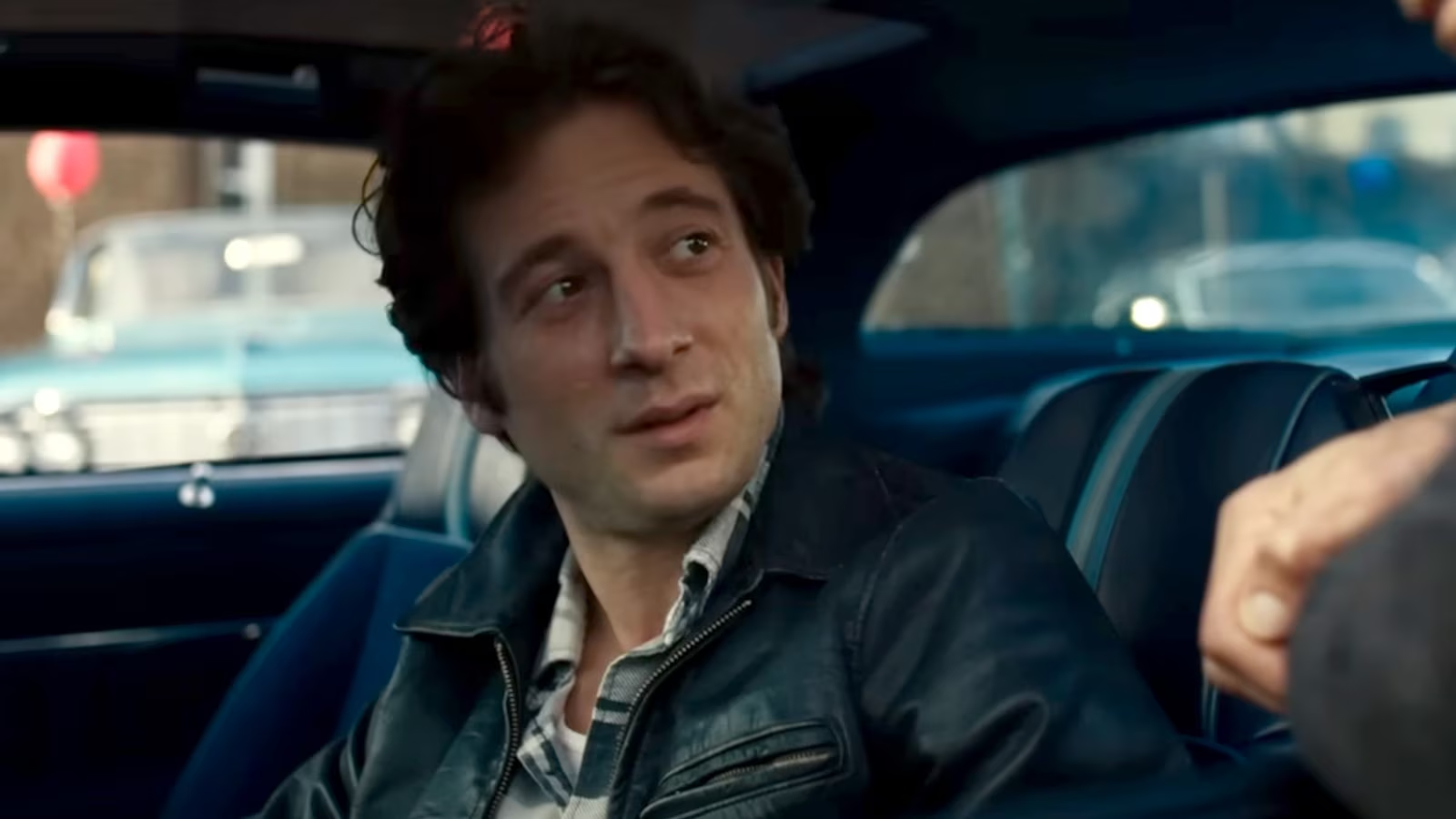
A film about this period has to resist the urge to explain too much. Explanation is the enemy of dread. If Deliver Me From Nowhere turns into a neat psychological case study—“here’s why Bruce felt sad”—then it misses the point. The power of Nebraska is that it doesn’t psychoanalyze its characters. It listens to them. And sometimes listening is more disturbing than understanding.
What makes Nebraska one of Springsteen’s best albums (I know, I already said that) is precisely what made it risky: it’s unfinished in all the right ways. The tape hiss is part of the meaning. The thin sound isn’t lo-fi nostalgia; it’s a sonic moral choice. These songs don’t deserve polish because their lives don’t have it. You don’t add reverb to a confession. You do not turn up a whisper, you lean in and listen hard.
If the movie captures that—if it lets silence do some of the talking—it could be one of the rare music films that understands restraint. Most biopics are loud because they’re afraid. Afraid the audience will get bored, afraid the myth won’t survive scrutiny. But Nebraska survives because it’s small. It’s the sound of someone realizing that being heard by millions doesn’t mean you’ve said what you needed to say. There’s also something profoundly American about the timing. Nebraska comes out in the early Reagan years, when optimism was being sold wholesale again, when flags were back in fashion, and the word “hardship” was being politely escorted off the stage. Springsteen responds not with protest anthems but with stories about people who don’t make it into speeches. That’s political without being programmatic. It’s sociology disguised as folk noir.

And here’s where the movie has an opportunity most Springsteen narratives avoid: showing that this record isn’t an aberration but a key. You can draw a line from Nebraska forward—to The Ghost of Tom Joad, to the quieter corners of Tunnel of Love, to every moment when Springsteen chooses unease over uplift. Nebraska isn’t the opposite of the stadium-Bruce; it’s the engine room underneath it.
In the end, Deliver Me From Nowhere doesn’t need to convince us that Springsteen is important. That argument was settled decades ago. What it needs to do is remind us that importance isn’t always loud, and greatness isn’t always communal. Sometimes it’s one guy, alone, trying to tell the truth without a safety net.
That’s why Nebraska endures. Not because it’s bleak, but because it’s honest. It refuses to fake hope, and in doing so, it earns whatever hope you find in it. If the movie understands that—if it trusts the audience to sit with discomfort, with ambiguity, with the hiss of the tape still running—then it won’t just be another rock biopic. It’ll be something rarer: a film that knows the quietest records sometimes make the most noise.


 your tuesday afternoon alternative