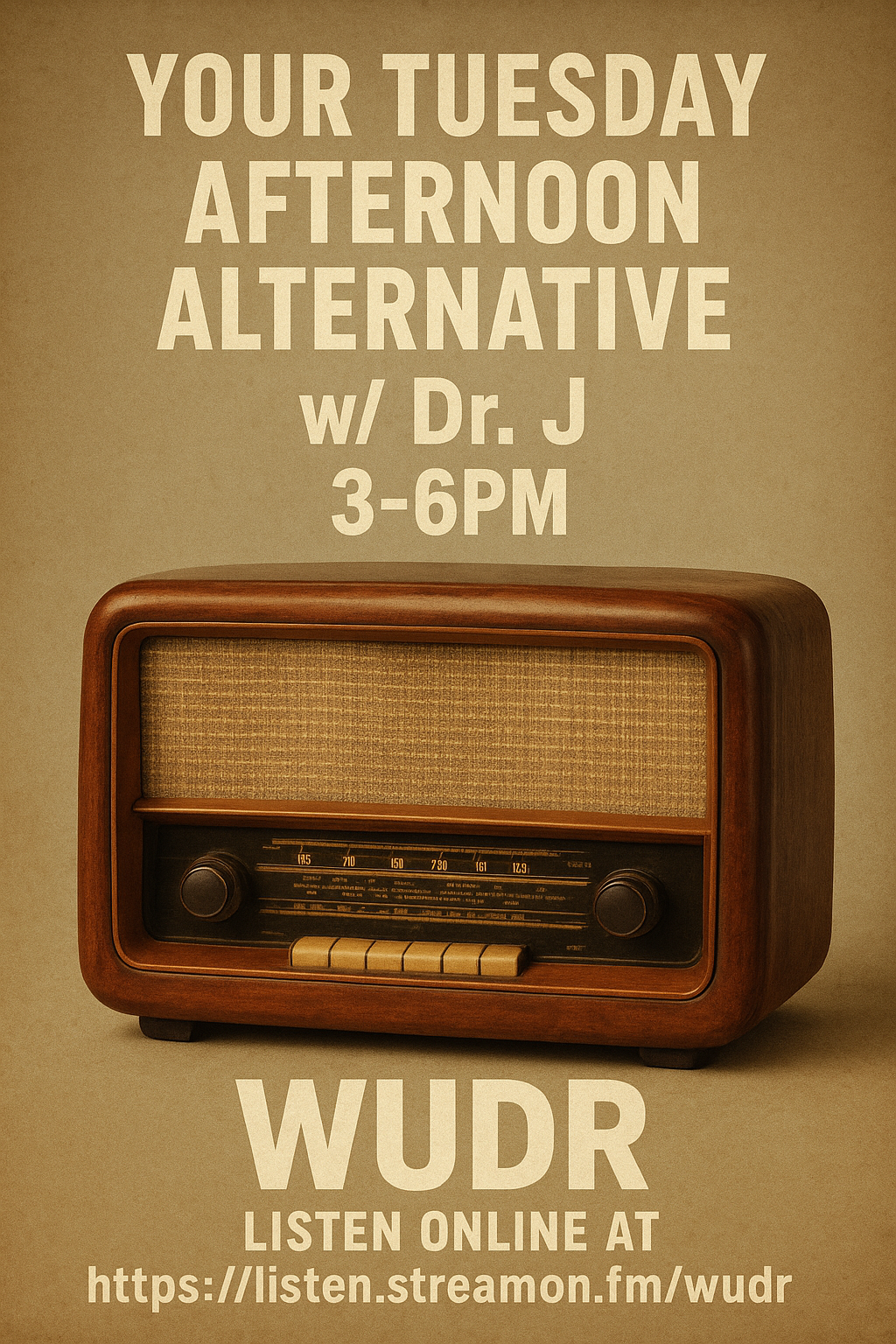
Six Hours in the Wild: The Latest Your Tuesday Afternoon Alternative Shows Land on Mixcloud

If you’ve ever driven around town with the radio on and the sun doing that late-afternoon slant that makes everything look like a memory already—gas stations glowing, parking lots half empty, the air buzzing with possibility and dread—then you already understand what Your Tuesday Afternoon Alternative is supposed to feel like.

And now, for the first time in a while, the last two full three-hour broadcasts are sitting online in all their sprawling, unruly glory over on Mixcloud. That’s six straight hours of music, ideas, weird segues, accidental poetry, and the kind of radio that only really works when nobody is trying too hard to make it work. Which, if we’re being honest, is the best kind.

Think of it as a kind of sonic time capsule: three hours where the world’s chaos gets distilled into guitars, synthesizers, a stray folk lament, maybe a punk blast that lasts ninety seconds but somehow resets your whole nervous system. Then you do it all again the next week. Radio as ritual. Radio as wandering conversation.

The thing about listening to these shows after the fact is that they become something slightly different than they were in the moment. Live radio is adrenaline and improvisation—you throw a song into the air and see what it does to the room. But on replay, the structure reveals itself. Themes emerge like ghosts in the static. Songs talk to each other across decades. A jangly indie track from 2024 suddenly feels like it’s answering a garage-rock scream from 1966.

That’s the secret architecture of good radio: it sounds loose but it’s secretly a web of connections. Which makes these two archived episodes especially fun to revisit. Over six hours, the mood drifts the way an actual Tuesday afternoon does. One minute the sun is out and everything sounds hopeful; the next minute you’re staring out the windshield thinking about every mistake you’ve ever made while some beautifully melancholy track hums through the speakers.

And that emotional whiplash is the point.
Great radio—especially college radio—has always been about resisting the algorithm. The streaming services want to smooth everything out into playlists that never challenge you. But real DJs still believe that music should occasionally knock the wind out of you. A dreamy pop song might suddenly give way to something ragged and noisy, and then a minute later you’re floating through a slow acoustic tune that feels like someone left a window open in your heart. That’s not bad programming. That’s life.

The two newly available shows capture that beautifully messy spirit. Across the six hours, you’ll hear indie rock rubbing shoulders with folk, garage, synth-pop, and the occasional left turn that makes you sit up and say, “Wait—what was that?” The answer, of course, is that it doesn’t always matter. Discovery is half the thrill.

And because the shows were recorded live, you also get the little human moments that make radio feel alive: the slightly crooked transitions, the spontaneous reflections, the sense that the whole thing could veer off the rails at any moment but somehow lands exactly where it needs to.

It’s the opposite of polished. It’s the sound of someone digging through a record collection and saying, You need to hear this.

Which is why having the full episodes archived on Mixcloud matters. Instead of a clipped highlight or a tidy playlist, you get the whole ride—the long arc of the afternoon, the gradual build, the strange emotional geography of three uninterrupted hours.

In other words: real radio.

Static Dreams: Why College and Community Independent Radio Still Matters

Let’s get something straight from the jump: independent radio—college stations, community stations, those hissing, crackling signals of barely legal wattage—are more than relics. They’re lifelines, and in a world drowning in curated blandness, they’re salvation that is desperately needed. Sure, you’ve got your algorithmic playlists and big-budget streaming platforms that can spit out the sonic equivalent of a hamburger combo meal, but let me ask you this: when’s the last time one of those songs on the apps and services truly blew your mind? When’s the last time a Spotify playlist made you feel something raw, something real, something alive?

Enter the humble, often-overlooked world of independent radio. These stations don’t play by the rules and thank God for that. College and community DJs who aren’t bound by focus groups or corporate overlords telling them which ten songs to cycle endlessly. They’re the anarchists of the airwaves, throwing down pop punk at 3 a.m., jazz fusion at noon, and some spoken-word poetry over ambient noise just because they can. They’re the kid in the back of the record store who’ll tell you that the B-side of a 7” pressed in someone’s basement in 1984 will change your life—and they’re right. Forgive me if this sounds trite or self-serving, but we believe in the power of music to change your life.

This is radio as it was meant to be: unpolished, unpredictable, and unafraid to go weird. College radio, especially, is often powered by the most crucial demographic for musical discovery—students who don’t yet know the rules they’re breaking. These DJs are sometimes just learning what it means to piece together a playlist, to tell a story in 20-minute sets, to unearth that obscure track nobody else has heard of. It’s raw, and it’s beautiful because it’s real.

And let’s not forget the community stations—the hyper-local powerhouses keeping neighborhoods and subcultures alive. These aren’t just radio shows; they’re conversations. They’re where you tune in to hear the pulse of your city, the heartbeat of your neighbors. It’s where activists and artists collide, where voices ignored by the mainstream get a microphone. It’s radio as rebellion, as resistance, as a refuge from the overpowering heavy challenges we all face.

Here’s the thing the big media conglomerates and tech giants don’t want you to realize: not everything should be convenient. Finding great music—or a great anything—takes work. It takes passion. That’s what makes it matter. Independent radio doesn’t spoon-feed you the hits; it hands you a map, points vaguely in a direction, and says, “Go get lost.” And in that wandering, you discover magic. You stumble across a DJ spinning a 10-minute opus made by an area band or a live set from some local group that sounds like they’re playing from the edge of the world. And you want to go there so you can be part of it.

In an era where everything feels like it’s been prepackaged, sanitized, and optimized for maximum engagement, independent radio stands as a glorious middle finger to the machine. It’s messy, it’s chaotic, and it’s alive in ways that nothing else in the modern media landscape can touch even thought they try to say that experimentation came from them.

What’s more, independent radio matters because it’s often the training ground for the voices we’ll be listening to in 10, 20, or 30 years. Think about all the media icons who got their start in college radio. Two words: Howard Stern. Ever heard of Rick Rubin? He was just some punk kid spinning records at NYU before founding Def Jam. Or Ira Glass, who honed his storytelling chops on the airwaves before becoming public radio’s golden boy. The indie stations are incubators for talent because they’re places where experimentation isn’t just allowed—it’s expected.

And don’t let anyone tell you radio is dead. Sure, the format’s shifted, and the big commercial stations are shells of their former selves, but indie radio persists because it’s adaptable. College stations now stream online, bringing their wild, untamed ethos to a global audience. Community stations podcast their shows, extending their reach far beyond the low-powered transmitter on the roof.

But more than that, indie radio matters because it’s personal. It’s not just about the music—it’s about the human connection. There’s something deeply comforting about hearing another person on the other end of the signal, someone who isn’t trying to sell you something, someone who’s just as excited about this obscure Brazilian psych-rock track as you are now that you’ve heard it. It’s a reminder that music isn’t just content—it’s communion.

And yeah, maybe it’s a little romantic to wax poetic about this scrappy corner of the media world. Maybe it’s easier to dismiss it as nostalgia for a pre-streaming era. But dismissing indie radio is to dismiss the very soul of music, the thing that makes it matter in the first place. It’s the idea that art doesn’t have to be perfect, that it doesn’t have to be profitable, that it can just be.

So the next time you’re scrolling through an endless stream of playlists that all sound the same, do yourself a favor: tune in to the static. Find the frequency where some over-caffeinated college kid is ranting about a new band you’ve never heard of, or where a local DJ is spinning records in a tiny room plastered with band posters and graffiti. Listen with your whole heart, and remember what it feels like to discover.

Because independent radio isn’t just a medium—it’s a movement. And in a world that desperately wants you to settle for the lowest common denominator, it’s the one place still daring to reach higher.