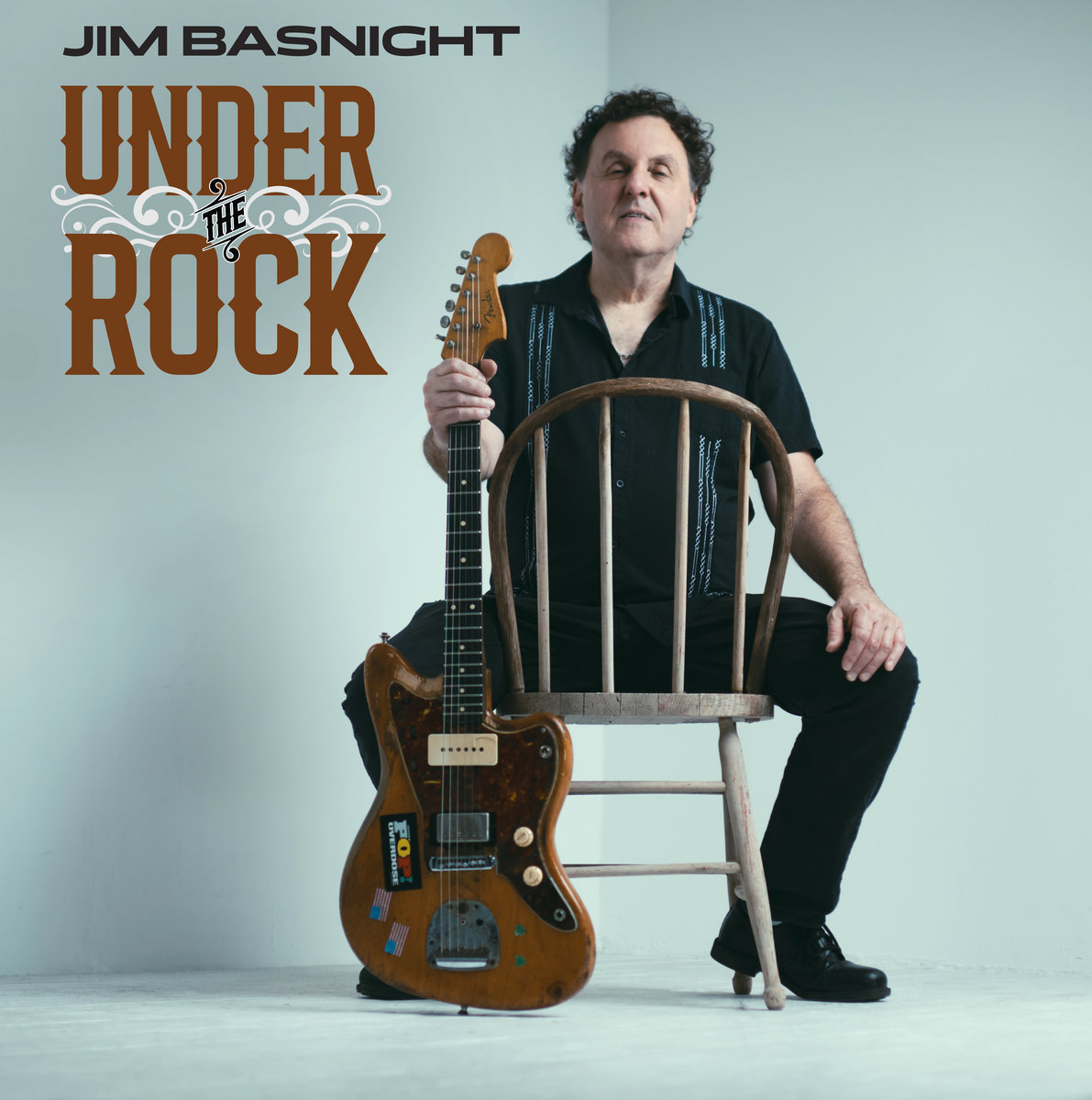
Under the Floorboards, Past the Hype: Jim Basnight and the Power of Under the Rock

Rock records don’t arrive like messages from the future anymore; they crawl out from under the floorboards, smelling of time, sweat, and unfinished conversations. Under the Rock is one of those stubborn artifacts that refuses to die quietly. Jim Basnight doesn’t sell you revelation; he hands you proof, the sound of a songwriter who outlasted the noise, survived the cycles, and came back swinging not with volume, but with authority.

Jim Basnight has never been interested in novelty, only in arrivalUnder the Rock sounds like the moment when a long-argued idea finally stops pacing the room and sits down and stays, perfectly certain it belongs there. This is his first album of all-new originals since 2019’s Not Changing, and it doesn’t sound like a comeback so much as a consolidation—five years of songwriting, touring, and living boiled down to something sturdy, melodic, and quietly defiant in the space of swaggering rock and roll.

Basnight has always written songs that know better than to scream at you. These are songs that wait for you outside in the undeniable groove of guitar and percussion. Under the Rock draws from the strongest material he’s written over the past half-decade, along with a few older pieces that have been dragged through the miles and sharpened by repetition. You can hear the refinement not as polish, but as confidence. The record captures a sound Basnight has been chasing for years. A sound imagined long before it existed, finally realized through patience, trust, and a refusal to rush the good parts.

Much of the album grew out of years on the road with drummer Sean Peabody and vocalist Beth Peabody, and it shows. Touring doesn’t just tighten a band—it creates a shared grammar, a way of knowing when not to play. Sean Peabody’s drumming is about feel rather than flash, locking into grooves that give the songs room to breathe without ever losing momentum. There’s an unspoken understanding at work here: the song always comes first.

Beth Peabody is one of the quiet revelations of Under the Rock. Her vocals don’t compete with Basnight’s; they complete them. Her phrasing is attentive, her pitch dead-on, but more importantly, her vocal personality has grown into something assured and expressive. She brings emotional shading that deepens the arrangements, turning good songs into lived-in ones. This isn’t backup singing—it’s partnership.

When Glenn Hummel steps in on drums for later sessions, he carries forward the rhythmic feel with the ease of someone who has been inside this music before, because he has. A longtime collaborator from the Jim Basnight Band, Hummel doesn’t reinvent the wheel; he keeps it rolling straight and true. The continuity matters. Under the Rock sounds cohesive because it is.

At the center of it all is Garey Shelton—bassist, engineer, mixer, and co-producer—anchoring every track. Thirty years of collaboration buys you something money can’t: trust without explanation. Working largely from his Seattle-area studio, Shelton often guided the project independently, shaping performances and sonics with an ear tuned not to trends but to truth. The bass playing is patient and grounded, the mixes clear without being sterile, warm without being nostalgic. Shelton helps realize the album’s clearest expression by knowing exactly when to intervene—and when to let Basnight be Basnight.

And that’s the thing: Under the Rock isn’t chasing relevance. It assumes it. Basnight writes like someone who understands that pop craft isn’t about youth or volume, but about clarity of intent. These songs carry melody the way some people carry history along with them, without strain, without apology. There’s rock here, yes, but also folk sense, power-pop instincts, and the accumulated wisdom of someone who’s learned that restraint is its own form of rebellion. Sometimes the music cooks best when you don’t throw everything possible in the stew.

The great music writer, reviewer, and critic Lester Bangs used to write about artists who meant it, who didn’t confuse sincerity with spectacle. Under the Rock is one of those records. It doesn’t beg for attention. It doesn’t posture. It just stands there, solid, humming with lived experience, daring you to mistake rock and roll arrangements for weakness.

Jim Basnight didn’t reinvent himself on Under the Rock. He didn’t need to. He just finally caught the sound he’d been hearing all along—and let it speak.

Traveling Lo-fi Locations: ‘Take A Trip’ Through Mythical Motors’ ‘Upside Down World'”

In the space where Guided By Voices, Neutral Milk Hotel, and Pavement are the well recognized signposts of indie rock, bands often struggle to carve out a distinct identity, Mythical Motors’ latest offering, “Upside Down World,” emerges as a refreshing assured guitar driven lo-fi beauty. Their sound is a kaleidoscope of rock aesthetics, alternative swagger, garage rock grit, and melodic hooks that ensnare the listener in a whirlwind of sonic exploration. Released amidst a sea of all too predictable soundscapes, this album boldly ventures into uncharted territory, blending elements of psychedelic rock, folk, and dream pop to create a mesmerizing sonic journey. If fairness truly existed, this band would be a household name.

At the heart of Mythical Motors’ sonic identity is their penchant for brevity and spontaneity. Each song feels like a fleeting moment captured in time, with abrupt transitions and a sense of urgency that keeps the listener on their toes. The lo-fi production quality adds a layer of authenticity, as if the music is being transmitted directly from the garage where it was conceived.

From the opening track, “Take A Trip,” Mythical Motors invites listeners into a swirling and swaying universe where reality blurs and imagination reigns supreme. The passionate vocals soar over layers of equal parts jangling and fuzzy guitars next to driving bass and sparkle of intense percussion, setting the tone for the album’s sonic palate. Amidst the fuzz and distortion, there’s an undeniable pop sensibility that shines through in the form of catchy melodies and infectious hooks. Mythical Motors has a knack for crafting earworms that burrow their way into your subconscious, lingering long after the music has stopped. You will hum the tune long before you know the words.

Throughout “Upside Down World,” Mythical Motors demonstrate a remarkable ability to seamlessly weave together disparate musical influences without losing the Ramones-ian power pop finish. Tracks like “The Office of Royal Discovery” and “Grand January High” showcase the band’s penchant for crafting immediate atmospheric environment reminiscent of ’60s psychedelia, while songs like “Plastic Saturn,” “Upside Down World,” and “Book of Broken Man” incorporate early alternative melodies and harmonies as if Peter Buck played in early Guided By Voices.

One of the album’s standout moments comes in the form of “Court of The Beekeepers,” a fantastic song that showcases emotive vocals against a backdrop of synth blips, fuzz guitar and perfect backing vocals. Feels like ‘A Bell is a Cup… until its Struck’-era Wire. The song’s introspective lyrics explore themes of introspection and self-discovery, adding a layer of depth to the album’s gravity. And that last ten seconds of call and response will make you want to play the song over and over again.

Yet, for all its lo-fi allure, “Upside Down World” is not without its moments of raw energy and intensity. Tracks like “Elijah Stop Spinning” and “Stop The Sun” inject a dose of adrenaline into the album’s sonic tapestry, with driving rhythms and distorted guitars that propel the listener into a frenetic cascade of sound that feels like the listener should be spinning.

But perhaps the most remarkable aspect of “Upside Down World” is its ability to evoke a sense of nostalgia while still feeling decidedly contemporary. Drawing inspiration from the music of alternative past while embracing the present, Mythical Motors crafts a sound that feels both timeless and fresh, inviting listeners to lose themselves in its hypnotic melodies and evocative lyrics.

Upside Down World” is more than just an album—it’s a transcendent experience that transports listeners to another realm entirely. With its near constant guitar attack, captivating vocals, and expansive sonic palette, Mythical Motors has crafted a musical odyssey that is sure to resonate with fans of indie rock and beyond. In a world where conformity runs the shop, Mythical Motors dares to defy expectations, offering up a sonic journey that is as daring as it is beautiful.

Facebook Soundcloud Bandcamp Songkick Instagram

New Motel Beds video

One of Dayton’s saviors of rock and roll, our own Motel Beds keep getting attention for their ‘we are not afraid of guitar’ songs. Their video for the second song on their terrific new album, Dumb Gold is called “Valentimes”. Remember now and do not forget that the ‘Beds have made Dumb Gold available for a name your own price — that means it could be free but you really should cough up a few dollars! Great music for your music listening pleasure!

Once you hear a Motel Beds song, you cannot go back!