More Than Chance: Review of Maps and Legends: The Story of R.E.M. by John Hunter
A good book on music becomes impossible to put down. The prose is compelling not just in the sense of wanting to finish a reading task, but with a sense of learning new facts or seeing a band from a different perspective. We used to call that a ‘page-turner’ – the reader could not stop. You know that you are reading a great book when you can feel the music, hear the music while reading. This book is just such an experience. I was so moved by the book that I sought out the author for an interview which will be shared here soon.
Maps and Legends: The Story of R.E.M. offers a captivating exploration of one of the most influential bands in alternative rock history. Written by John Hunter, the book deftly chronicles R.E.M.’s journey from their humble beginnings in Athens, Georgia, to international superstardom. Hunter brings rich depth from a fan’s perspective but shows the band’s warts and all for the reader without engaging in hero worship or gossip.
Far too often, books about successful rock bands are written in fait accompli style where the success of the project is assumed. That is not the case with Maps and Legends. Part of the reason for the success of R.E.M. is a series of lucky breaks that the band can capitalize on and does so with enthusiasm. Beyond blind luck, the band can capitalize on several situations that make the path possible. For example, the relationship between Bill Berry and Ian Copeland who formed Frontier Booking International (FBI) due to Berry’s internship when he was younger allows R.E.M. access as an opening band to several major opportunities to advance their career. Copeland’s brother’s ownership of IRS Records certainly gave the band a significant opportunity to have their music more widely distributed. However, the story of the band is not a series of unexpected chance moments or simply social networking, the work ethic and nearly herculean effort of the collective members played a role as well. Yet even with these opportunities the members as individuals and the band as a collective struggle with the transition from indie status to something larger to eventual international status. Hunter provides the facts so that the reader can see that in some ways the success was not foretold, it was not automatic.
(Photo used by courtesy of John Hunter)
Hunter provides a thorough account of the band’s evolution, analyzing their unique sound and lyrical depth, which set them apart from their contemporaries. The gradual growth of Peter Buck’s guitar work is especially well explained. Buck’s efforts to avoid music theory and play based on feel and intuition allow sonic choices that set the band apart from their contemporaries.
The narrative is rich with anecdotes, past interviews, and insights that highlight the band’s origins, development, creative process, personal dynamics, and the musical landscape they navigated. Hunter’s attention to the biographic detail of the four individuals who collectively gave life to the band brings into stark relief how the band began. To date, few books have explored Michael Stipe’s early musical career before co-forming R.E.M. Throughout this book key moments in R.E.M.’s career, including the release of landmark albums like Murmur, Reckoning, Document, Life’s Rich Pageant, Out of Time, and Automatic for the People are detailed engagingly and directly. The reasons that the albums sound the way that they do are answered.
One of the book’s strengths is its balance between personal stories and broader cultural commentary. Hunter situates R.E.M. within the context of a changing music industry, exploring their impact on the rise of indie and alternative rock. He captures the essence of their appeal: a blend of introspective lyrics, innovative sounds, and a commitment to making music. Hunter is deftly able to show how the words and music change across the early, mid, and late periods of the band without sounding trite or apologetic.
While the book is comprehensive, it also invites readers to reflect on the emotional resonance of R.E.M.’s music, making it a compelling read for both longtime fans and newcomers. Hunter’s engaging writing style and deep understanding of the band make Maps and Legends not just a good biography, but a celebration of a musical legacy that continues to inspire. Overall, it’s a must-read for anyone looking to understand the profound influence R.E.M. has had on music and popular culture.
In the ever-shifting realm of music, where emotions dance to the rhythm of melodies and lyrics, the significance of first-person accounts is akin to the heartbeat of that sonic industry. Many books, articles, ‘zines, blogs, documentaries, and more have chronicled the evolution of rock and roll. Often the stories are made vivid through personal narratives which serve as soulful storytellers, encapsulating the visceral essence of musical experiences.
At the heart of this effort lies the undeniable truth that music is a deeply personal affair. Beyond the glitz of stage lights and the glamour of fame, the authentic narratives of individuals thrust us into the beating heart of musical spaces. First-person accounts unravel the mysteries behind the creation of iconic songs, giving us a backstage pass to the emotions, struggles, and triumphs that shape the artist’s sonic voyage.
Take, for instance, the confessional tales of Bob Dylan as he traversed the winds of change in the 1960s. His first-person accounts, woven into the lyrical tapestry of folk and protest music, became the anthems of a generation. Rolling Stone’s intimate interviews with Dylan, where he bared his soul and articulated the intricacies of his musical odyssey, stand as testaments to the power of firsthand narratives in deciphering the magic behind the music. First-person accounts from producers, engineers, and mixers also offer a peek behind the curtain at music creation. When those who shape and capture sound share their ‘I was there’ experiences as only someone who was present at the creation of the music can, all music fans are given an opportunity to learn how the various pieces were captured and assembled into song.
These direct accounts bridge the chasm between artist and audience, forging a profound connection. Whether it’s the euphoria of a Woodstock moment, the stories that surround Live Aid, or the fan culture of Swifties, first-person experiences, oral histories, and those who bear witness to the melancholy of a heartbreak anthem, the firsthand narratives serve as empathetic conduits. The reader becomes a fellow traveler in the sonic expedition, sharing the highs and lows, and reveling in the universal language that transcends boundaries.
In our digital culture, where streaming services and algorithms dictate musical preferences, the authenticity of firsthand accounts offers a refreshing counterpoint. It reminds us that behind every beat, every lyric, every strum of a guitar, there’s a human story waiting to be unveiled. It’s the firsthand narratives that echo through attempts to understand music and the music industry, immortalizing the songs and the artists who dared to dream. These narratives, with their raw honesty and unfiltered passion, weave an indelible tapestry that captures not just the sound but the soul of music.
With these ideas in mind, we contacted various music professionals who work in different facets of the industry. Tim Anderl who has written extensively on music and shared his passion and enthusiasm for music to the extent of creating — from the ground up — his own music promotion company is one of the first to kindly answer our call for a reflective essay on their personal experiences. Thank you very much, Tim. This excellent essay shines a light on music publicity and promotion.
Although I’d studied magazine journalism as an undergraduate student at Ohio University with the intent of becoming a professional music feature writer, the reality upon graduation was that if I wanted to live independently and have the blessings of creature comforts like health and dental insurance, I might have to be agile in my job search. Roughly two months later, I’d secured a junior administrative position at a medical non-profit in Cleveland, Ohio. While I did have the opportunity to flex some of my writing/journalism muscles — organizing a monthly health lines program for AM news radio, writing for and editing the organization’s monthly newsletter/magazine, and coordinating inputs for an insert in the Cleveland Plain Dealer — the truth was, I was drifting farther, and farther from my original plan.
Thus began a series of DIY endeavors, including a cut-and-paste print zine, an online music magazine, a blog, and eventual “freelance” work for a variety of publications, a couple paid, but most unpaid. The payment, or lack thereof, never really bothered me. During the ’90s and ’00s, publicists still sent physical releases for review. This meant sometimes dozens of free CDs, and occasionally records, for many years. Any writing that did yield a payday was donated to a charity or local food bank as by this time I’d taken a comfortable job as a marketing and communications professional with a large government contractor that primarily paid my bills. And, my day job also afforded me the freedom of spending every waking hour outside of work going to shows, promoting shows, reviewing music, and interviewing bands.
Then, 12 years ago I had a crisis of conscience after the subjects of a handful of features and two cover stories, published in international print magazines, were outed publicly for abusing their power dynamic to take advantage of or sexually abuse members of their fanbase. The question that emerged for me was, “Why am I spending hundreds of hours a month writing features on seemingly disgusting people that I don’t actually know in real life?” As the recipient of dozens to hundreds of pitches by music publicists each day via email, I decided to try my hand at music PR, something that I really had no experience in aside from being familiar with writing and circulating press releases to non-music entities.
Original color logo by Dan Rizer
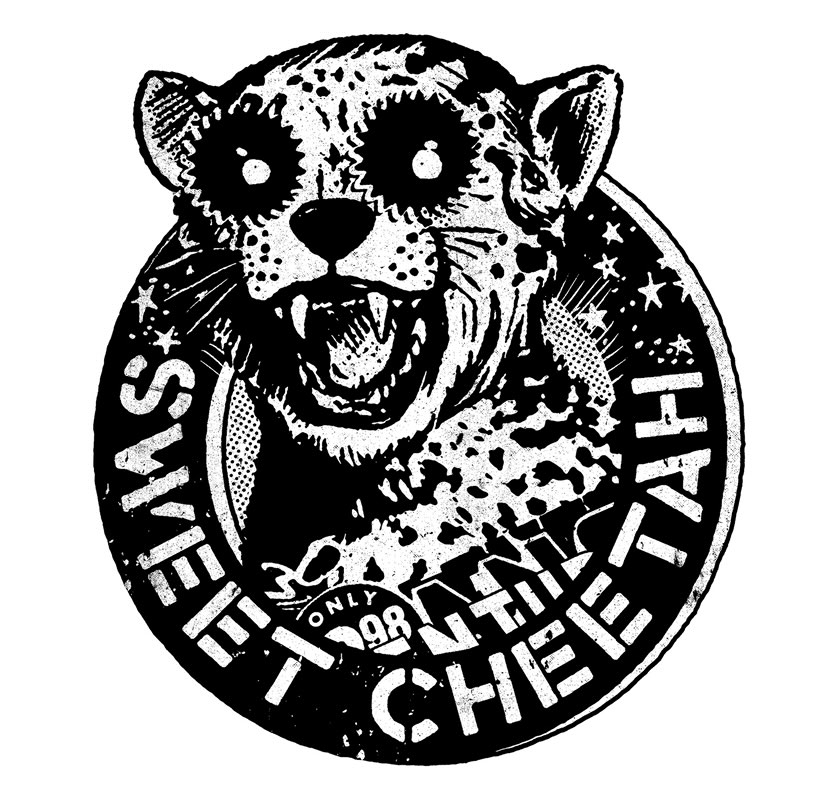
And Sweet Cheetah Publicity was prematurely born. Where did the moniker come from you ask? The answer is two-fold. First, it was inspired by a short-lived Kent, Ohio band called Suite Cheetah. How does that make sense you ask? As I visualized what I wanted writers/listeners to say when they heard a release I’d sent them, the answer became, “Sweet Cheetah! This is so good!” It made sense in my mind’s eye anyway…
At the time, the swim lane that I decided to concentrate on consisted of doing free PR for my local friends and their bands and projects, leaning on a small list of publications and my Hotmail account. But, it wasn’t long before longtime friends from other parts of the country and world came calling. Then friends of friends came calling, as did people with no prior connection to me circle in any way. And as the requests for help multiplied exponentially, so did the workload. It no longer made sense to send individual emails to a couple hundred contacts on my modest list, and I purchased a Mailchimp subscription, importing my contacts, and making strategic email blasts possible.
Another complete game-changer for the endeavor came when my brother’s band, The 1984 Draft, began planning for their debut album release. Suffering from severe imposter syndrome as a publicist, I provided my brother with contacts for those that I deemed the best publicists I knew and he began to contact them. Of the dozen or so he reached out to, he received only a single reply. This resulted in a conference call where the publicist outlined the cost of an effort that would place a few singles as premieres, and result in circulation of a press release or two. The cost: $1,000 for a month’s campaign.
Black and White Logo by Paul Rentler
When I heard about the meeting, I offered my brother the option of working with me to push the record out together. Simply, it didn’t, and still doesn’t really, make sense to me that a small independent artist or band that is already shouldering the cost of a practice space, recording, mixing, mastering, pressing a physical product, booking their own shows, printing their own merch, paying a grand a month for a publicist, who, truth be told, can’t really promise a tangible ROI or sales. Anyway, as a result of dozens of hours of research on his part, and an old press list a friend had received from someone in the Guided By Voices camp, my brother returned to me with an audience list, including radio, that was several hundred publications, podcasts, blogs, etc. deep.
The result of that campaign, in which my brother and I worked for 7 months, was dozens of interviews, features, reviews, radio plays, and much to our delight, placements on several “best of the year” lists. Additionally, this established a solid, somewhat successful modus operandi that I would use to work on other campaigns in the future.
Additionally, around that time and with the amount of work continuing to grow, the model for SCPR evolved into a “pro-bono PR in exchange for some commitment to charitable giving” model that, to date has resulted in donations of over $100K to a variety of charitable organizations including the NAACP legal defense fund, the American Heart Association, Brigid’s Path, House of Bread, Shoes For The Shoeless, Punks with Lunch, and Appalachian Prison Book Project, to name a small sampling. Sometimes the contribution is $20, sometimes $100, sometimes over $1,000.
Palm Ghosts cover art by Joseph Lekkas
In 2023, inspired by my friends from Palm Ghosts and Bobby Johnson from The Ghost Is Clear Records also launched a SCPR Cover For A Cause series this year, delivering incredible covers from Canyons, Jeremy Porter & The Tucos, halicon, Palm Ghosts, and Resignation to the Bandcamp platform and with the proceeds going to charity.
Thanks also to the behind-the-scenes heroes who helped with mixing and mastering including Dan Coutant from Sun Room Mastering, J Robbins, and Chris Common.
Sweet Cheetah PR also saw a variety of exciting projects. For instance, working with Brainiac on their UK/U.S. tour and archival releases, and saw a tremendous amount of attention including a review in Pitchfork, Brooklyn Vegan, and feature items in Stereogum, The New York Times, The Guardian, etc. I was also blessed to continue working with some of my very favorite musicians and labels of all time like J. Robbins and Jawbox, Jack Duckworth of Scotland’s Soft Riot, Philadelphia noise mongers Rid of Me, Scott Padden and the gang from Pilot To Gunner, Mark Kaiser, the genius behind the Sacramento-based Mt.St.Mtn label, Matt Traxler of Cleveland’s Steadfast Records, etc. SCPR also continues to sponsor our favorite music interview podcast, Peter Tanski’s The Book of Very Very Bad Things.
I also discovered, via my network of friends, some incredible emerging artists: Toledo-based, teenaged songwriter Cash K. Allen (who joined the SCPR 11th anniversary celebration with Fred Mascherino, Paige Beller, and The 1984 Draft), Richmond, Virginia’s Roseneath, and Los Angeles’ Lewis.
Truth be told, I’m so blessed to have a cadre of talented, awesome friends who’ve allowed me to remain in the orbit during my adult life, and that makes it impossible to name them all and detail the reasons why I love and am inspired by them. They’re the reason Sweet Cheetah has the good fortune of being curated to my personal tastes, and a high level of musicianship, which brings an incredible sense of pride with regards to my involvement and work.
Toward the end of the year, in partnership with Dayton’s Poptek Records, the California Bay Area label Sell The Heart Records, and Engineer Records in the UK/EU released the most recent album from Palm Ghosts, titled I Love You, Burn In Hell. With the help of the SCPR network, the band also visited Dayton, Columbus, Cleveland, and Athens for live performances this year. Although I’m not sure what the future of Sweet Cheetah Records will be, I’m beyond thankful to have been involved in this trio’s incredible release.
I’m not sure what 2024 has to offer by way of Sweet Cheetah yet. I have made a handful of commitments to a couple great bands and labels already. Will there be more Covers For A Cause or another Sweet Cheetah Records release? Will publications and journalists who’ve not responded to us in 12 years start paying attention? Will journalists and publications who’ve been kind to us in the past, continue to spread the good news about those we work with? The only thing I can say for sure is that any commitment I make to a project will receive the same stubborn tenacity that I think I’ve proven in the past, and anyone who supports our work is sure to receive a sincere, and heartfelt thank you. And, thank YOU.
Streaming Forward, Powered By The Past - if you love the 80s music, new music, Eurovision, cheesy pop and awesome playlists then let's get this pop party started!




 your tuesday afternoon alternative