Songs Against the Sirens

When the helicopters circle low over a neighborhood, they make a sound that feels older than electricity. It is the thrum of authority announcing itself. In Minneapolis last winter, that sound mixed with others: the clatter of hurried suitcases, the click of phones spreading warnings in Spanish, Somali, Hmong, and English, the uneasy quiet of schoolrooms where too many desks sat empty. Federal immigration enforcement swept through the Twin Cities with a force that startled even communities accustomed to living with uncertainty.

And, as has happened so many times before in American history, musicians began turning the noise into music.

Protest songs rarely arrive as tidy manifestos. They appear instead as fragments of feeling—ballads scribbled on tour buses, verses tested at benefit shows, choruses sung in church basements and union halls. Bruce Springsteen has spent half a century mastering this art: the ability to take a specific injustice and fold it into the larger story of who we are. His recent live sets have revived “The Ghost of Tom Joad” and “American Skin (41 Shots),” reframing them for a new era in which questions of policing, borders, and belonging are once again painfully urgent. When he introduces those songs now, he often speaks directly about families living in fear of raids, making the connection between past struggles and present ones impossible to miss.

Springsteen has also used newer material to gesture toward the same terrain. In “Rainmaker,” from 2020’s Letter to You, he warns of leaders who “steal your dreams and kill your prayers,” a lyric that fans have increasingly heard as an indictment of the politics that enable harsh immigration crackdowns. At concerts in the Midwest, he has dedicated “Long Walk Home” to immigrant communities, turning an older song about alienation into a present-day pledge of solidarity. The message is classic Springsteen: America belongs to those who build it, not merely to those who police it.

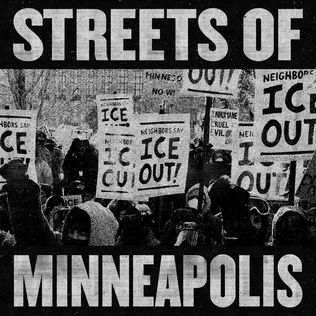
Bruce Springsteen’s “Streets of Minneapolis” stands as one of the most direct and urgent protest songs of his long career, written and released in January 2026 in response to violent federal immigration enforcement actions in Minneapolis. The song’s lyrics paint a stark picture of a city under duress—“a city aflame fought fire and ice ’neath an occupier’s boots”—and explicitly name the deaths of Alex Pretti and Renée Good at the hands of ICE agents as catalysts for the track’s creation. Springsteen recorded the song within days of the events and dedicated it to “the people of Minneapolis, our innocent immigrant neighbors,” underscoring its solidarity with those resisting what he called “state terror.” Musically, it begins with a spare acoustic arrangement before building into a fuller folk-rock chorus that includes a chant of “ICE out of Minneapolis,” transforming the narrative from lament to communal call to action. By invoking local streets and specific victims, Springsteen shifts from abstract critique to vivid storytelling, grounding national debates over immigration enforcement in the lived experiences of a particular place and its people.

Across the Atlantic, Billy Bragg has been sharpening his own brand of melodic concern. Bragg’s music has always insisted that politics is not an abstract debate but a lived experience. In recent years, he has circulated new compositions such as “The Sleep of Reason” and “King Tide and the Sunny Day Flood,” songs that connect nationalism, xenophobia, and state power in plainspoken language.

Billy Bragg’s recent song “City of Heroes” exemplifies how veteran protest singers are responding in real time to state violence and grassroots resistance. Written, recorded, and released in less than 24 hours in late January 2026, the track was inspired by the killing of Alex Pretti and the earlier death of Renée Good—both widely reported incidents involving U.S. Immigration and Customs Enforcement agents in Minneapolis, Minnesota. Bragg frames the song around a powerful invocation of Martin Niemöller’s famous warning about silence in the face of oppression, repurposing its structure to insist that individuals must stand up when “they came for the immigrants… refugees… five-year-olds… to my neighborhood.”

Rather than dwelling solely on the perpetrators of violence, the song centers the courage of ordinary Minneapolis residents who “will protect our home” despite tear gas, pepper spray, and intimidation, making the city itself a locus of collective heroism and moral witness. Through its stark lyrics and urgent folk-punk delivery, “City of Heroes” both honors local resistance and challenges listeners everywhere to confront injustice rather than look away.

What is different now is how quickly these songs travel and how intimately they are connected to specific communities. In Minnesota, local artists have woven themselves into the fabric of resistance. Somali American rapper Dua Saleh’s “body cast,” though not written solely about immigration, captures the claustrophobia of living under constant surveillance. Minneapolis songwriter Chastity Brown released “Back Seat” after volunteering with local advocacy groups; the song tells of a mother trying to explain to her son why “men in badges came before the sun.” Musicians have often turned their songs into anthems at rallies.

Nationally, a wave of artists has confronted immigration enforcement head-on. The Drive-By Truckers’ blistering “Babies in Cages” remains one of the clearest condemnations of family separation ever recorded, and the band has revived it repeatedly as raids intensify. Margo Price has performed the song at fundraisers, adding her own spoken-word verses about rural Midwestern towns emptied by deportations. Latin pop star Residente’s “This Is Not America” links border policy to a longer history of hemispheric violence, while Mexican-American band Las Cafeteras’ recent single “If I Was President” imagines a world where “no kid sleeps in a holding cell.”

Music becomes a form of accompaniment. It says to frightened families: you are not alone in this story.

Music critic Ann Powers has often observed that songs do not replace policy. They cannot halt a raid or change a law. But they shape the emotional climate in which those laws are debated. They help define what cruelty feels like and what compassion sounds like. In moments of crisis, they keep the human stakes visible. The current wave of immigration enforcement has produced images that feel almost medieval: agents in tactical gear arriving at dawn, children escorted past news cameras, workplaces emptied in minutes. Musicians respond by insisting on the modernity—and the intimacy—of these events.

These acts may seem small, but protest music has always worked through accumulation. One song becomes a hundred, then a thousand. The civil-rights anthems of the 1960s did not end segregation on their own, yet they provided the soundtrack that made the movement recognizable to itself. Today’s musicians are doing similar cultural labor, stitching together a sense of shared purpose across neighborhoods and genres. There is also a new bluntness in the language. Where earlier generations sometimes relied on metaphor, many contemporary artists name ICE directly. Punk bands from Duluth to Des Moines sell T-shirts that list hotline numbers on the back. Choirs gather outside detention centers to sing lullabies in many languages, turning public space into an improvised concert hall of solidarity.

Still, the best songs resist becoming mere slogans. Springsteen’s gift has always been his ability to locate the political inside the personal: the worker who just wants to get home, the teenager who dreams of a wider world, the immigrant who believes the promises printed on postcards. Bragg, too, mixes anger with tenderness, pairing sharp choruses with melodies that invite sing-alongs. Protest music must be welcoming as well as confrontational; it has to create a community big enough to hold grief and hope at the same time.

In Minneapolis and beyond, that community is gathering wherever music is made. At a recent benefit concert on the West Bank, performers from Somali jazz groups, Hmong folk ensembles, and indie-rock bands passed a guitar from hand to hand while families shared homemade food. Between songs, organizers explained how to donate to emergency housing funds and accompany neighbors to court hearings. The event felt less like a show than a temporary village, built out of rhythm and resolve.

This is how culture pushes back against fear. Not with grand gestures, but with steady, persistent acts of care. A chorus sung together. A lyric that tells the truth. A melody that refuses to look away.

The helicopters will eventually move on. Policies will change, as they always do. What remains are the stories people tell about how they treated one another when the pressure was on. Musicians like Springsteen and Bragg—and the countless local artists standing beside them—understand that their job is to help write those stories in sound: to give courage a tune that can be carried home and passed along.

Somewhere tonight in Minnesota, a teenager is learning three guitar chords and trying to fit the chaos around them into a song. That, too, is part of the resistance. In the long American argument over who belongs, music keeps insisting on an answer both simple and radical: everyone who can sing along.

11 Questions with… Given Names

Happy New Year to everyone! Welcome to 2024!

The new year opens with the return of our 11 Questions with… column. Given Names is an exciting new project from Dr. J’s home state of Minnesota. That state has always been home to thrilling music such as The Replacements, Husker Du, Soul Asylum, Prince, Semisonic, Babe in Toyland, The Jayhawks, The Suburbs, and many more.

Given Names is a group of friends who create music that combines elements of indie, rock, dream pop, and power pop, with hints of synth and dance. The group is an exciting indie pop quartet based in Mankato and Minneapolis, featuring Laura Schultz (lead vocals, rhythm guitar), Meghan Irwin (synth, backing vocals), Michelle Roche (drums, backing vocals), and Mandy Wirig (lead guitar, backing vocals). In 2023, they released their debut single, “Makin’ Eyes’ last year. It is a song that channels their influences while incorporating their distinctive musical vision. It is also one of our favorite singles from this past year.

Given Names creates a swirling yet solid indie dream pop that encapsulates the ethereal essence of dreams through a distinctly feminine lens. It is a musical realm where the boundaries between reality and imagination blur, and emotions cascade in a surreal mix of sound. The musicians collaborate to craft a sonic dreamscape that is both otherworldly and intimately connected to the intricacies of experience. It is real.

Dream pop is often characterized by its atmospheric soundscapes and lush melodies, sound becomes a canvas for these artistic collaborations to explore themes of loss, love, empowerment, and self-discovery. The almost ethereal vocals, layered and harmonized, transport listeners into a transcendent-like state where time seems to slow down, and emotions are amplified. The dreamy quality of the music is a manifestation of the artists’ collective desire to create a space that reflects the intricacies of the psyche.

Lyrically, ‘Makin Eyes’ delves into introspective narratives that navigate the complexities of relationships, self-realization, connection, and the pursuit of one’s dreams. Themes of resilience and empowerment seem to subtly weave through the verses, creating a tapestry of emotions that resonate with listeners on a deeply personal level.

The collaborative nature of Given Names fosters a bond among the artists involved, each contributing a unique perspective to the collective soundscape. This collaboration extends beyond the music itself, influencing the visuals, single art, and live performances. The result is a holistic artistic expression that celebrates the diversity of artists’ voices and experiences. As dreamy all-women-created power pop continues to evolve, it not only pushes the boundaries of musical exploration but also challenges preconceived notions about femininity in the music industry. It remembers and celebrates the creative prowess of women in shaping the sonic landscapes of sonic dreams and emotions, inviting listeners to immerse themselves in a world where the line between reality and reverie is beautifully blurred.

We contacted the band and Laura and Mandy kindly answered our questions for this column (LS: Laura Schultz; MW: Mandy Wirig).

Dr. J: What can you share with us about when and how you started writing music?

LS: I started writing music with a good friend, Laura MacDonald, in high school. She and I wrote songs about strange dreams we had or our World History Teacher, (some lyrics were “Mr. Schnieder, you’re a really cool guy. In World History, you taught us to ask why”). I started doing it more seriously in undergrad in Oshkosh, WI, where I played with some absolutely amazing musicians and friends.

MW: I started writing music in high school. I began playing guitar at thirteen and was in my first band, a punk band, at 16-17. I’ve always been influenced by singer/songwriters and the very melody-driven sounds of the sixties, particularly The Beatles and McCartney, and that influence can be found in almost all of my guitar parts.

Dr. J: What first led to your recording music? How do you approach production?

LS: I see recording as a snapshot of a song in a moment. It may not be how we always perform the song, but it is representative of that moment, with those players and resources that we had at the time. I think of a producer as an editor, someone who can look more objectively at the song and make suggestions, or provide an outside perspective that we might not have been able to access, since we are closer to the song itself.

Dr. J: ‘Makin Eyes’ is your most recent music, what led to the making of that song? What were the main influences on your recording this song?

LS: From the writing perspective, almost all of my songs are written the same way I wrote them with my high school friend, Laura. I free-write a full page of words, careful not to judge them as they come out, not thinking of them as lyrics but just as phrases or strings of words, then I go back and circle words or phrases I like, then I figure out how they all make sense together. The music comes last for me, but it comes easiest for me after I have lyrics.

MW: My love of melody is what inspired the main guitar riff in the song. I’ve always loved how “hummable” George Harrison’s guitar solos are, and how prominent melodic guitar work is in so much of the British Invasion and Power Pop songs that I love. I wanted a lead guitar part that could stand on its own as a melody while still incorporating that shimmery, jangly sound.

Dr. J: The song ‘Makin Eyes’ seems to capture a remarkable constellation of musical influences. The song seems to have an ‘80s pop feel. Is that a correct interpretation? If that is correct, did you intend to create a song that connects to that style? If that is not correct, how would you describe the feeling of the song?

LS: Well thank you! I think you can interpret the song however you like! ’80s pop feel sounds good to me! I try not to think about what style I’m writing songs in, just kind of letting the song ask for what it needs.

MW: I think it definitely hearkens back to bands like The Go-Gos and The Bangles, who themselves were influenced by a lot of Power Pop and earlier styles of music, and I love that you’ve grouped “Makin Eyes” in that category.

Dr. J: How did the song ‘Makin Eyes’ come together musically for you?

MW: Laura is our principal songwriter, and she brought the lyrics and chords to us shortly after I joined the band, so this is one of the first songs that was a true full-band collaboration for us. Within two weeks of our first rehearsal, I had brought the song home and developed what became the signature guitar riff, and the song has really fleshed out during the last couple of years as we’ve continued to perform it live. To see how it’s evolved into the multi-tracked studio version with all of its jangle and shimmer has been really gratifying.

Dr. J: Where do you often derive inspiration to make music?

LS: I think of my lyrics as a sort of amalgamation of what is happening in my life, the way I am consciously or unconsciously feeling about things; the worries or thrills or boredoms of everyday life. I think of songs as a container for my present moment experience.

MW: I’m also a visual artist in addition to a musician, and each medium has always influenced the other. I also derive inspiration from surrounding myself with art of all types—the books I read, the music I listen to, the films I watch, the events I attend. And as cliche as it sounds, there’s nothing quite like a hot shower, a weird dream, or boredom to spark an idea that can be scribbled down for creation.

Dr. J: What is next for you musically? How would you describe your thoughts at this point for your next project or release?

MW: We’re currently in the process of finishing up our first album and getting ready to choose our second single for release. The plan is to get those squared away, and then to start performing more often, hopefully expanding the areas we’re booking shows in beyond our southern Minnesota roots.

Dr. J: How would you describe the music that you create? How has that process evolved or changed over time (especially as you think about your journey in the last few years)?

MW: We describe the music we create as Indie Pop, which is a pretty broad category in and of itself. We originally began as a four-piece with a synth player, and that synth-heavy ‘80s influence is still prevalent in our work, but we also include influences like the Velvet Underground, Low, and reverb-heavy guitar work from the mid- to late-‘60s.

Dr. J: What is your favorite song to perform live? What is your favorite song to perform in general? What makes that song a current favorite in your performances?

MW: My personal favorite is “Game Was Rigged.” It’s a story of love gone wrong set to a bouncy melody that’s impossible not to dance to when you’re playing it.

Dr. J: What is one message you would hope that listeners find in ‘Makin Eyes’?

LS: Honestly what first comes to mind is that I’m interested in narrowing the gap between performer and audience member. I want people to feel as though they could write a song too, they could perform it, they could record it! If it’s something that inspires you, please let it! Let’s all make things.

Dr. J: a musician, how are you adapting to the challenges of creating music? What are your biggest challenges to creating music?

MW: We’ve got a somewhat unique situation where we don’t all live in the same location anymore, with Laura and Michelle living in Mankato while I’ve moved almost an hour-and-a-half away to Minneapolis. Things like practices and recording sessions definitely need to be planned out pretty well in advance to
accommodate this. We’re also three very busy women juggling full-time careers in addition to the band—I’m an artist, teaching artist, and gallery owner, Laura is a social worker, and Michelle is a full-time musician and music teacher who plays in several groups—which can make it challenging to not only coordinate our schedules, but also to make time for things like social media and finding new venues to perform.

We want to extend our sincere gratitude to Given Names and especially Laura and Mandy for answering our questions and continuing to make some really excellent music! Click on the links below the article to visit their social media or to listen to the song that we discussed! If any musicians or artists would like to participate in future ’11 Questions with…’ columns, please feel free to email us at drjytaa@gmail.com. All photos and images courtesy of Given Names.

Bandcamp  Instagram  YouTube