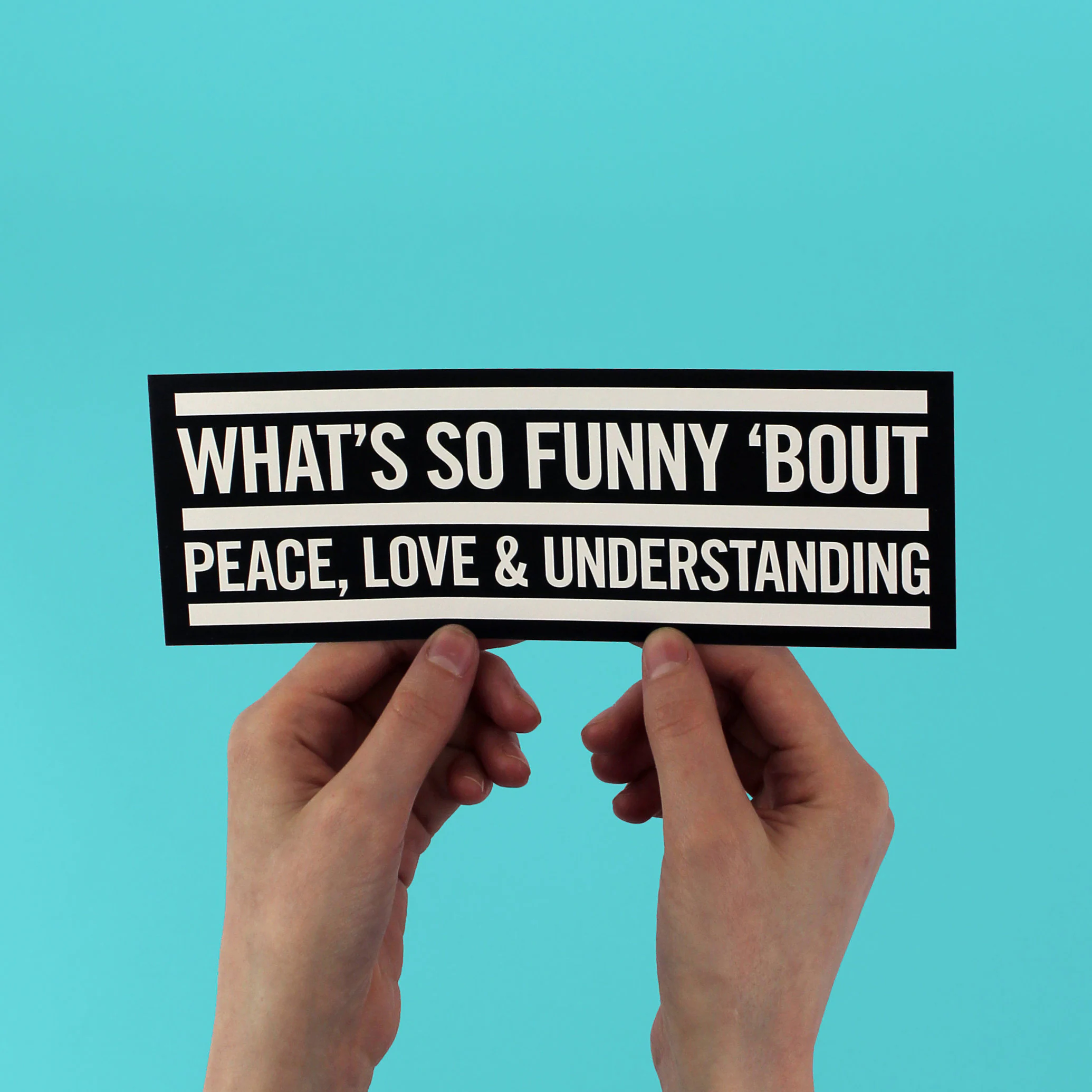
In 1974, Nick Lowe wrote a song that asks a question so earnest it borders on naïve: (What’s so funny ’bout) peace, love, and understanding? Lowe recorded the song with his band, Brinsley Schwarz, on their album The New Favourites of… Brinsley Schwarz.
When Elvis Costello later recorded it in 1978—with Lowe as producer—he “donated” it as a B-side secret cover to his producer’s A-side single. The song then became so popular that it was included on Costello’s next album in America, added as the final track to the US version of Costello’s 1979 album Armed Forces, replacing the song “Sunday’s Best”.
In Costello’s version the question took on a sharper edge. Sung with urgency and a trace of frustration, it sounded less like a slogan and more like a plea shouted into the wind.
Half a century later, the song still circulates, but its emotional register has shifted. What once sounded idealistic now risks being heard as faintly ridiculous. Peace, love, and understanding? In this economy?
The song’s humor was always there. Lowe didn’t write an anthem so much as a rhetorical shrug. The narrator isn’t triumphantly declaring belief in human goodness; the narrator sounds confused, even wounded. Someone trying to connect in a world that seems determined to misunderstand them. The repeated question—what’s so funny…?—suggests that someone, somewhere, is laughing. The joke, apparently, is on anyone who thinks empathy might still matter.
In the 1970s, this skepticism made sense. The optimism of the 1960s had curdled. Vietnam dragged on, Watergate unfolded, and rock music itself was getting louder, angrier, and more ironic by the minute. Punk was around the corner, sharpening its knives. Against that backdrop, asking for “peace and love” could sound hopelessly retro, like showing up to a street fight armed with a daisy.
But Lowe’s song never fully abandons the daisy. Instead, it holds it out stubbornly, as if daring the listener to swat it away. The narrator wants connection. They want understanding. A real need, a desperate urgency for someone—anyone—to meet them halfway. The joke, if there is one, is that these desires are treated as unserious, even embarrassing.
Fast forward to the Trump era, and the song begins to sound less like irony and more like anthropology. We now live in a political culture where empathy is routinely framed as dangerous, compassion is dismissed as weakness, and kindness is treated with deep suspicion. Caring too much is naïve; caring at all is often portrayed as manipulative. Understanding others is rebranded as “coddling.” Peace is for suckers. Love is sentimental nonsense. And understanding—well, that sounds like something an elite would do.
In this context, Lowe’s question lands differently. What’s so funny about peace, love, and understanding? The answer, it turns out, is that they violate the prevailing norms of performative toughness, constructed morality whose point is to judge others. Lowe’s lyrics plead to slow things down, to stop and look around you. They complicate simple stories about winners and losers. They ask us to imagine other people as human beings rather than as enemies, caricatures, or content.
The song’s narrator is lonely, but not in the grand, romantic sense. They’re lonely in a mundane, social way. They want to talk. They want to be heard. They wants to be understood without having to shout or sneer. This is not the loneliness of heroic alienation; it’s the loneliness of someone living in a world that has lost patience with vulnerability.
That loneliness feels oddly familiar today. Contemporary political discourse often rewards outrage over curiosity and certainty over reflection. Admitting uncertainty—or worse, seeking understanding—can be treated as a sign of weakness. In that environment, Lowe’s song sounds almost transgressive. It insists that connection is not only desirable but necessary, even if it makes you look foolish.
There’s also something delightfully inconvenient about the song’s moral framework. It doesn’t divide the world neatly into good people and bad people. Instead, it suggests that everyone is confused, defensive, and afraid—and that the solution is not domination but mutual recognition, mutual aid. This is not a message that lends itself easily to rally chants or cable news panels.
Perhaps that’s why the song feels so quaint now. Its moral universe assumes that understanding is possible and worth pursuing. It assumes that people might actually change if they felt heard. These are dangerous assumptions in a political culture built on permanent grievance and perpetual conflict.
And yet, the song persists. It keeps being covered, replayed, and rediscovered. It resists. Maybe that’s because its central question refuses to age out. Every era has its reasons for mocking peace, love, and understanding. Every era has its own version of the sneer. The song doesn’t argue back so much as it asks us to notice the sneer and sit with it uncomfortably.
In that sense, the song’s humor is less about punchlines than about exposure. It reveals how strange it is that basic human values need defending at all. Why is kindness funny? Why does empathy provoke eye-rolling? Why does understanding feel like a liability?
The joke, Lowe seems to suggest, isn’t on peace and love. It’s on a society that finds them laughable.
So maybe the song’s endurance isn’t ironic after all. Maybe it survives because, in moments when cruelty becomes fashionable and indifference is rebranded as realism, someone needs to keep asking the unfashionable question. Calmly. Repeatedly. Almost politely.
What’s so funny about peace, love, and understanding?
The unsettling answer, then and now, is not that they are absurd—but that we’ve worked very hard to pretend they are, so maybe… just maybe we can work to make them real.

 your tuesday afternoon alternative