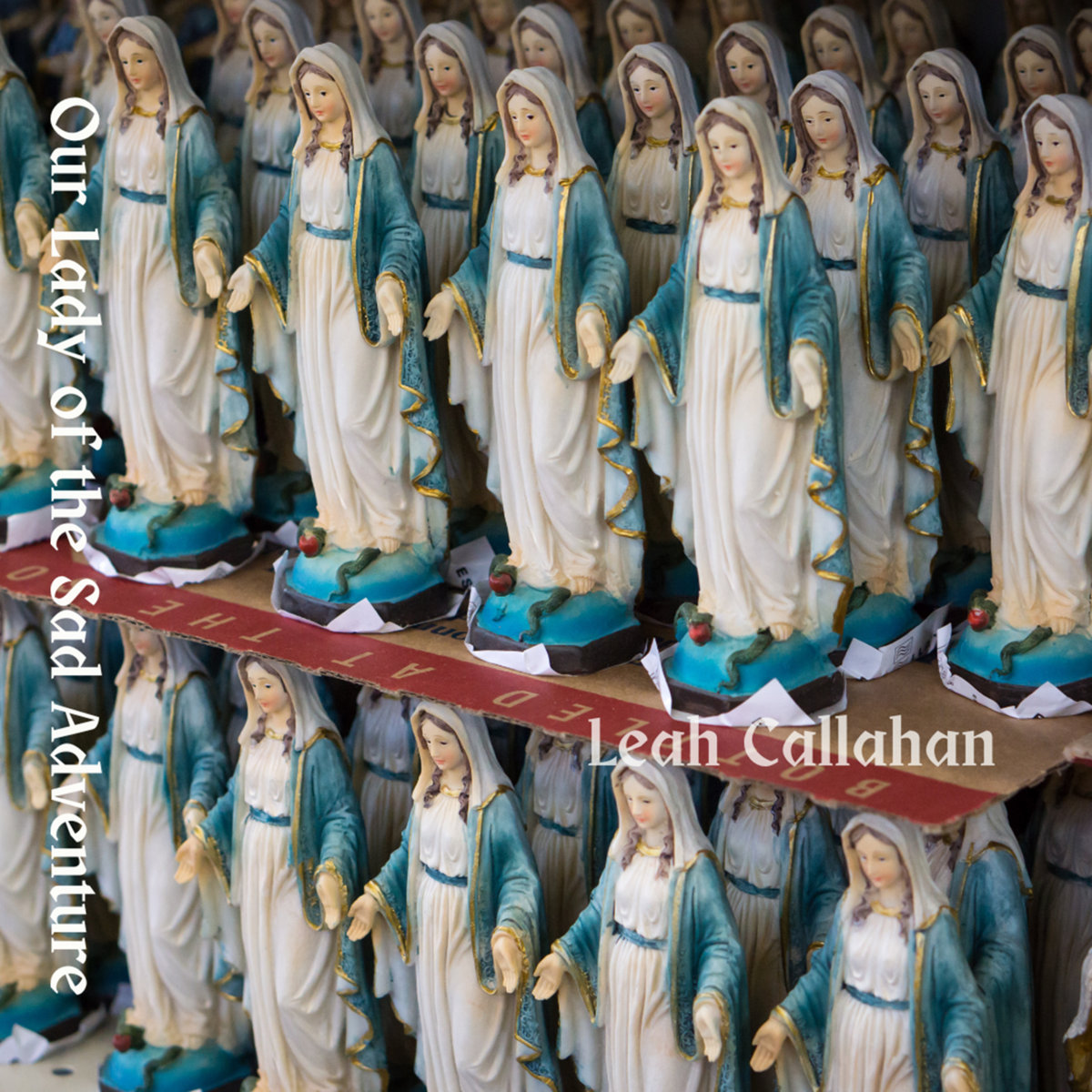
Boston songwriter Leah Callahan has never been an artist content to stay in one sonic lane, and her new record, Our Lady of the Sad Adventure, feels like both a continuation and a widening of that restless creative spirit. Now her sixth solo release—and thirteenth studio album overall—it arrives as a kind of dream journal set to music: hazy, reflective, occasionally playful, and often quietly daring. It is, as she suggests on her Bandcamp page, a reverie—but one that is constantly in motion.
From the very first pulse of “Fall in Love with Your Mind,” Leah Callahan throws open the curtains and lets the colored lights spill out into the street. This isn’t just atmosphere—it’s a head rush, a slow-motion swirl of 1960s psychedelia tumbling through the baggy, beat-happy swagger of 1990s Madchester like somebody spiked the punch with equal parts nostalgia and nerve. The message lands fast and loud: genre isn’t a rulebook here, it’s a paint box dumped across the floor, colors bleeding into one another until something strange and beautiful starts to take shape.
And listen closely—because beneath the shimmer and the sugar rush, there’s a tremor in the walls. Those distant siren-like sounds and the sideways glances at the “good old days, bad old ways” feel less like fond remembrance and more like a warning light flickering on the dashboard. The song smiles, sure, but it smiles with its teeth clenched. That tension—between bliss and unease, between the dream and the hangover—is the engine that keeps Our Lady of the Sad Adventure humming. Even when the melodies sparkle like neon at midnight, there’s always a shadow pacing just behind them, waiting for its turn in the spotlight.
That push-and-pull between sunshine and storm clouds turns into the nervous system of Our Lady of the Sad Adventure, the thing that keeps the whole machine twitching and alive. Every song feels like it’s sticking a finger into the emotional socket just to see what voltage comes back—some run hot, some hum low and blue, but none of them sit still long enough to get comfortable. “Driving” barrels down the highway with the windows cracked, and the radio turned up just past responsible, all momentum and possibility, like you’re outrunning yesterday without quite knowing where tomorrow lives. Meanwhile, “Devil May Care” struts in with a crooked grin and a leather jacket that’s seen some weather, radiating a confidence that feels road-tested, not handed down from a motivational poster.
What you hear in these tracks is Leah Callahan leveling up—not just sharpening her songwriting chops, but becoming a kind of mad scientist behind the console, mixing moods and textures like potions in a back-alley laboratory. She and her crew aren’t chasing uniformity anymore; they’re chasing sparks. Each song gets to be its own strange animal, free to grow claws or wings or whatever the moment demands. And somehow, in that glorious refusal to play it safe, the record finds its real unity—not in sameness, but in motion, in risk, in the thrill of letting the music decide what it wants to become.
This willingness to experiment—what might fairly be called sonic adventurism—is perhaps most evident in “New Punk.” The title alone suggests reinvention, and the track delivers on that promise. Rather than simply revisiting punk’s raw edges, Callahan reframes its spirit through shimmering synth textures and melodic restraint. The result feels less like rebellion for rebellion’s sake and more like a thoughtful reconsideration of what punk energy can mean in a contemporary indie-pop context. It is punk as attitude, not just sound.
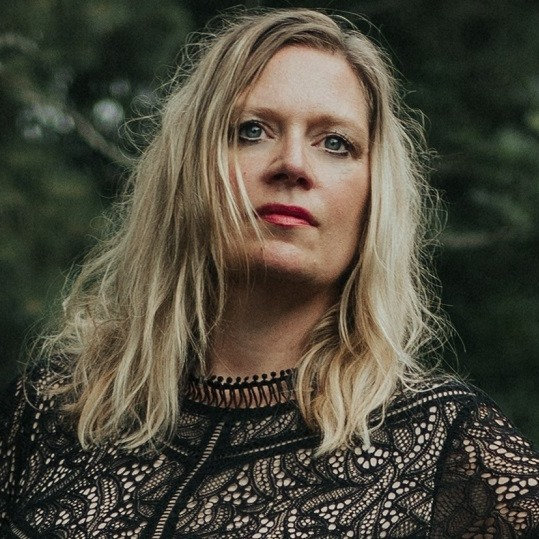
The album’s title track, “Our Lady of the Sad Adventure,” sits at the emotional center of the record. There is a sense of pilgrimage in the music—of moving through uncertainty with a mixture of melancholy and hope. The arrangement feels spacious, almost cinematic, allowing Callahan’s voice to carry a quiet authority. It is here that the album’s central theme becomes clearest: adventure is not always triumphant or loud; sometimes it is introspective, fragile, and tinged with longing.
Elsewhere, Our Lady of the Sad Adventure slips off the leather jacket, turns down the lights, and starts whispering secrets in your ear at 2 a.m., when the party’s over, and the truth finally feels safe enough to come out. “Clouds” floats in like a half-remembered dream—soft edges, slow breathing, the musical equivalent of staring out a rain-streaked window and wondering how you got here in the first place. It doesn’t demand attention; it seduces it, gently, patiently, until you realize time has stopped moving altogether.
Then “About You” arrives and cuts straight through the fog with the clean, bright blade of honesty. No tricks, no smoke machines—just feeling, plain and unvarnished, standing in the center of the room with nowhere to hide. It becomes the album’s emotional gravity, the steady hand on the wheel while everything else spins in beautiful, dizzy circles. And “Irish Goodbye”? That one lands like a wry smile exchanged across the bar as someone slips out the door without a speech or a scene—funny, a little sad, achingly familiar. It’s the kind of small human moment that Leah Callahan captures so well: messy, tender, and honest enough to sting just a little.
One of the most striking aspects of Our Lady of the Sad Adventure is how confidently it moves between moods. “Miss Me” carries a pop sensibility that feels accessible and immediate, yet never simplistic. Then, near the album’s close, “I Remember,” written by the late songwriter Molly Drake (the mother of actress Gabrielle Drake and musician Nick Drake), provides a reflective coda. Its inclusion feels intentional and reverent, connecting Callahan’s contemporary explorations to a longer lineage of introspective songwriting. The track lands softly, like the final page of a diary being closed.
Throughout the album, Callahan’s collaborators—Chris Stern on guitars and keyboards, Jeremy Fortier on viola, and Ben Polito on drums—help create a soundscape that is textured without becoming cluttered. The production by Richard Marr and Stern gives the record a sense of cohesion even as the songs travel across stylistic terrain. Synths shimmer, rhythms pulse gently, and melodies linger just long enough to feel familiar before drifting into something new.
And through it all, the secret weapon—the thing that makes the whole beautiful contraption actually work—is Leah Callahan’s voice. It’s strong without flexing, expressive without slipping into melodrama, and dialed in with the instincts of someone who knows exactly how much gasoline to pour on each fire. She doesn’t oversing; she aims, landing every phrase right where the song needs it, whether that’s a dreamy sigh, a sly grin, or a full-throated declaration that rattles the rafters.
In a lesser set of hands these songs might drift off into atmosphere and vapor, but Callahan plants her voice dead center like a flag in the middle of the storm—steady, human, and unmistakably present. It’s not just the right voice for these songs; it’s the voice that makes them believe in themselves.
What ultimately distinguishes Our Lady of the Sad Adventure is its sense of artistic confidence. This is not the work of an artist searching for a voice; it is the work of someone expanding it. Callahan seems increasingly willing to trust her instincts, to follow a song wherever it leads, and to embrace the possibility that growth requires risk. That willingness to wander—to explore new sounds, moods, and perspectives—gives the album its emotional depth.
In that sense, the record’s title feels perfectly chosen. Our Lady of the Sad Adventure is not about grand gestures or dramatic transformations. It is about the quieter journeys: the ones marked by reflection, curiosity, and resilience. Listening to it feels like stepping into a landscape where nostalgia and possibility coexist, where memories linger but the road ahead remains open.
For longtime listeners, the album confirms what has been building across Callahan’s recent work: a deepening sense of purpose and play. For new listeners, it offers an inviting entry point into a catalog defined by curiosity and craft. Either way, Our Lady of the Sad Adventure stands as a testament to the power of creative exploration. This album embraces uncertainty not as a problem to solve, but as a path worth following. Fans won’t have to wait long to step fully into this shimmering, restless world—Our Lady of the Sad Adventure officially arrives June 1, 2026, ready to spin its late-night dreams and neon-lit confessions straight into your headphones.

 your tuesday afternoon alternative