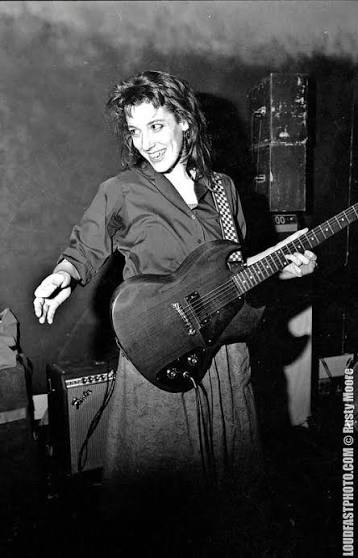
Lynn Blakey never needed to raise her voice to be heard. She sang the way a good front-porch storyteller talks—leaning in just enough to make you feel like the song was meant for you and you alone. And for decades around Raleigh and the wider North Carolina music scene, that feeling wasn’t an illusion. It was her gift.
It is hard to believe that Blakey, beloved North Carolina indie-rock singer and member of Tres Chicas, Let’s Active, and Oh-OK, has died at 63 on February 6, 2026, of metastatic cancer. Her voice helped define a fiercely independent Southern music scene in the 1980s and ’90s—clear-eyed, melodic, and emotionally direct—and she was the inspiration behind The Replacements’ “Left of the Dial,” a college-radio anthem that captured the scrappy romance of underground rock.
Blakey first emerged in the orbit of Athens, Georgia’s post-punk ferment before becoming a cornerstone of North Carolina’s Triangle scene, bringing a jangly intelligence and unforced warmth to every project she touched. With Let’s Active, she helped marry the British Invasion sparkle to Southern introspection. In Oh-OK, she contributed to a band that, though short-lived, became cult-beloved for its artful minimalism. And in Tres Chicas, she found a late-career home for luminous three-part harmonies and songwriting that felt both rooted and timeless.
She was never the loudest person in the room, but when she sang, rooms leaned in. Her phrasing carried both ache and assurance, the sound of someone who understood that understatement can hit harder than volume. Across decades and lineups, she remained a musician’s musician—collaborative, literate, and grounded—whose influence far exceeded her fame.
Blakey’s passing leaves a quiet but undeniable absence in the community she helped build. The records remain: bright guitars, close harmonies, and that unmistakable voice—forever just left of the dial, and right at the heart of a scene she helped make possible.
Blakey was also known as a founding member of Tres Chicas, the harmony-rich trio she formed with Caitlin Cary (formerly of Whiskeytown) and Tonya Lamm (formerly of Hazeldine) in the late 1990s. But even that shorthand doesn’t quite capture her range. Before Tres Chicas, she fronted Glory Fountain, a jangly, literate outfit that blended folk-rock shimmer with a songwriter’s eye for the telling detail. And outside of bands, she was the sort of musician who could slip into a room with a guitar and quietly rearrange the emotional furniture.
If you were around the Triangle during the years when local record stores doubled as community centers and midweek shows felt like reunions, you probably remember the first time you heard her voice. It had a clarity that cut through bar noise without ever sounding sharp. There was ache in it, but not self-pity; resolve, but never bluster. She sang about love, distance, and the small negotiations of everyday life in a way that suggested she’d done her homework—on people, on history, on herself.
Tres Chicas arrived at a moment when harmony-driven Americana was enjoying a modest renaissance, and their self-titled debut felt both rooted and new. The trio’s blend nodded to classic country and Laurel Canyon without getting stuck there. Blakey’s presence in that mix was crucial. Cary brought a flinty edge, Lamm a warm steadiness, and Blakey a kind of luminous center. When the three voices locked in, it sounded less like three singers competing for space and more like a conversation among old friends who trusted one another enough to leave room.
That sense of trust extended beyond the stage. Blakey was, by all accounts, a musician’s musician—generous with time, quick with encouragement, and allergic to pretense. In a scene that has always prized authenticity, she embodied it without trying. She showed up. She learned the songs. She listened. Those qualities don’t make headlines, but they build communities.
Her work with Glory Fountain hinted early on at the strengths she would refine over the years: a knack for melody that felt inevitable rather than flashy, lyrics that rewarded close listening, and arrangements that gave songs space to breathe. There was often a literary bent to her writing, but never at the expense of heart. She understood that the best songs carry their intelligence lightly.
In performance, Blakey had a way of making even well-worn covers feel personal. She didn’t overpower a song; she inhabited it. You could hear her respect for the material, whether it was a country standard or a deep-cut folk tune. And when she stepped forward for an original, there was a quiet authority in the way she delivered a line—an assurance that she had something worth saying and trusted you to meet her halfway.
Like many artists who balance creativity with the practicalities of life, Blakey’s path wasn’t a straight line. There were stretches when family and work took precedence, when the spotlight dimmed and the songs were written in the margins of busy days. But even then, she remained woven into the fabric of the scene. Appearances might have been less frequent, yet when she returned to a stage, it felt less like a comeback and more like a continuation of a conversation paused but never ended.
Part of what made her so beloved was the absence of ego. She seemed more interested in the collective sound than in staking out territory. In Tres Chicas, that meant surrendering to three-part harmonies that required precision and humility. In solo settings, it meant letting a lyric land without overselling it. She trusted the audience to hear what she was offering.
In recent years, as the music industry grew louder and more frantic, Blakey’s approach felt almost radical. She stood for craft over clamor, for community over competition. The North Carolina scene has produced its share of nationally known acts, but it has always depended just as much on artists like her—people who stay, who mentor, who make the local feel consequential.
The measure of a musician isn’t only in album sales or marquee placement. It’s in the way songs linger after the last chord fades. It’s in the younger songwriter who finds the courage to share a new tune because someone like Lynn Blakey once did the same for them. It’s in the audience member who walks out of a show feeling a little less alone.
Blakey leaves behind recordings that still shimmer and a network of friends, collaborators, and listeners who carry her harmonies with them. In a town and a region that pride themselves on musical depth, she was one of the quiet pillars. Not flashy, not loud—just steady, thoughtful, and true.
In the end, that may be the most fitting tribute. Lynn Blakey made music that felt like an honest conversation. And for those who were lucky enough to hear her—live in a small club, on a record spinning late at night, or in the shared hush of a harmony line—that conversation continues.

 your tuesday afternoon alternative