Favorites of 2025: The Tisburys – A Still Life Revisited

If rock & roll really is supposed to be dead, then The Tisburys clearly didn’t get the memo, becauseA Still Life Revisited sounds like the kind of record made by people who still believe guitars can change your pulse rate and a chorus can rescue you from the beige grind of everyday life. It’s big-hearted, jangly, melodically drunk on its own hookiness, and just earnest enough to make cynics roll their eyes—right before quietly admitting that, okay fine, this rules. In an era where “indie rock” has become an algorithmic suggestion instead of a real-time human exhale, The Tisburys are writing songs that swing for transcendence without pretending they’re saints. They’re too busy making music that actually moves. And that might be the most subversive thing any band can do in 2025.

And live well, let’s just say that this band will change your life. They certainly did that for me in May when they played in Columbus, Ohio.

There’s a delicate alchemy in making music that sounds both freshly urgent and comfortably familiar. With A Still Life Revisited, The Tisburys — a Philadelphia band led by singer-songwriter Tyler Asay — manage that trick across ten tracks that feel immediate, carefully arranged, and, surprisingly, wise. The album moves with the confidence of a band that’s learned how to translate small domestic crises (turning thirty, marriages, memory, the peculiar ache of hometowns) into classic, hook-driven indie rock: chiming guitars, harmonized choruses, and narratives that reward close listening. In other words, this is modern power-pop with a conscience, and it may be the Tisburys’ sharpest collection yet.

What makes A Still Life Revisited sound like more than a solo songwriter backed by colleagues is the apparent solidity of the lineup and the way each instrumental voice gets its moment. The Tisburys cohere around Tyler Asay’s warm, slightly plaintive voice and his knack for melody, but the record belongs to a group: guitarist John Domenico’s tasteful leads, Jason McGovern’s keyboards and co-production instincts, Ben Cardine’s steady bass and Dan Nazario’s drums. The band’s website and press materials emphasize that this is “a band record,” one where arrangements were built by people who have been playing together for years and know how to leave space for each other. That chemistry is audible: the guitars converse, the rhythm section moves like a unit, and the keys add texture rather than crowding the mix.

Sound and lineage: power pop, indie rock, and a Philly-Jersey DNA

If you trace the DNA of A Still Life Revisited, you’ll find a lineage that ranges from jangly 90s college rock to the more melodically ornate sides of the early 2000s indie wave. The Tisburys wear those influences proudly — there are echoes of The Replacements’ emotional bluntness and Beatles-style melodic craft, but also the stadium-ready shimmer of bands who balanced grit with sheen. Yet the album never sounds like a pastiche. It’s unmistakably contemporary: production is bright without being slick, vocal harmonies land with the immediacy of a live show, and arrangements are built to make choruses stick. The band explicitly cites its Philly and Jersey Shore influences, and that regional grounding shows up in the record’s blend of small-town narrative detail and seaside, sing-along energy.

What makes The Tisburys special — and what lifts A Still Life Revisited above many power-pop records — is their attention to lyrical detail. Tyler Asay writes about ordinary moments in a way that strips them of cliché. Songs on the record address the “first half” of life — relationships, nostalgia, homecomings — without falling into mawkishness. Lines about family photographs, local landmarks, and the strange combination of comfort and claustrophobia that comes with returning to familiar places make these songs feel lived in. The best of the album pairs those specifics with anthemic choruses: you can sing along, but you can also listen closely and discover a story unfolding. Critics have singled out the band’s knack for marrying hooky arrangements with narrative songwriting as a central strength. And, you know, they are absolutely right.

Ordinary lives, big choruses

A Still Life Revisited isn’t a concept album in the strict sense, but the sequencing creates a coherent emotional arc — from longing to reflection to a kind of defiant hope. Several tracks stand out for the way they crystallize the band’s gifts.

“Forever” opens the record with a declaration:

“April days are forever
Nineteen days not together
Show my flaws through a camera lens
No more lies waiting to forget”

Armed with a chorus designed to lodge in the skull. It’s a song built slowly: clearly, Asay rewrote and revised the arrangement until the parts clicked, and that patience shows. The song’s telescoping structure — verse to pre-chorus to a cathartic refrain — demonstrates the band’s skill at sculpting dynamics so that the chorus lands like a communal exhale. It feels right.

Elsewhere, the album dips into more reflective territory. Tracks rich in harmonies and piano offer moments of tenderness: memories, small defeats, and reconciliations appear in detail rather than in sweeping generalities. The sonics are dynamic, bloom with backing vocals and subtle keyboards — a technique the band uses repeatedly to give emotional weight to otherwise modest lines.

Other songs lean into the band’s power-pop muscles. Hooks here are not mere commercial concessions but emotional amplifiers; when the group sings together, the effect is immediate and communal. The closing track “Here Comes the Lonesome Dove” — described in reviews as an “urgent, upbeat” send-off — mixes strong harmonies, urgent rhythm, and slightly darker lyrical shades to finish the album on a note that feels both celebratory and bittersweet. It’s a perfect closer, an effective summation of the album’s themes: growth, memory, and the ambiguity of home.

Production and studio choices: warm, direct, human

Recorded at Mt. Slippery (Dr. Dog’s suburban studio) with longtime engineer/producer Justin Nazario, the album’s sonic identity favors clarity and warmth over gimmickry. That environment — a comfortable, band-friendly studio with analog sensibilities — helps the band capture immediacy without losing fidelity. The drums snap, guitars shimmer, and the vocal center is forward without being overly compressed; harmonies sit naturally in the room rather than stuck on top of a slick production. Listeners who prize the feeling of a live band in a room will find much to like here.

If you know The Tisburys’ older releases, the evolution on A Still Life Revisited is noticeable but not jarring. Earlier records leaned more heavily on 90s radio rock and could feel rawer in places; here, the songwriting feels tighter and more collaborative. Reviews suggest this is the band’s “most collaborative effort to date,” with multiple members contributing production and arrangement ideas — a shift from a single songwriter model to a more democratic studio approach. The result is songs that are fuller in texture but no less intimate; the details of domestic life are still central, but the band now frames them with broader, more anthemic musical gestures.

Importantly, the Tisburys haven’t abandoned their core voice. Where some bands try to “grow up” by abandoning what made them distinctive, The Tisburys have expanded their palette while preserving their melodic instincts and narrative focus. That balance — between continuity and growth — is what makes this album feel like a genuine step forward instead of a rebrand.

Who will love this album?

A Still Life Revisited will appeal to a broad swath of listeners: fans of modern power pop, devotees of literate indie rock, and anyone who finds comfort in songs that sound like they were written by people who noticed life’s small edges and decided to sing them out loud. In 2025, when many records either chase novelty or hide behind irony, there’s a particular pleasure in music that foregrounds craft and communal warmth. The Tisburys offer both: the skill of well-constructed pop songs and the feeling of a band that wants to connect, not merely perform.

Sure, everyone says that no record is perfect, and A Still Life Revisited has modest limits. For listeners looking for radical sonic innovation that avoids melody or confrontational protest-based lyrical stances, this is not the album for you. The album’s strengths: finely tuned melodies, thoughtful narratives, and a band that clearly knows how to shape a song’s emotional arc make this record a stellar release for 2025.

A band refining its craft

Ultimately, A Still Life Revisited reads like the work of a group that has learned how to harness its influences — The Beatles’ melodic sense, 90s power-pop energy, and early-aughts indie bombast — and direct them toward songs that feel honest and communal. The album isn’t trying to shock or to invent an entirely new style; it’s trying to do something arguably harder: write memorable songs that respect the listener’s intelligence and reward repeated listening.

For a modern band based in a city with a cultural identity as rich and complicated as Philadelphia’s, making an album this warm, melodic, and grounded is no small feat. A Still Life Revisited is The Tisburys at their most assured: a record of small truths and big choruses, sung by a band that understands the difference between a catchy line and a song that stays with you. If you like your indie rock crafted, communal, and emotionally direct, this is an album worth putting on repeat.

Favorites of 2025: Kim Ware and The Good Graces – Grand Epiphanies

I’ll just say it: Grand Epiphanies is one of the most human records you’re going to hear in 2025, and maybe one of the few that doesn’t insult your intelligence along the way. While many releases this year seem hell-bent on either drowning themselves in studio varnish or hiding behind hipster irony, Kim Ware walks in like someone who’s survived a few things and isn’t afraid to speak plainly about the bruises. These songs don’t howl, they don’t posture—they breathe. And in an era when pop throws confetti over every emotional breakdown and calls it catharsis, Ware has the guts to sit with the silence, to let the ache settle, to make music that’s actually about feeling something and not just Instagramming the wreckage. This is a record that believes in sincerity, and for that alone, it hits like a revelation.

Deepening the craft: Why Grand Epiphanies matters

When Grand Epiphanies was released in September 2025 via Fort Lowell Records, it arrived not as a gimmick or a throwback — but as an earnest statement from a songwriter who has spent nearly two decades refining her voice. For fans of Kim Ware and The Good Graces, the EP represents both continuity and evolution. It retains the emotional honesty and Southern-tinged indie-folk roots listeners have come to expect, while embracing fuller arrangements, sharper lyrical clarity, and a maturity of perspective that only time (and living) can provide.

What emerges is a collection of songs that treat heartbreak, regret, longing, and self-doubt not as melodrama, but as shared human truths. Ware doesn’t write to shock, to boast, or to gloss over. She writes to reach — to offer a mirror to listeners, and maybe a little company in whatever dark or quiet moment they find themselves. This EP is a reminder: vulnerability doesn’t have to be pretty. It just has to be honest.

The team: musicians behind the music

Although Kim Ware remains the creative heart of The Good Graces — vocals, guitar, and songwriting — Grand Epiphanies is a collaborative effort, supported by skilled players and producers who understand how to highlight nuance rather than mask it.

On this release, producers and multi-instrumentalists Steven Fiore and Justin Faircloth play central roles, adding guitar, piano, keyboards, bass, and even backing vocals, and in doing so, help shape the record’s rich but still intimate sonic layers. Their presence builds on a long tradition within The Good Graces: throughout previous albums, different collaborators have drifted in and out of the lineup, each contributing something distinct to the band’s evolving sound. That kind of fluid membership has always been part of the project’s identity, keeping Kim Ware’s songwriting deeply personal while allowing the music itself to remain open, flexible, and continually renewed rather than fixed in a single form.

This flexible model echoes what Ware once said about the band: not as a fixed entity but as a “very talented group of friends,” coming together when inspiration, time, and circumstance allow.

In practice, this means Grand Epiphanies doesn’t feel overproduced or manufactured. Instead, it feels like friends gathered in a room, listening, playing, and creating together — a mood that invites trust and intimacy rather than distance and gloss.

Sound and style: picking up old threads, weaving new ones

Listeners familiar with earlier Good Graces albums — from Sunset Over Saxapahaw (2008) through Ready (2022) — will find much that’s familiar on Grand Epiphanies. Ware’s Southern-tinged twang, her blend of folk, country, and indie-rock sensibilities, the unhurried melodies, the earnest vocal delivery — these remain essential.

Yet this EP also feels more expansive than some earlier efforts. The production, led by Fiore and Faircloth, layers guitars, piano, subtle harmonies, and occasionally banjo or other acoustic touches to build a richer emotional landscape around Ware’s voice. Although personal taste will always shape which tracks linger the longest, several songs on Grand Epiphanies stand out for the way they crystallize what the record does best. Take the track “Old/New”: its guitar strumming and vocal lines evoke late-afternoon melancholy, but as the song unfolds, piano and backing instrumentation widen the space — giving the listener room to sink into memory, longing, and possibility. unfolds like a gentle meditation on what we leave behind and what we carry forward, its subtle layers of instrumentation creating room for genuine emotional reflection.

Wish I Would’ve Missed You approaches heartbreak without melodrama, turning regret and longing into something more like the experience of leafing through old photographs—quiet, tender, and unexpectedly overwhelming. And then there is Missed the Mark,” a song that speaks directly to the insecure, the hopeful, and the uncertain, offering both an appeal for human connection and a confession of imperfection that feels disarmingly honest.

The choice to include a cover — a reimagined version of Some Guys Have All the Luck — also signals the confidence in balancing reverence and reinvention. On this EP, the cover doesn’t feel like a novelty; instead, it sits comfortably alongside Ware’s originals, transformed gently to align with the EP’s mood and tone. Some Guys Have All the Luck serves as a bridge between past and present, inspiration and reinterpretation. It doesn’t overshadow the original; it complements it, reminding listeners that songs evolve just as people do.

Overall, the sound of Grand Epiphanies suggests maturity without restraint, emotional depth without melodrama — the kind of record that lingers long after the final note fades.

The gift in the songs: everyday life, honest reflection, and human connection

What often sets the best singer-songwriters apart is a gift for translating ordinary moments into emotional touchstones. On Grand Epiphanies, Kim Ware exercises that gift with clarity and courage. Rather than lean on clichés — heartbreak melodrama, romantic tropes — she mines the subtler, messier terrain of real experiences: regret, nostalgia, second chances, self-doubt, hope, and quiet resilience. Many of these themes resonate universally: longing and loneliness, memory and loss, the ache of roads not taken, the fragile optimism that hums beneath everyday life.

In Wish I Would’ve Missed You”, Ware reflects on regret and longing with a spare lyricism that strikes more powerfully than most breakup ballads. “Spent it all on grad school… every now and then a memory stops me in my tracks,” she sings — not flaunting heartbreak but confessing to being human, vulnerable, flawed.

Elsewhere — in songs like “Missed the Mark” — she turns the lens inward, wrestling with feelings of inadequacy, uncertainty, and the desperate hope to connect. “I scan the room and hope the messages I send / Somehow reach a brand new stranger, and they become a brand new friend,” she confesses, exposing the artist’s fear and longing behind performing.

The album doesn’t promise closure. It doesn’t pretend that “everything works out.” Instead, it offers companionship: a voice that says, “I feel a lot of this too.” In that way, Grand Epiphanies avoids insulting the listener’s intelligence by offering simplistic solutions. It acknowledges complexity. It honors pain. And it believes in healing — not as a fairy tale but as a slow, sometimes messy process.

How Grand Epiphanies compares to previous work

To appreciate Grand Epiphanies, it helps to see it against the backdrop of Kim Ware’s musical journey. The Good Graces began in 2006 after Ware picked up an old acoustic guitar and started composing songs rooted in Southern indie-folk traditions.

Earlier records, like Close to the Sun (2014), showed a willingness to experiment — to mix folk and country, to play with ambient touches, drum machines, and subtle electronic textures. But even then, the core remained familiar: Ware’s voice, simple guitar patterns, emotionally candid lyrics.

With Ready (2022), the songwriting felt sharper, more intentional; melodies caught between wistful longing and restless urgency. Yet Grand Epiphanies pushes further. The songs are more cohesive; the instrumentation more deliberate; the emotional stakes clearer. Listeners can trace how time, experience, and loss have deepened Ware’s perspective.

This latest EP also suggests a renewed trust in collaboration. Rather than relying solely on acoustic minimalism — the refuge of vulnerability — Ware embraces fuller arrangements. The result isn’t flashy, but it feels abundant in feeling. It’s as though she’s saying: “These aren’t just my stories alone anymore; they are ours.”

Why Grand Epiphanies feels especially relevant in 2025

We live in a time when noise is constant — in our politics, our social media, our media cycles. Simplicity and quiet reflection often feel like luxuries. In that environment, an EP like Grand Epiphanies doesn’t just matter musically; it matters morally. It represents a kind of resistance — not flashy or confrontational, but human.

Kim Ware doesn’t demand answers; she offers empathy. She doesn’t pretend life gets clean after the hard parts; she reminds us that even when scars remain, beauty can survive. For listeners who feel worn down, uncertain, or haunted by memory, these songs can be small lamps in a dark room. For those simply seeking honest songwriting in a sea of glossy distractions, the EP offers relief.

Moreover, the collaborative, evolving model of The Good Graces — weaving friends, producers, rotating musicians into a living tapestry — speaks to music as community, not commodity. In an age of streaming algorithms and viral hits, that matters.

A few honest limitations — and why they don’t hurt the EP’s purpose

As with any release built around vulnerability and introspection, Grand Epiphanies may not cater to all tastes. Listeners expecting polished pop hooks, glossy production, and immediate gratification might find its pacing too slow, its mood too muted. The EP’s strength lies precisely in its restraint — in accepting that some feelings don’t come wrapped up neat and loud.

And with only five tracks, Grand Epiphanies can feel more like a snapshot than a full portrait. Themes are introduced, emotional arcs hinted at, but not always resolved. The sense is less of closure and more of continuation. Which, in many ways, may be the point: life rarely offers tidy endings.

Still — if you’re open to being held in uncertainty for a little while; if you’re willing to sit with a guitar, a voice, and a few gentle chords — the EP offers something rare: a place to breathe.

Kim Ware and The Good Graces — still speaking, still feeling

In a musical climate often dominated by spectacle, loudness, and overstated sentiment, Grand Epiphanies stands out not because it demands attention, but because it deserves it. Kim Ware’s songwriting remains a gift: honest, gentle, unguarded, but never cloying or insincere. Backed by The Good Graces, she continues to prove that folk and indie rock can still speak to our messy, uncertain lives with clarity and heart.

For longtime listeners, the EP will feel like a meaningful evolution — a band maturing, growing more confident, more open to collaboration. For those just discovering Ware, it offers a doorway into a catalogue full of stories that don’t hide behind cliches or affectation. And for anyone longing for music that reflects rather than distracts, that comforts rather than commodifies — Grand Epiphanies is a small, glowing jewel.

In 2025, when the world often seems determined to overwhelm us with noise, Kim Ware and The Good Graces invite us to slow down, listen, and remember: we are not alone. We are human. We are trying. And maybe — just maybe — that’s enough.

Favorites of 2025: Bruce Springsteen – Nebraska 82 Expanded Edition

Look, Nebraska was already perfect in that cold-coffee, blackout-3-a.m. way that records sometimes accidentally are—Springsteen mumbling ghosts into a four-track like he’s afraid the neighbors might hear him unraveling. You don’t “improve” a hallucination. But here comes Nebraska ’82 with its alternate visions, its rust-belt apparitions, and suddenly you realize perfection isn’t the point anyway. What we’re getting now is the messy archaeology of a masterpiece—the dirt under its fingernails, the tape hiss, the roads not taken. It doesn’t dethrone the original bedroom-confessional monolith; it stands off to the side like a cracked mirror held up to the same bleak American sky. And damn if that mirror doesn’t show something worth staring into all over again.

Nebraska ’82: Expanded Edition arrives at the right time

With the 2025 release of Nebraska ’82: Expanded Edition, Springsteen and his team have delivered the most comprehensive, honest, and vivid portrait of one of the most haunted, intimate, and influential albums in rock history. The box set includes a newly remastered version of Nebraska as originally released, previously unheard demo outtakes, the long-rumored “Electric Nebraska” sessions with the full band, and a newly recorded live performance filmed in 2025.

For newcomers and longtime fans alike, this release offers both context and extension: context for how Nebraska came to be — from home demos on a TASCAM to a full LP — and extension in the form of alternate takes, jukebox-ready electric arrangements, and reflections of the songs through decades of memory.

It’s not just nostalgia or archival shelf-cleaning. What emerges is an album whose darkness, subtlety, and emotional power remain urgent. Nebraska ’82 still speaks — perhaps even more clearly now — to lives marked by uncertainty, longing, and resilience.

The original Nebraska — stark, personal, unforgettable

When Springsteen recorded Nebraska in late 1981 and early 1982, he did so not with a studio full of musicians but with a four-track recorder in his bedroom, an acoustic guitar, and a stark vision. The result was an album unlike anything else in his catalogue: bleak, intimate, confessional, but not confessional in a self-pitying sense. These were songs born from solitude, from the rawness of fear, regret, despair — made real by economy of arrangement.

Tracks like “Atlantic City,” “Johnny 99,” “State Trooper,” and “My Father’s House” traversed the margins of the American dream: economic hardship, moral desperation, violence, yearning for redemption. The spare instrumentation — sometimes only a guitar and a voice — made every lyric, every tremor of the vocal, every pause between notes count. The result is widely considered one of the great solo records in rock.

Decades later, Nebraska remains the gold standard for how quiet, low-fi recordings can deliver emotional immediacy. For many, it’s not just an album — it’s a private confessional, seen through the lens of loneliness and lost dreams.

What the Expanded Edition adds — and why it matters

Remastering with care

First, the 2025 remaster brings Nebraska into sharper focus without erasing its haunted intimacy. In a landscape where remasters often polish away character, this one preserves the album’s texture — the creaks, the echoes, the warmth of an acoustic guitar reverberating in a home studio — while improving clarity and depth. Critics who’ve heard the new edition note that the remastering reveals subtle layers previously buried: the quiet background of a mandolin here, the soft echo in the final chords there, the breath before a harsh lyric.

In short: the remastered Nebraska doesn’t feel like a revived relic — it feels alive again.

Solo outtakes and previously unreleased songs

The set’s first discs unearth acoustic outtakes and songs from the original 1982 sessions that didn’t make the album: Child Bride, The Losin’ Kind, Gun in Every Home, and On the Prowl — material fans have traded as bootlegs for decades or assumed lost forever.

Hearing them in official, high-quality form is revelatory. Tracks like “Gun in Every Home” offer a nightmarish portrait of domestic collapse and despair; “On the Prowl” pulses with a restless, searching energy that resonates with the rest of the album’s themes. Even though these songs were originally omitted, they expand the emotional terrain of Nebraska — reminding listeners that the darkness had multiple facets and that the record’s focus was always selective, not total.

Electric Nebraska — the “what might have been”

Perhaps the most dramatic and controversial addition is the long-rumored “Electric Nebraska” sessions. In April 1982, shortly after finishing the solo demos, Springsteen brought several members of the E Street Band into the studio (including Max Weinberg and Garry Tallent) and attempted full-band recordings of several Nebraska songs. In 2025, those sessions have finally emerged publicly — the first time many had heard them.

The results provoke awe — and ambivalence. On one hand, songs like electric versions of Atlantic City or Johnny 99 have a muscular, rock-ready energy. A demo of Born in the U.S.A. — originally written in the same era — appears in trio form (Springsteen, Weinberg, Tallent), described as “punk rockabilly.”  It is electrifying, raw, and historically fascinating.

On the other hand — and critics largely agree — turning Nebraska into a full-band rock record would have gutted much of its power. The original’s bleak intimacy, its ghost-town loneliness, its moral urgency — all flowed from isolation and austerity. As Uncut’s review put it: “Electric Nebraska might have produced a competent rock album, but it wouldn’t have been Nebraska.”

The electric versions often feel like exercises — intriguing, occasionally thrilling, but never quite as honest. The contrast only strengthens the myth of the original: a man alone with a guitar, bearing witness to the American underbelly.

A 2025 live performance: memory as lens

Rounding out the set is a newly filmed live performance — Springsteen playing the full Nebraska album in order, at the Count Basie Theatre, Red Bank, New Jersey. Accompanied subtly by veteran musicians such as Larry Campbell and Charlie Giordano, the performance is respectful rather than grandiose, earnest rather than nostalgic. In a press statement, Springsteen remarked on the experience: hearing the songs again, he was struck by their “weight” — their capacity to move, even after decades.

The filmed concert is not a re-creation but a meditation. Compared with the original 1982 recordings, the live versions reflect the distance of time — a deeper voice, more lived-in phrasing — but they carry the songs’ sorrow, hope, and grit into a present that, for many listeners, remains uncertain.

What Nebraska ’82: Expanded Edition reveals about Nebraska’s enduring power

Listening to the full box set is, in a way, a masterclass in artistic decision — what to keep, what to discard, what to preserve, what to experiment with.

The original Nebraska stands undiminished. If anything, the contrast with the electric takes and outtakes sharpens what made it special. The sparseness, the solitude, the haunted tonal space — all reveal that Springsteen’s choice to release demos instead of studio recordings was not a compromise but a commitment to emotional truth. As one critic writes, the set underscores that “even when testing out the material with his most intuitive collaborators … the definitive version of Nebraska remains the one he captured on tape… tracking solo demos.”

Yet the collection is not purely about preservation — it expands the artist’s vision. The outtakes and electric versions show songs as living things: malleable, re-interpretive, incomplete. They reflect a period of creative restlessness, of questioning whether Americana songs needed to be acoustic, dark, personal, or if they could rock, rage, and roar.

For fans and historians, Nebraska ’82 offers context. For new listeners, it might serve as the entry point. For all, it’s a reminder that rock — stripped-down or electric — can still carry the weight of real human stories.

A few tensions and enduring questions

The Expanded Edition is not without controversy. Some reviewers warn against over-romanticizing the demos and dismissing the electric takes outright. As one Guardian column argues, if listeners imagine full-scale E Street–style treatments, they’ll likely be disappointed: the electric tracks “take the edge off, neutralising their impact.”

Others worry that the outtakes and alternate versions — while fascinating — might dilute the mythic purity of Nebraska. After all, part of the record’s power lies in its restraint. The expanded set invites comparisons, second-guessing, and reconsideration that can feel like peeling away a protective layer.

But perhaps that is precisely the point: art is not a mausoleum. Revisiting is not desecration — it is re-examination. And Nebraska ’82 gives listeners the tools to understand not just what the album was, but what it might have been, and what it still can be.

Why this edition matters — now so many years later

2025 is not 1982. The world Springsteen sang about — poverty, despair, moral compromise, broken dreams — has changed in many ways, yet in others remains startlingly similar. Economic instability, social dislocation, disillusionment with institutions — many of the conditions that haunted Nebraska then still haunt us now.

In that sense, Nebraska ’82: Expanded Edition arrives not as nostalgia, but as relevance. The spare melodies, the tales of desperation and longing, the fractures in the American dream — they resonate with renewed urgency. And by revisiting them alongside alternate takes and newer interpretations, listeners are invited to reflect not just on the past, but on how songs age, shift, and heal.

For younger listeners who might only know Springsteen from his arena-rock anthems or later work, this box set offers a different face of “the Boss” — quieter, darker, more human.

For longtime fans, it’s a gift: a chance to listen again, to compare, to reconsider.

A masterpiece re-examined — and still alive

Nebraska ’82: Expanded Edition does more than archive a landmark record. It reopens its doors, pulls back the curtain, and lets us hear not just the final songs, but the echoes, the experiments, the what-ifs, and the near-misses.

In doing so, it reaffirms what made Nebraska a classic: the courage to strip away everything but voice and guitar, to trust silence, to speak plainly about fear, regret, and survival. But it also acknowledges that songs are not static. They breathe, shift, and can be reborn.

Whether you come for the electric sessions, the unheard demos, the 2025 live film — or simply to hear Nebraska again — the result is the same: you feel the weight of its stories, the depth of its sorrow, the faint but persistent light of hope.

Forty-three years after it was first recorded in a bedroom in Colts Neck, Nebraska still matters. Nebraska ’82: Expanded Edition proves that not just as history, but as living, breathing music.

Favorite of 2025: The Beths – Straight Line Was A Lie

Introduction: Why The Beths Matter

The New Zealand indie‑pop quartet The Beths have long stood out for their sharp songwriting, earworm melodies, and the emotional honesty that pulses through their lyrics. With their 2025 album Straight Line Was a Lie, they arrive at a new peak — refined in sound yet deeply raw in sentiment. It’s a record that doesn’t just reaffirm what makes them special; it feels like a rebirth: more considered, more textured, and more vulnerable than ever. As the band enters this next chapter, it’s become increasingly clear that The Beths aren’t just good at what they do — they’re extraordinary.

I want to take a moment and explore how each member’s musical contributions blend to form the band’s signature sound, and how the lyrics on Straight Line Was a Lie carve out an intimate, unsettling, yet hopeful portrait of life, growth, and mental health.

First, a quick refresher on the lineup. The Beths consist of:

  • Elizabeth Stokes – lead vocals, rhythm guitar, main songwriter
  • Jonathan Pearce – lead guitar, backing vocals, producer/engineer (on this record)
  • Benjamin Sinclair – bass guitar, backing vocals
  • Tristan Deck – drums, cymbals and percussion, backing vocals

In past releases, The Beths were already celebrated for their “jangly” guitar pop, shimmering harmonies, and driving rhythm section.  On Straight Line Was a Lie, each member seems to lean more deeply into their strengths, and — crucially — into experimentation.

Elizabeth Stokes remains the heart of the band. Her voice — often conversational, sometimes aching — carries the emotional weight; her lyrical voice is sharper, more introspective, grappling frankly with themes of mental health, existential anxiety, familial ties, self-doubt, and the paradoxes of healing. The songs come from a place of personal upheaval, shaped by her experiences with health struggles, medication, and self‑reflection.

Jonathan Pearce wears dual hats on this record: lead guitarist and producer / engineer / mixer (on most tracks). That shift seems to have given the album a more cohesive, textured sonic palette: guitars (both his lead and Stokes’s rhythm) shimmer, sizzle, crash — sometimes jangly, sometimes atmospheric, sometimes dissonant. On songs like “Take,” the guitar solos ring with a fresh urgency; on “Ark of the Covenant,” guitar lines meld with subtle ambient touches to build something cinematic and haunting.

Benjamin Sinclair’s bass underpins the album with steady, often driving low‑end that grounds even the most introspective or experimental moments. While bass can be underappreciated in guitar‑heavy pop, here it anchors songs like “Take” with a muscular backbone that gives weight to the emotional landscape, and in upbeat numbers it drives the momentum forward, pushing choruses into sing‑along territory. The result is a rhythm section that feels both steady and alive.

Tristan Deck’s drumming and percussion complete the engine. On Straight Line Was a Lie, the drums don’t just keep time — they accentuate mood, shake loose tension, and steer transitions between jubilation and melancholy. Whether it’s propulsive beats on faster tracks or minimal, contemplative rhythms on the quieter ones, Deck’s playing adapts to the emotional terrain without overshadowing it. Backing vocals from Deck and Sinclair add subtle harmonic depth, reinforcing what has always been The Beths’ hallmark: layered vocal harmonies that linger.

Together, these four don’t just play instruments — they channel mood, memory, and meaning. On this record, the result feels less like a “band playing songs” and more like four people collaboratively mapping emotional terrain.

The sound of Straight Line Was a Lie: More than “jangly” pop

One of the defining qualities of The Beths’ earlier albums was that “jangly guitar + power‑pop hooks + emotional honesty” formula — and it worked beautifully. On Straight Line Was a Lie, they keep the hooks, but deepen the textures. The production (led by Pearce) emphasizes space, layering, contrast; songs can shift from bright, chiming pop to darker, atmospheric, even gritty territory. Critics note this album as “bigger, better and more complicated than they’ve ever been.”

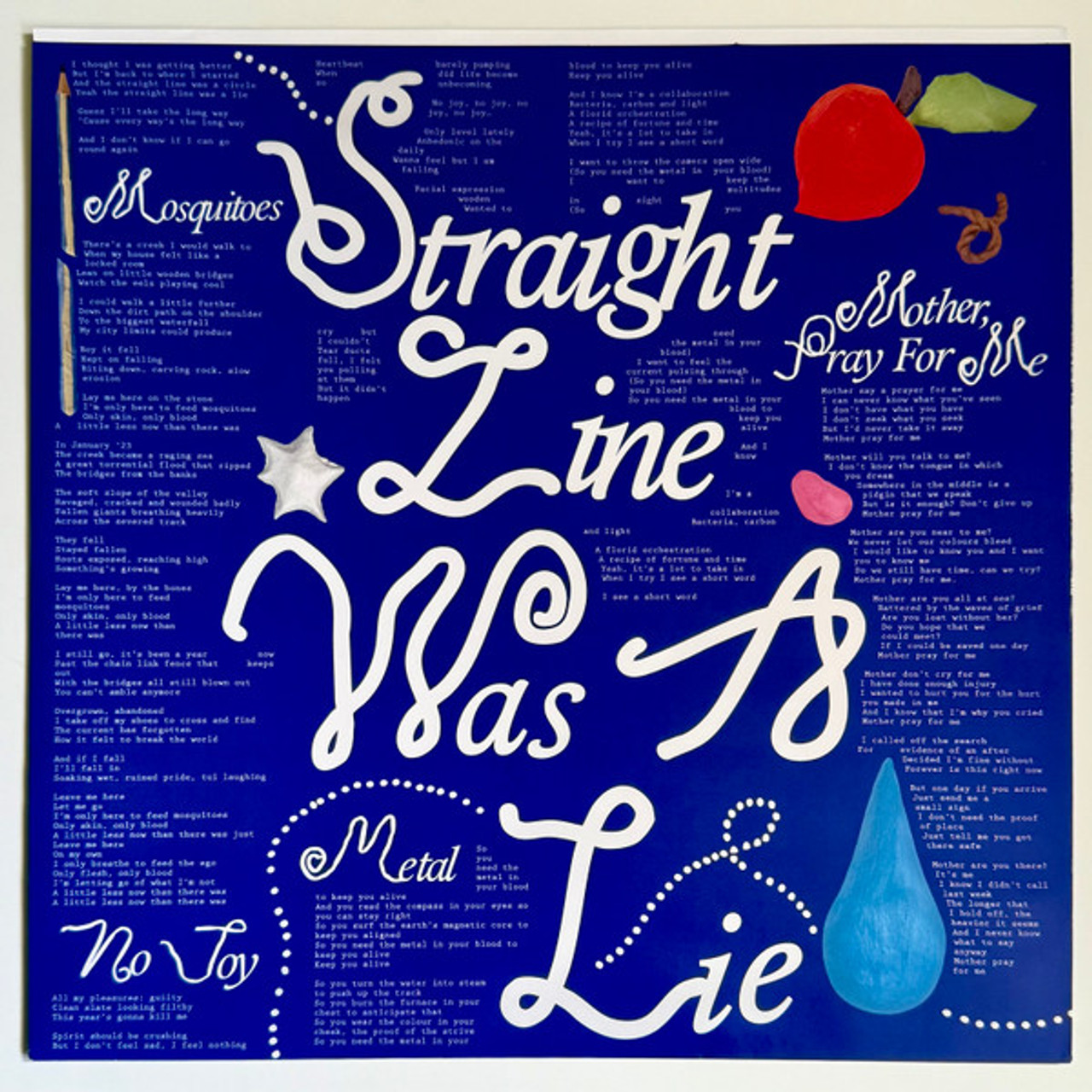
The opening track and title song begins with a false start — a spoken “sorry I was thinking about something else” — a move that feels deliberate: it sets the tone for an album preoccupied with interruption, derailment, and return. The lyric “I thought I was getting better / But I’m back to where I started / And the straight line was a circle / Yeah the straight line was a lie” resounds as a central thesis. Life, the record suggests, is not a linear progression but a messy, looping, often contradictory journey.

Meanwhile, tracks like “No Joy” jolt with nervy urgency — the upbeat melody and driving beat bely lyrics that speak to anhedonia and existential stasis: “All my pleasures, guilty / Clean slate looking filthy / This year’s gonna kill me … Spirit should be crushing / But I don’t feel sad, I feel nothing.”

On “Metal,” they give form to something beautiful and strange: a metaphor about being alive as a “collaboration of bacteria, carbon and light,” needing “the metal in your blood to keep you alive.” It’s biological, cosmic, grounded, and dreamlike all at once — marrying emotion, science, and wonder in a simple but powerful package.

There’s also room for quiet minimalism. “Mother, Pray for Me” strips things back: gentle picking, soft vocals, aching longing. It’s a song about complicated family, grief, and generational wounds — and it lands not through bombast but through tender reserve.

Even the album’s final moments — on “Best Laid Plans” — feel bittersweet: jangly guitars and a buoyant rhythm, but implicit in the instrumentation and tone is a sense of unresolved longing, of “unfinished business.” It’s the sound of hope, but also of memory’s weight.

In sum: Straight Line Was a Lie isn’t simply “jangly indie pop with hooks” — it’s more ambitious: emotionally deeper, texturally richer, and willing to lean into shadows as much as light.

Lyrical worlds: Mental health, Memory, and the Myth of Progress

If the musical side is about textures, the lyrical work is about truth. On this record, The Beths — primarily through Stokes’s pen — interrogate themes of mental health, healing, identity, memory, and the uneasy breaks in between. The album’s title succinctly captures its philosophical impulse: that “linear progression is an illusion.” Life doesn’t follow a neat arc; healing does not happen on a straight line.

Much of that perspective comes from Stokes’s own life. In recent years she’s navigated serious health challenges (including a diagnosis with Graves’ disease), anxiety, and the disorienting effects of starting antidepressants for the first time. That upheaval forced a radical shift in how she writes: among other changes, she turned to stream‑of‑consciousness writing on a typewriter, exploring memories and feelings she’d avoided, and forcing herself to reckon with difficult emotions.

That kind of emotional honesty shows up throughout. On “Mosquitoes,” she wanders a creek near her home — a haven when “my house felt like a locked room” — only to find devastation: the same creek turned into a “raging sea” after floods. The song becomes quietly terrifying: an elegy to disappearance, impermanence, and the fragility of refuge.

In “Til My Heart Stops,” there’s a longing for simple embodied pleasures — riding a bike in the rain, flying a kite, dancing — even as the world feels heavy and weightless at once. According to one review, the song, with its unsettling distortion and ghostly atmosphere, “charts the fragility of life itself,” its abrupt ending like a heart’s final beat.

Elsewhere, “Ark of the Covenant” and “Best Laid Plans” explore inner excavation: digging through memory, confronting “fossilised nightmares,” searching for meaning — or closure — in the negative space of the self.

But it’s not purely despair or existential weight. There’s still wry humour, sharp imagery, and defiant tenderness. The need for “metal in your blood” in “Metal” — a call for grounding, resilience, a kind of elemental insistence on life — turns the personal and biological into something poetic and universal.

Taken together, the lyrics on Straight Line Was a Lie don’t just reflect mental health struggles or personal trauma — they interrogate the myth of constant improvement. They suggest healing is messy; growth is circular; humanity is fragile, often contradictory — but still worthy of wonder.

What this album means: Growth, Maturation, and a New Chapter for The Beths

For longtime fans, Straight Line Was a Lie may at first sound familiar: The Beths still write songs that stick in your brain. But this time, there’s a sense of expansion, of maturity, of ambition being reframed with nuance. Production is richer, the emotional stakes higher, and nothing feels simply disposable or background music. This is an album that rewards — demands — close listening.

Critically, the record has been widely praised. On aggregators it earns a strong Metascore, reflecting generally favorable to enthusiastic reviews. Reviewers note the band is “bigger, better and more complicated than they’ve ever been.” Others call it perhaps their “most incisive” album yet, one where existential anxieties and lyrical ambition meet pop hooks and evocative soundscapes.

Moreover, Straight Line Was a Lie feels like a milestone — not just in their discography, but in their artistic evolution. The move to have guitarist Jonathan Pearce handle production and engineering gives the album a more unified sonic identity. The decision by Stokes to overhaul her songwriting method — to face trauma, memory, and illness head‑on — brings a weight and vulnerability previously only hinted at. The whole band seems aligned: playing not just with precision and popcraft, but with emotional honesty.

For listeners, this album offers more than catchy choruses: it offers fellowship. It whispers that you are not alone if you’ve felt lost, stuck, or numb. It suggests that healing is not always about triumphs or tallies of progress, but about maintenance — about showing up, living, feeling, enduring. And it does all that while giving you songs you can dance to, or cry to, or sing loud at a concert.

Conclusion: The Beths as Emotional Architects

In a world that often feels driven by optimization, forward momentum, and constant productivity, Straight Line Was a Lie comes as a quiet, necessary reckoning. It refuses the idea that healing, growth, or life itself must follow a neat, linear trajectory. Instead, The Beths propose a different metaphor: life as cyclical, messy, and ongoing — something to be maintained, revisited, reflected upon, not “completed.”

As a band, The Beths have always been more than the sum of their catchy hooks or jangly guitars. On this album, they feel less like a pop act and more like emotional architects — sculptors of feeling, memory, and existential wonder. Each band member’s contribution is essential — from Stokes’s wrenching lyrics to Pearce’s layered production, from Sinclair’s grounding bass to Deck’s subtle but powerful rhythms.

Straight Line Was a Lie may end up being a soundtrack for an era — an album for when the world feels too fast, too forward, too relentlessly optimistic. It offers instead a different rhythm: patience, honesty, acceptance, and defiance.

If you haven’t listened to it yet — or haven’t listened closely — this is the moment: sit back, headphones on, and let The Beths guide you down the crooked, beautiful trail.

Screaming in the Dark: How Rock Lyrics Tear Your Soul Open and Leave You Wanting More

Rock and roll has always been a violent, all-consuming beast that claws at your insides and leaves you aching for more. But it’s not just the guitar riffs that keep you coming back; it’s the words. The lyrics, when they hit, can get under your skin, lodge in your brain, and make you feel like you’ve been struck by lightning—or a falling star, depending on how poetic you want to get. The best rock songs are often the ones that tear down the walls between the listener and the songwriter, making you feel as if you’re walking through the fires of their soul, even if they don’t want you there.

This kind of raw vulnerability, this open wound of expression, can’t be faked. And if it is, you know it. But when it’s authentic? When it comes from a place that is somehow both personal and universal? That’s when you hear it: the sound of someone throwing everything they have into their lyrics, turning something that might just be a scribbled note into an anthem for the disillusioned.

And that’s where songs like those from The Connells, The Counting Crows, R.E.M., and The Replacements come in. They’ve got it—whatever it is. And they know how to wield it like a sword, carving out spaces for us all to exist inside their verses. It’s not just about being clever or complex. It’s about being real. It’s about making you feel something.

So what makes these lyrics powerful? Let’s dive in and break it down.

The Connells – The Beauty of the Everyday Struggle

Let’s start with The Connells. They’re like that band you heard on the radio and never quite knew whether you were supposed to cry or just nod along to the rhythm. Their song “74-75” is a classic example of lyrics that don’t just tell a story—they pull you into the middle of it, making you feel like a participant rather than an observer.

The thing about “74-75” isn’t the narrative; it’s the way it captures a feeling, a sense of longing for a time that’s already passed, a time that exists only in memory. The line “I was the one who let you know
I was your “sorry ever after”/’74-’75”
hits with the subtle melancholy of a songwriter who knows that the world they once envisioned didn’t quite turn out as expected. There’s no bitterness, no anger—just a quiet resignation. It’s not the anger of punk or the bombast of glam rock, but something more delicate: a personal and collective sadness.

This sense of fading away, of history marching on regardless of your desire to keep up, is where The Connells find their power. The lyrics don’t scream for attention. They don’t force you to accept them. Instead, they settle in, like the dust in an old attic that you haven’t bothered to clean. In a way, The Connells’ ability to articulate the passing of time, the things that slip away without us even realizing it, taps into a very human vulnerability: we can’t stop the inevitable, but we can remember, and sometimes that’s enough.

Counting Crows – The Beauty of Messy, Imperfect Souls

Counting Crows are often described as the quintessential ‘90s band, and while that might seem like a dismissive label to some, it’s hard to ignore how well they captured the emotional complexity of that era. The lyrics in songs like “Mr. Jones” or “A Long December” are imbued with a kind of longing that speaks to the frustrations of being stuck in your own head, lost in self-reflection, while also looking outward toward the world and wondering why it all feels so… empty.

There’s a rawness in Adam Duritz’s delivery, a sense of vulnerability that comes across as both introspective and confessional. In “A Long December,” Duritz sings, “And it’s been a long December, and there’s reason to believe / Maybe this year will be better than the last.” The power here isn’t just in the lines themselves but in the tone—the weariness in Duritz’s voice, the way it wavers, suggesting that this isn’t just about a bad month or a rough time. It’s about the constant cycle of hope and despair, the cyclical nature of life that repeats even though you don’t want it to. The power of Counting Crows’ lyrics lies in their ability to capture that very human struggle: the push-pull between wanting to believe things can get better and the awareness that life often doesn’t give you any guarantees.

But it’s not just about the sad, reflective moments. Counting Crows are also masters of finding beauty in the messiness of life. In “Mr. Jones,” Duritz sings about longing for fame and success, but in a way that’s almost self-deprecating, revealing the insecurity that so often accompanies dreams of grandeur. There’s something painfully human about the way he expresses these desires, especially when paired with the upbeat, almost celebratory musical backdrop. It’s as if Counting Crows are trying to convince themselves that they can rise above their own doubts, even if they don’t fully believe it. This contradiction—wanting something so badly while knowing it won’t solve your problems—is what makes their lyrics hit so hard.

R.E.M. – The Beauty of Ambiguity and Mystique

Now, R.E.M. is where things get interesting. They’re a band known for their obtuse, enigmatic lyrics—songs that you can never quite figure out, yet they speak to you as if they understand your deepest thoughts. “Losing My Religion” is the prime example of this. Michael Stipe’s lyrics are fragmented, filled with obscure references, and yet they carry an emotional weight that speaks to the very heart of human confusion and self-doubt.

“Losing My Religion,” for instance, is about more than just faith; it’s about the moment when you realize that the rules you’ve followed might not hold true anymore. The phrase “losing my religion” isn’t literal. It’s not about God or theology—it’s about that overwhelming sense of being on the verge of breaking, of seeing everything you thought was true start to unravel. Stipe’s voice doesn’t just sing these words; it resonates with the sorrow of understanding that, sometimes, there is no answer. The ambiguity is powerful because it reflects the messiness of our own lives: we’re all searching for meaning in a world that doesn’t provide any simple answers.

R.E.M.’s strength lies in their ability to articulate universal feelings—loss, confusion, longing—through highly ambiguous lyrics. You might not always know exactly what they’re talking about, but you know what it feels like. And that’s what makes their songs so potent. They create a space where the listener can impose their own experiences, their own meanings, into the lyrics, making each song feel personal.

The Replacements – The Beauty of Chaos and Rebellion

And then there are The Replacements. If R.E.M. is ambiguity, The Replacements are the messy, unpolished, chaotic force that says, “Here I am, take me or leave me. Either way, we don’t care.” There’s an undeniable power in their ability to capture the feeling of disillusionment with the world, but they do it with a defiance that borders on self-destructive. Their lyrics are often frantic, raw, and vulnerable as if the band is afraid that, if they don’t get it all out in one go, they might implode.

Take “Bastards of Young,” for example. It’s a call to arms for the disaffected youth, the ones who are always on the outside, looking in. The repeated refrain “We are the sons of no one / Bastards of young” rings with both anger and an almost celebratory tone—like a badge of honor worn by those who never quite fit into society’s neat little boxes. What’s powerful about this is that it isn’t just about rebellion for the sake of rebellion. It’s about a deep-seated sense of alienation, a recognition that the world may never accept you, and maybe that’s okay.

There’s a sense of desperation in these lyrics, a feeling that maybe the only way to survive is to burn everything down. But there’s also humor, even in the chaos, a reminder that life is messy, imperfect, and sometimes beautiful in its destruction.

The Power of Lyrics in Rock and Roll

The lyrics that make rock and roll so potent aren’t the ones that try to fit neatly into a box or explain everything away. They’re the ones that dive into the mess of human existence and say, “This is who I am, for better or worse.” It’s the raw vulnerability of The Connells’ reflections on time, the longing and self-doubt of Counting Crows, the cryptic mystery of R.E.M.’s disillusionment, and the raw, unvarnished chaos of The Replacements that make rock and roll lyrics so powerful. It’s not simply about the clever wordplay or the polished metaphors—it’s the truth, delivered with all the mess and pain that comes with it.

Rock and roll is about real emotions. And the best songs? They make you feel something, deep down—whether you want to or not. And we are all the better for it.