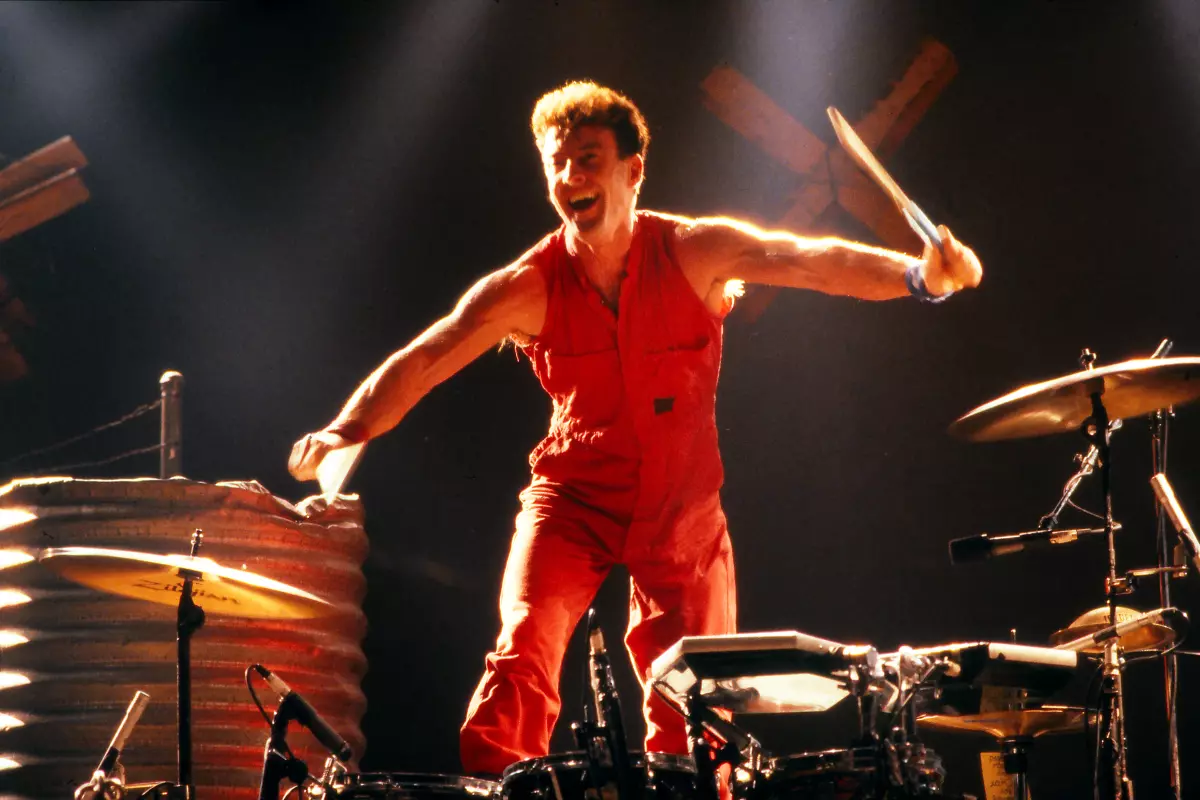
Rock music has always been good at noise. What it has been less reliable at—though never incapable of—is meaning. That is why the passing of Rob Hirst from Midnight Oil lands with a particular weight. It is not only the loss of a musician, but the loss of someone who helped prove that rock and roll could still function as a moral instrument without becoming preachy, hollow, or self-satisfied.
Midnight Oil was never just a band you put on in the background. Their music demanded attention. It asked listeners to sit up straighter, to think harder, to consider their place in a world shaped by power, inequality, and history. Rob was part of that engine—part of the collective force that turned urgency into sound and commitment into motion.
To understand why this matters, it helps to remember what Midnight Oil represented in the broader history of popular music. By the late 1970s and early 1980s, rock was splintering. Punk had stripped things down to raw confrontation. Arena rock had blown things up into a spectacle. New wave flirted with irony. Somewhere in that mix, Midnight Oil arrived with a different proposition: that rock could be loud and political, muscular and ethical, uncompromising without losing its humanity.
Rob’s contribution to that vision was not flashy. That is precisely the point. The band’s power never came from virtuosity for its own sake. It came from restraint, discipline, and a sense that every note existed in service of something larger than individual ego. This was rock music as collective labor—tight, propulsive, and purposeful. Think of this as where cultural significance often gets overlooked. We tend to focus on front figures, lyricists, or visible symbols of protest. But movements—musical or political—are sustained by people who show up consistently, shape the structure, and hold the center. Rob helped hold that center. The music moved because it was grounded.
That grounding mattered because Midnight Oil treated politics not as branding but as responsibility. Their songs did not offer vague calls to “change the world.” They named systems. They pointed to consequences. They located listeners inside histories of colonialism, environmental destruction, and economic exploitation. This was not background protest—it was confrontation set to a beat you could not ignore.
Yet what made Rob and the band enduring was that the music never collapsed into scolding. There was anger, yes, but also care. There was urgency, but also solidarity. The sound invited people in even as it challenged them. That balance—between confrontation and connection—is rare, and it is one reason the band still resonates across generations.
From an academic perspective, Midnight Oil complicates the idea that popular music must choose between mass appeal and political seriousness. Their success suggests something else: that audiences are often more capable of engaging complex ideas than the industry assumes. Rob’s work helped demonstrate that rhythm itself can carry ethical weight, that repetition can reinforce not just hooks but commitments.
There is also something important about how Midnight Oil aged. Many politically minded bands burn bright and disappear, their relevance trapped in a specific historical moment. But the Oil’s music did not rely on trend or novelty. Its concerns—land, labor, justice, responsibility—remain unresolved. In that sense, Rob’s legacy is not nostalgic. It is unfinished.
Loss sharpens this realization. When someone like Rob passes, we are reminded that cultural work is always temporary, even when its impact is not. The people who make the music eventually leave us. What remains is the sound—and the question of what we do with it.
For listeners, the answer is not just remembrance. It is continuation. To keep playing the records, yes—but also to keep asking the questions the music raised. To refuse the comfortable separation between art and action. To remember that rock and roll, at its best, has never been about escape alone. It has also been about attention. Rob’s life and work stand as a quiet rebuke to cynicism. At a time when political engagement is often reduced to slogans and aesthetics, Midnight Oil insisted on substance. Rob helped give that insistence a pulse. A beat that did not rush. A rhythm that held steady while the world lurched.
In the end, that may be the most fitting way to understand his contribution. Rob was part of a band that believed sound could still carry responsibility—and he helped make that belief audible. His passing is a loss. But the music remains, still insistent, still unresolved, still asking us to listen harder than we might prefer.
And that, in rock and roll terms, is about as real as it gets.

 your tuesday afternoon alternative
Ah, sorry to hear.
K. Kennard